

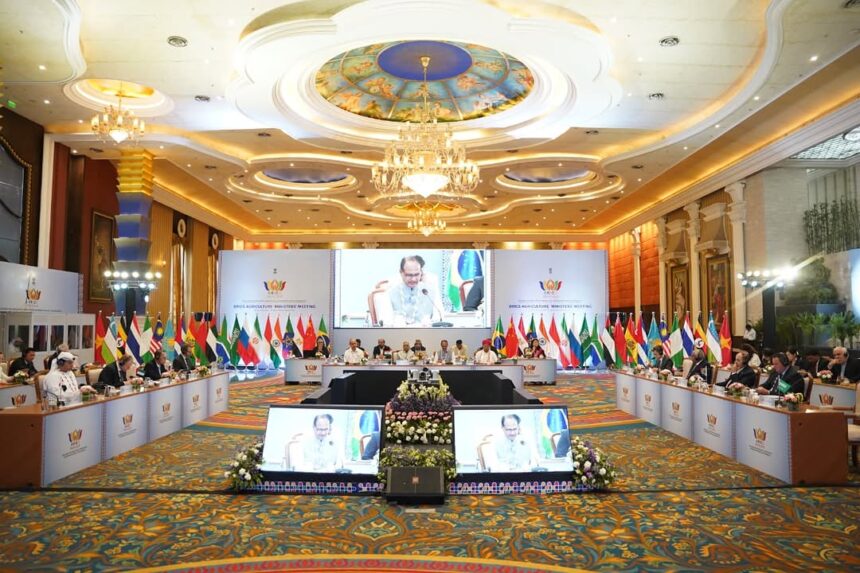
BRICS nations adopted a joint declaration rejecting unilateral trade restrictions that threaten food security and agreed to launch new mechanisms for seed and fertiliser cooperation, a move welcomed by Egyptian Minister of Agriculture and Land Reclamation Alaa Farouk during the bloc’s ministerial meetings in India.
The 16th Joint Ministerial Declaration of the BRICS Agriculture Working Group, convened in Indore, Madhya Pradesh, supported a multilateral trading system based on World Trade Organisation (WTO) rules. The declaration called for the establishment of the “AGRIN” network for seed and fertiliser cooperation, the launch of the “Global Forum for Farmers’ Rights in Seed Production Systems,” and the enhancement of the BRICS Agricultural Research Platform (BARP).
In a recorded address to the conference, Farouk thanked the Indian government and the Indian Minister of Agriculture and Farmers’ Welfare for their organisation and efforts to advance the bloc’s agricultural cooperation. He affirmed Egypt’s full support for international efforts to strengthen global food security, transfer technology, and empower small farmers, noting the meeting’s significance amid global challenges such as climate change, supply chain disruptions, and economic fluctuations.
“Investment in scientific research and digital transformation represents the primary key to building resilient food systems,” Farouk said, adding that “South-South cooperation” and knowledge exchange between BRICS members are the most effective tools for achieving regional and global sustainable development.
The meetings in Indore featured the participation of ministers, senior officials, and experts from 21 countries, including delegations from Brazil, Indonesia, China, Iran, South Africa, and the United Arab Emirates. Ali Abdel Mohsen, Head of the Central Administration for Strategic Management, participated via a live virtual broadcast as the Egyptian agriculture ministry’s official focal point.
The adopted declaration targets the formulation of an independent and flexible agricultural system, facilitating small producers’ access to finance, technology, insurance, and markets, alongside full support for production and marketing cooperatives.
According to an Egyptian agriculture ministry statement, the conference focused heavily on climate-resilient agriculture. Discussions covered expanding regenerative and organic farming, improving soil and water management, and issuing international calls to increase climate finance directed at the agricultural sector.
The meetings also prioritised advancing digital transformation, artificial intelligence, and remote sensing applications, upgrading the livestock and fisheries sectors using modern vaccines and genetic technologies, and injecting new investments into cold chains and storage to reduce post-harvest food loss.


