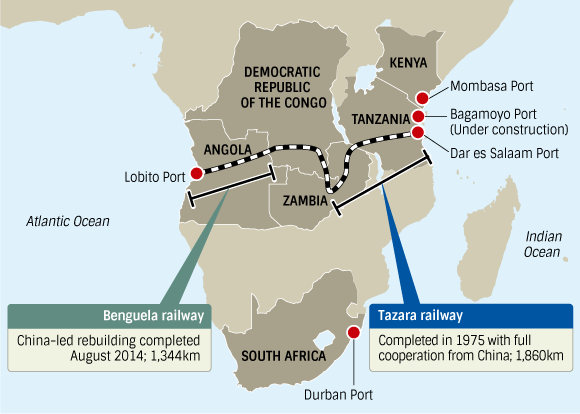
In early July, the US International Development Finance Corporation (DFC), in partnership with the Development Bank of Southern Africa, completed a $753m financing package to rehabilitate and modernise the Lobito Corridor—a railway linking Angola’s Atlantic port of Lobito with the Democratic Republic of the Congo (DRC), with plans to extend into Zambia. Days later, the DRC approved the rehabilitation of the section crossing its territory in partnership with the Portuguese engineering company Mota Engil, bringing the corridor back to the centre of international attention.
At almost the same time, China advanced along a different—but equally significant—track. The DRC signed a memorandum of understanding with Beijing to develop a 2,100 kilometre fibre optic network along the Congo River. At first glance, the project appears unrelated to mining or rail transport. In reality, however, it reflects a profound shift in strategic competition. While the United States and its partners are investing in the physical infrastructure required to move critical minerals to global markets, China is strengthening the digital infrastructure that carries the data associated with those minerals. Competition is therefore no longer confined to who builds railways and ports; it increasingly extends to who builds and governs the digital networks on which the global economy depends.
These developments cannot be understood outside the broader geopolitical context. The world is witnessing an accelerating race to reshape global trade routes and supply chains. Over the past decade, China has invested heavily through the Belt and Road Initiative in ports, railways, industrial zones, and logistics hubs stretching across Asia, Africa, and Europe. In response, the United States and its allies have promoted alternative corridors, including the Lobito Corridor in Africa and the India–Middle East–Europe Economic Corridor (IMEC), to diversify trade routes and reduce dependence on networks where Beijing enjoys substantial influence. The Lobito Corridor is therefore far more than an African infrastructure project; it is a strategic component of an emerging global economic architecture.
Its importance stems above all from the resources it connects. The Democratic Republic of the Congo is the world’s largest producer of cobalt, while Zambia ranks among the leading producers of copper. Together, these minerals underpin the industries of the twenty first century, supplying electric vehicle batteries, semiconductors, data centres, artificial intelligence technologies, renewable energy systems, and advanced defence industries. As a result, competition over these resources is no longer merely commercial; it has become inseparable from national security and technological leadership.
At this point, an obvious question arises: if the competition is about copper and cobalt, what do fibre optic cables and digital data have to do with it? The answer is remarkably straightforward.
Modern mines produce far more than minerals; they also generate enormous volumes of data. From the moment a mineral deposit is identified, detailed digital records are created, documenting geological location, estimated reserves, ore quality, ownership rights, mining licences, production volumes, transport schedules, export destinations, tax payments, environmental compliance, and labour conditions. These data accompany every shipment from the mine to the railway, from the port to the vessel, and finally to the factories where the minerals become batteries, smartphones, or electric vehicles. Every shipment now carries what may be described as a digital passport, recording its entire journey from extraction to the final product.
This explains why railways and fibre optic networks are inseparable. Railways transport the minerals themselves, while digital networks carry the information that accompanies them; production records, shipping documentation, customs declarations, certificates of origin, contracts, and tracking data. Without trusted digital records, multinational companies cannot verify where minerals originated or whether they comply with environmental, legal, and ethical standards.
To understand the relationship more clearly, imagine the Lobito Corridor as a living organism. The railway functions as the circulatory system, moving the lifeblood of critical minerals through the economy, while fibre optic networks serve as the nervous system, transmitting the information needed to keep that system operating efficiently. Neither can perform its role without the other. In today’s economy, digital infrastructure has become just as essential as physical infrastructure.

The strategic significance of this transformation is captured in an important report published by Chatham House on 20 July 2026, authored by Christopher Vandome and Roman Sidyberg. Although written primarily for specialists in political economy and the mining sector, its central argument can be distilled into a simple question: Who will define the rules governing mineral data, and who will establish the standards through which those data are exchanged, verified, and recognised internationally? That question lies at the heart of today’s competition between the United States and China.
A common misconception is that Washington seeks to collect and store African mining data in American databases. In reality, those data remain with African governments, mining authorities, operating companies, ports, transport firms, and certification agencies. What the United States and its partners are attempting to shape is something different: the governance framework. Their priority is to establish digital standards, interoperability rules, certification systems, and verification mechanisms that ensure mineral data are trusted and internationally accepted.
Consider an American manufacturer purchasing cobalt for electric vehicle batteries. Knowing the shipment’s volume and purity is no longer sufficient. The company also requires a complete digital record proving that the mineral did not originate in a conflict zone, was not produced through child labour, complied with environmental regulations, and met all tax and royalty obligations. If such information cannot be independently verified, the shipment may be rejected regardless of its quality.
This illustrates an essential point: strategic influence no longer derives simply from possessing data but from defining the international standards that govern how those data are collected, verified, exchanged, and certified. Whoever establishes those standards gains considerable leverage over global trade, even without owning a single mine. In effect, rule makers determine who participates in international markets—and who is excluded from them.
China approaches the same challenge from a different, yet complementary, perspective. For more than two decades, Beijing has invested not only in mineral extraction but also in railways, ports, highways, industrial zones, telecommunications infrastructure, and digital operating systems under the Belt and Road Initiative. Increasingly, these projects rely on integrated digital platforms that manage production, coordinate rail transport, optimise logistics, and enable real time information exchange among mines, ports, customs authorities, and manufacturers.
From this perspective, the proposed fibre optic network in the Democratic Republic of the Congo is far more than an internet expansion project. It is a critical component of the digital ecosystem required to manage mining operations, coordinate logistics, support port activities, and ensure the rapid and secure movement of information throughout the supply chain. Just as trains require railways, digital data require advanced communications networks to move efficiently.
It would therefore be misleading to argue that one side competes for minerals while the other competes for data. Both the United States and China are investing simultaneously in physical and digital infrastructure, but they pursue different strategic priorities. Washington places greater emphasis on alternative transport corridors integrated with internationally recognised systems of traceability, transparency, and regulatory compliance, facilitating access to Western markets. Beijing, meanwhile, continues expanding its extensive network of mines, ports, logistics platforms, telecommunications systems, and industrial infrastructure, reinforcing the interconnected ecosystem it has built across Africa over the past two decades.
Each strategy generates a different form of influence. The United States seeks regulatory power by shaping the rules governing global supply chains and determining the conditions under which minerals enter Western markets. China, by contrast, seeks operational influence by becoming the indispensable partner in extracting, transporting, processing, and digitally managing mineral resources. As African economies become more integrated with Chinese infrastructure and digital platforms, Beijing strengthens the long term flow of raw materials to its industries, expands markets for its technology companies, and deepens its political and strategic partnerships. In short, while the United States competes to shape the rules, China competes to shape the networks through which global trade operates.
If the twentieth century was defined by competition over oil fields and mineral deposits, the twenty first century is increasingly becoming a contest over the language of those resources: the data that describe them, the standards that regulate them, and the digital networks that connect them. Power today derives not only from controlling natural resources, but also from controlling the information that determines how those resources move through the global economy.
The implications of this transformation extend well beyond Africa. Across the Middle East, Gulf states are investing heavily in ports, logistics hubs, digital infrastructure, and critical minerals to strengthen their position within global supply chains. Egypt, with the strategic advantage of the Suez Canal, is equally well positioned to remain a pivotal trade hub. Yet geography alone will no longer be sufficient. Preserving that advantage will require sustained investment in digital infrastructure, data centres, and intelligent logistics systems, because the trade routes of the future will depend as much on the movement of information as on the movement of ships.
It would be an oversimplification to dismiss this competition as merely a new form of colonialism. At the same time, it would be equally naïve to ignore the strategic ambitions that underpin it. China presents itself as a long term partner in infrastructure development and investment, while Western countries emphasise governance, transparency, and internationally recognised standards. Between these competing models, African governments have gained greater room to manoeuvre, leveraging geopolitical competition to maximise developmental benefits in an increasingly multipolar international system.
Ultimately, this may be the most important lesson of the Lobito Corridor. Railways are no longer simply channels for transporting minerals, just as fibre optic cables are no longer merely conduits for internet traffic. Together, they have become the twin foundations of a quiet yet profound struggle to reshape the architecture of the global economy.
In an era defined by artificial intelligence, clean energy technologies, and resilient supply chains, the most influential nations may not be those possessing the largest mineral reserves, but those capable of building the networks that connect resources with information—and of establishing the rules that govern both. That, perhaps more than anything else, defines the evolving logic of great-power competition in the digital age.
Author’s Comment
This article is principally based on Christopher Vandome & Roman Sidyberg, Governing Mineral Data: A New Frontier in the US-China Competition for Critical Minerals, Chatham House, 20 July 2026, while also incorporating the author’s independent geopolitical analysis and interpretation of the strategic implications of the Lobito Corridor within the broader context of global supply chains, digital infrastructure, and US-China competition.
Dr. Marwa El Shinawy, Academic and writer