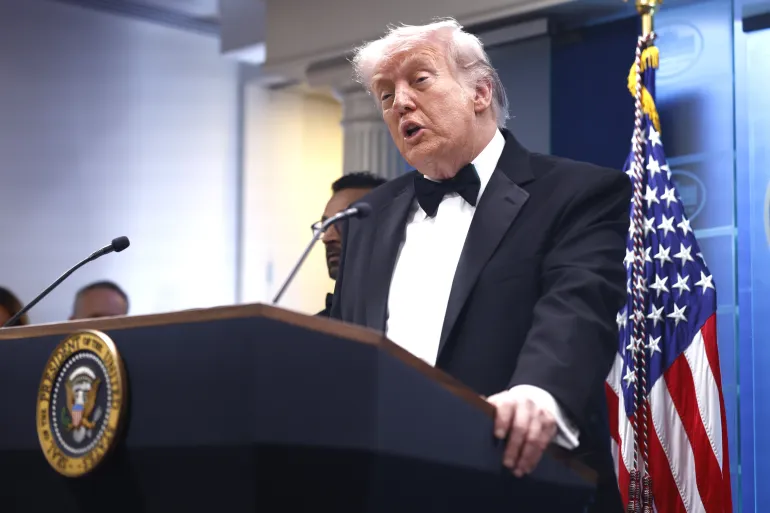
US President Donald Trump stated that Iran had informed Washington it was “in a state of collapse” and wanted the Strait of Hormuz reopened as quickly as possible.
In a social media post, Trump said Iran was pressing for the reopening of Hormuz while attempting to stabilize its internal leadership, though he did not specify how this message had been conveyed.
His remarks come amid reports of divisions within Washington over whether to continue relying primarily on economic pressure or to resume military strikes. Axios reported that Trump is weighing options between maintaining sanctions and naval pressure on Iran or launching new military attacks, with concerns that the United States could become mired in a prolonged strategic stalemate described as “neither war nor peace.”
US officials cited by the outlet warned that such a frozen conflict could destabilize global energy markets for months while preserving the risk of sudden escalation.
Iran, meanwhile, signaled that it does not consider the conflict resolved. An Iranian military spokesperson said Tehran had updated its target bank during both wartime and the ceasefire period, adding that Iran’s army and Islamic Revolutionary Guard Corps (IRGC) maintain coordinated control over the Strait of Hormuz, the IRGC securing the western side, and the regular army overseeing the eastern sector.
Iran’s defense ministry announced that future shipping through Hormuz would be subject to new security protocols aimed at safeguarding Iranian interests, describing recent US and Israeli military actions as a severe blow to trust and international law.
On the ground, Iran’s Tasnim news agency reported that the Japanese oil tanker Idemitsu Maru, carrying roughly 2 million barrels of crude, passed through the Strait of Hormuz in coordination with Iran, potentially signaling the early implementation of Tehran’s new maritime oversight framework.
Diplomatically, Iranian Foreign Minister Abbas Araqchi welcomed Russian support for negotiations following talks with President Vladimir Putin, highlighting the depth of their strategic partnership. Moscow has repeatedly offered mediation and previously proposed storing Iran’s enriched uranium stockpiles as a de-escalation measure, though Washington rejected the idea.
US Secretary of State Marco Rubio reiterated that Washington’s core objective remains preventing Iran from acquiring a nuclear weapon, arguing that Tehran often uses negotiations to buy time. He stressed that any future agreement must decisively block Iran’s path to nuclear weapons capability.