

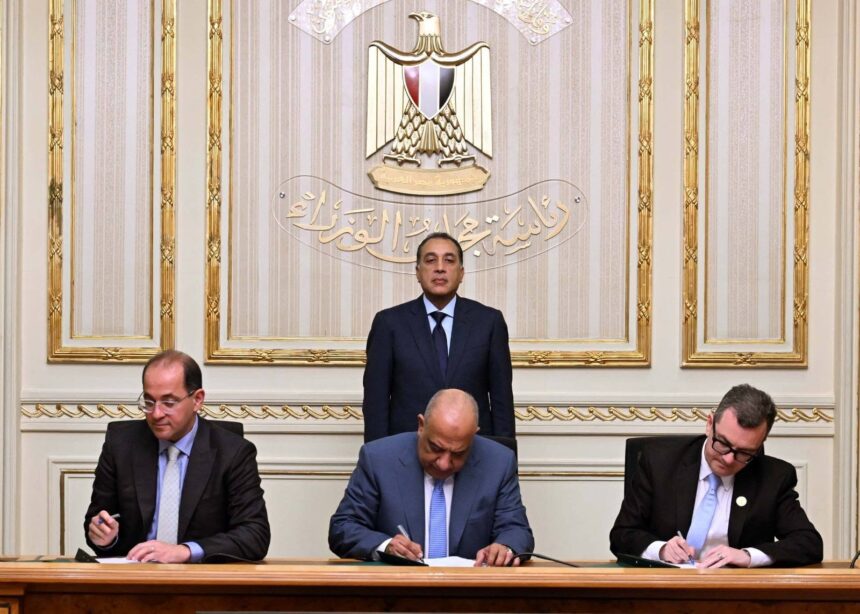
Prime Minister Mostafa Madbouly witnessed the signing of a protocol agreement to finance projects aimed at strengthening and upgrading Egypt’s national electricity grid to accommodate growing renewable energy capacity, as the government accelerates its transition towards a greener and more sustainable energy mix.
The agreement was signed by Minister of Electricity and Renewable Energy Mahmoud Esmat, Minister of Finance Ahmed Kouchouk, and Minister of Planning, Economic Development and International Cooperation Ahmed Rostom.
Under the protocol, EGP 60bn will be allocated to support the Egyptian Electricity Transmission Company (EETC), enhancing its financial and operational capabilities and enabling it to implement critical grid expansion and modernisation projects.
Following the signing ceremony, Madbouly highlighted the government’s ongoing efforts to expand renewable energy projects and increase their contribution to Egypt’s energy mix in line with the country’s green economy and sustainable development strategy.
He stressed the importance of continuing investment in the national electricity grid, as well as transmission, distribution, and evacuation networks, to accommodate the renewable energy capacities planned for the coming years.
Esmat said the development and modernisation of the national electricity grid is a continuous process aimed at strengthening its ability to absorb new renewable energy generation capacity while meeting growing electricity demand.
He noted that grid expansion projects are essential to ensuring the stability and reliability of electricity supplies and improving service quality across the country.
The minister added that efforts are being accelerated to bring solar and wind energy projects online, supported by compressed implementation schedules that align with Egypt’s target of increasing the share of renewable energy to 45% of the electricity mix by 2028.
He stressed that securing adequate and reliable electricity supplies remains a key pillar in supporting major national development projects and advancing the country’s broader economic growth agenda.
For his part, Kouchouk reaffirmed the Ministry of Finance’s commitment to supporting Egypt’s renewable energy transition, including investments in electricity infrastructure.
He noted that strengthening the national grid will help ensure sustainable electricity supplies for citizens and investors alike, while enhancing the competitiveness and attractiveness of Egypt’s industrial, productive, and export-oriented sectors.
Meanwhile, Rostom described the protocol as a model of integration between the state’s financial and investment policies. She said the EGP 60bn allocation represents more than sector-specific financing, characterising it as a strategic investment in infrastructure and national projects that are critical to attracting both domestic and foreign investment and encouraging greater private-sector participation in development initiatives.
The agreement comes as Egypt continues to expand renewable energy generation and modernise its electricity infrastructure as part of its long-term strategy to support economic growth, improve energy security, and advance sustainability goals.


