

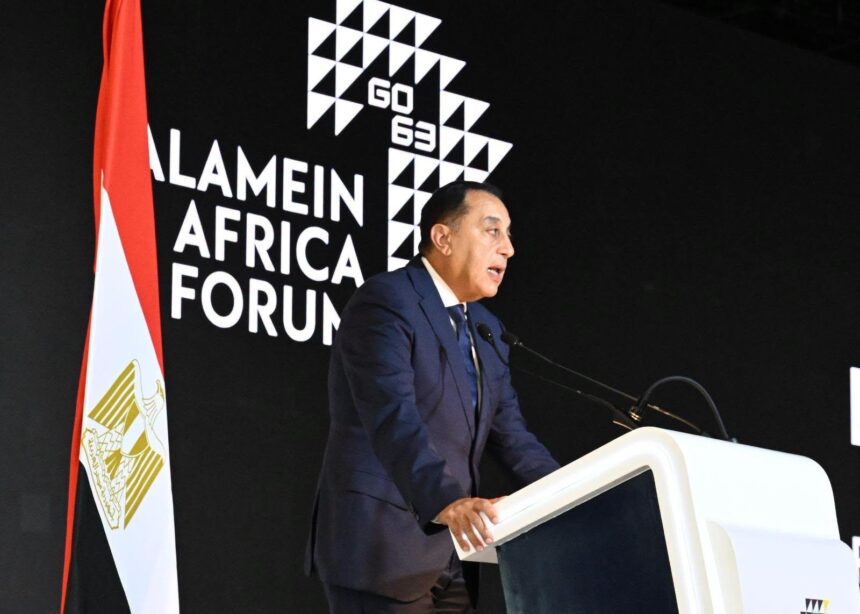
Egyptian Prime Minister Mostafa Madbouly urged African nations to transform rapid urbanization from a demographic challenge into a primary engine for economic growth, industrialization, and job creation, speaking during a plenary session on cities and urban development at the Alamein Africa Forum on Saturday.
Addressing the forum in the presence of President Abdel Fattah Al-Sisi, Madbouly noted that Africa is experiencing one of the world’s fastest urbanization rates, with the continent’s urban population projected to double by 2050. He argued that cities must no longer be viewed merely as residential clusters but as integrated economic, social, and environmental ecosystems.
“The question we must ask is not just how to accommodate urban growth, but how to turn this growth into a driving force for comprehensive development and structural transformation in our economies,” Madbouly stated.
Exporting Egypt’s Urban Experience
The Prime Minister highlighted Egypt’s extensive experience in spatial development and the construction of “fourth-generation cities,” citing the New Administrative Capital, New Alamein, and New Mansoura as models of integrated planning combining advanced digital infrastructure, climate resilience, and economic activity.
He emphasized that Egypt is actively transferring this expertise across the continent through large-scale infrastructure projects executed by Egyptian firms. Madbouly pointed to the Julius Nyerere Hydropower Plant in Tanzania, road and bridge projects in Uganda (including the Saka bridge), and the Winneba-Takoradi road project in Ghana as proof of Cairo’s capacity to deliver complex infrastructure tailored to specific national needs.
“Egypt does not present a theoretical model, but rather possesses executive expertise that can be utilized in cooperation with African countries to design and implement infrastructure projects and new cities,” Madbouly said, offering to share Egyptian knowledge in urban planning, facility management, and capacity building.
Technology, Climate, and Finance
Madbouly stressed that climate resilience and technology are no longer supplementary elements but core requirements for functional cities. He argued that a city unable to manage heatwaves, floods, or water scarcity cannot attract investment, and that technology has become essential for resource efficiency, traffic management, and data-driven governance.
Addressing the critical challenge of financing urban development, Madbouly acknowledged that states alone cannot bridge the funding gap for infrastructure and housing. He called for innovative partnerships between governments, the private sector, and development finance institutions, urging the direction of long-term capital toward sustainable urban infrastructure and affordable housing to prevent the expansion of informal settlements.
He noted that the Egyptian government’s 2025/26 fiscal plan targets the launch of 310,000 new housing units, including 285,000 designated for social housing.
Madbouly concluded by highlighting the upcoming African Urban Forum—established following an AU committee meeting in Cairo in 2022—as a vital platform to transition from sharing expertise to building concrete continental partnerships in smart cities, clean energy, and urban finance.
The first Alamein Africa Forum opened Friday in the northern Egyptian coastal city of El Alamein, bringing together around 1,500 African business leaders to discuss investment, trade and economic cooperation. Running from Oct. 2 to 4, the Alamein Africa Forum aims to promote greater economic integration and business cooperation across the continent. It is co-organized by the Egyptian government, the African Export-Import Bank, and the African Union Development Agency.


