

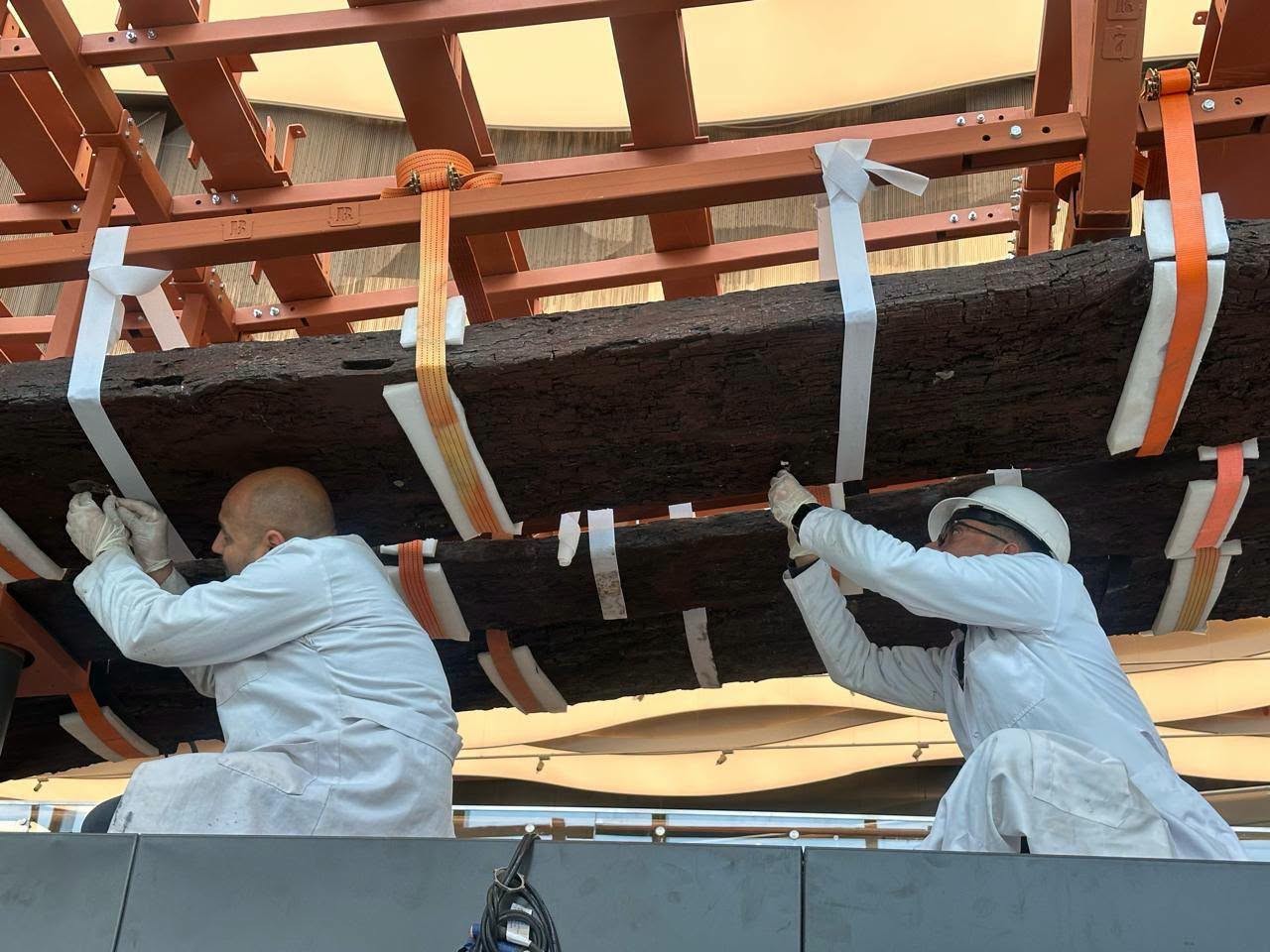
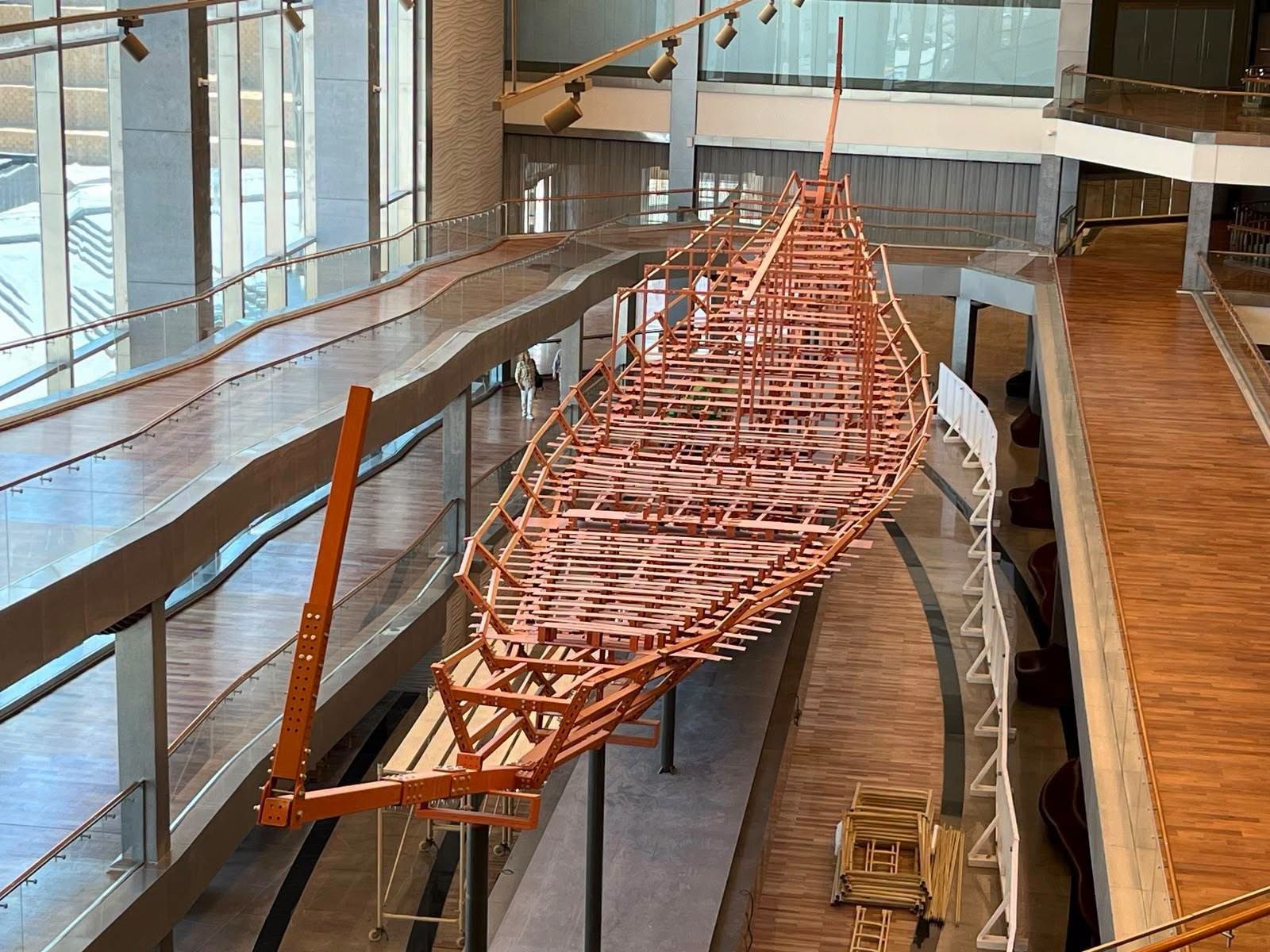
An Egyptian-Japanese archaeological team has completed the restoration and installation of 16 wooden pieces forming part of the floor of King Khufu’s Second Boat at the Grand Egyptian Museum (GEM), the Ministry of Tourism and Antiquities said.
Restoration and reconstruction work on the remaining components of the ancient vessel is continuing inside the Khufu Boats Museum, where visitors can observe the conservation and assembly process as part of an interactive museum experience.
The project is being carried out under an integrated plan to reassemble the boat’s wooden components and secure them to a specially designed metal support structure, based on studies and documentation of the original pieces and using advanced conservation techniques.
The project is being implemented through cooperation between the Grand Egyptian Museum, the Supreme Council of Antiquities, and Higashi Nippon International University, with support from the Japan International Cooperation Agency (JICA).
Tourism and Antiquities Minister Sherif Fathy said the restoration and reconstruction of Khufu’s Second Boat demonstrate the specialised expertise developed by Egypt and Japan in conserving organic archaeological materials.
He added that the partnership provides an important model for international cooperation in archaeology through the exchange of expertise and the use of advanced scientific methods and technologies to preserve cultural heritage.
Ahmed Ghoneim, CEO of the GEM, said the reconstruction of Khufu’s Second Boat represents a major technical and scientific challenge given the condition of the archaeological wood and the large number of pieces requiring careful documentation, treatment, and assembly.
He noted that conducting restoration and reconstruction work in front of visitors allows them to follow the conservation process and learn about the scientific methods used to handle organic antiquities, adding an educational dimension to the museum experience.
Sakuki Yoshimura, president of Higashi Nippon International University and head of the Japanese side of the project, expressed his appreciation for the long-standing research cooperation with Egypt and stressed the project’s importance to archaeology and cultural heritage conservation.
He said the Japanese side remains committed to working with the Grand Egyptian Museum and Egyptian specialists to complete the project in accordance with established scientific and technical standards, while strengthening the exchange of expertise and technologies.
Khaled Hassan, Deputy CEO for Archaeological Affairs at the GEM, said Khufu’s Second Boat has exceptional archaeological and historical value as one of the rare surviving organic antiquities from the reign of King Khufu and an important example of the advanced shipbuilding and woodworking techniques achieved by ancient Egyptians.
He added that preserving the boat requires close coordination among archaeological, conservation, and engineering specialists to protect its original components and ensure that it is eventually displayed in a manner befitting its historical significance.
Issa Zidan, Director General of Restoration and supervisor of the Khufu Boat restoration project, said the wooden components were in a severely deteriorated condition when work began.
The process therefore involved carefully lifting, recording, and documenting each piece, followed by treatment, preparation, transportation, and installation in its correct position.
According to Zidan, the project uses digital documentation, laser scanning, and three-dimensional modelling to determine the location of each component and its structural relationship with other pieces, creating an accurate database to help reconstruct the boat’s original configuration.
Wood treatment and reinforcement are continuing using materials and techniques suited to the nature and condition of the archaeological remains, alongside the installation of components that have completed the necessary conservation work.
Hiromasa Kurokushi, director of the Japanese side of the project, said the metal support structure was designed to accommodate the delicate structural condition of the wooden components and provide the necessary support and stability without subjecting the original pieces to stresses that could compromise their preservation.
The design incorporates structural calculations and load-distribution requirements, as well as an advanced fastening system that allows each wooden component to be handled independently, providing flexibility and precision throughout the assembly process.
The ministry noted that the first restored wooden plank from Khufu’s Second Boat was installed in December last year, marking the beginning of the boat’s reconstruction inside the Khufu Boats Museum. Restoration, preparation, and installation of additional components have continued since then in accordance with the project’s implementation plan.


