Egypt’s Minister of Industry Khaled Hashem inspected the manganese alloy plant operated by Sinai Manganese Company during his first visit to the Abu Zenima Industrial Zone in South Sinai, reviewing the company’s production operations and expansion plans, including a target to raise annual production capacity to 50,000 tonnes by the end of 2028.
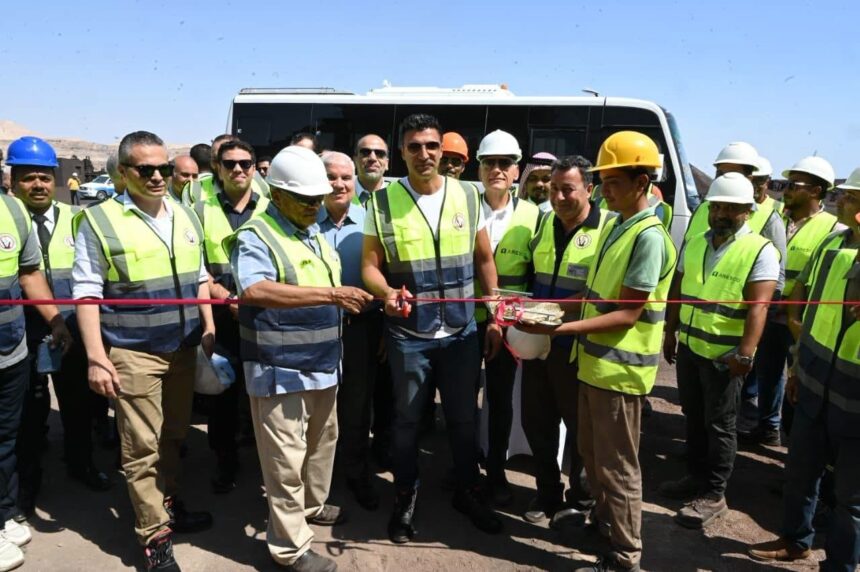
The minister also inaugurated a new dust and particulate separation system at the plant as part of efforts to reduce gaseous emissions and dust, improve working conditions and ensure environmental compliance.
Sinai Manganese produces silicomanganese and ferromanganese alloys at a facility covering 23,500 square metres, with investments of EGP 2.5bn and paid-in capital of EGP 300m. The plant currently has an annual production capacity of 18,000 tonnes, with around 60% local content.
The company exports approximately 49% of its production to markets including Turkey, Libya and Italy.
During the visit, Hashem held an expanded meeting with South Sinai Governor Ismail Kamal and company officials to review Sinai Manganese’s history, production operations and plans to double its production capacity.
The meeting also covered the company’s plans to increase the added value of raw materials, promote sustainable mining, adopt advanced technologies and expand exports.
The company presented several future projects, including kaolin calcination, agricultural gypsum, medical glass, flat glass, solar panels and a project to separate iron from manganese.
Hashem said manganese alloys are among the complementary industries included in Egypt’s industrial strategy and represent key inputs for the iron and steel sector and other heavy industries.
He added that silicomanganese and ferromanganese play an important role in improving the quality of final steel products by removing impurities, increasing steel purity and enhancing mechanical properties, including hardness, corrosion resistance and durability.
The minister noted that the rapid development of engineering and construction industries in Egypt and globally is driving higher demand for manganese alloys, creating an opportunity for Sinai Manganese to increase domestic production, reduce reliance on imports and lower production input costs.
“Egypt’s Ministry of Industry is working to expand the industrial base supporting the iron and steel sector and integrate it into local and global supply chains,” Hashem said.
He added that strengthening these supporting industries would increase the added value of Egyptian manufacturing, improve the competitiveness of local products, reduce the import bill and enhance Egypt’s ability to access export markets.
During the tour, the minister inaugurated the plant’s new gas purification and dust filtration system, which was designed, supplied and installed to reduce gaseous emissions and particulate matter and improve environmental conditions inside and outside the facility.
He also inspected the construction site of the iron-manganese separation plant, which is designed to produce high-manganese slag and is scheduled to begin operations by August 2027.
The tour included inspections of the alloy storage yards, sintering machine, and the loading and services facilities at Abu Zenima Port.
The minister and governor also discussed the current status of the Abu Zenima Industrial Zone, including operating projects, infrastructure and utilities, as well as challenges facing the area.
Hashem said the ministry would coordinate with the South Sinai Governorate and relevant ministries and authorities to support the development of the industrial zone, improve its infrastructure and identify industries suitable for the area’s resources and geographic characteristics.
The government also aims to provide qualified industrial labour to meet the needs of factories operating or planned in the zone.
South Sinai Governor Ismail Kamal welcomed the minister’s support for Sinai Manganese’s development and expansion plans, stressing the importance of maximising the company’s mining resources and increasing the added value of natural resources.
He explained that expanding the company’s projects could create additional employment opportunities for young people in the governorate and contribute to broader economic and social development in South Sinai.
Kamal added that the governorate would continue coordinating with the Ministry of Industry, the Chemical Industries Holding Company and Sinai Manganese to facilitate industrial and mining investments, remove obstacles to expansion and maximise the economic and development benefits of the governorate’s natural resources.