

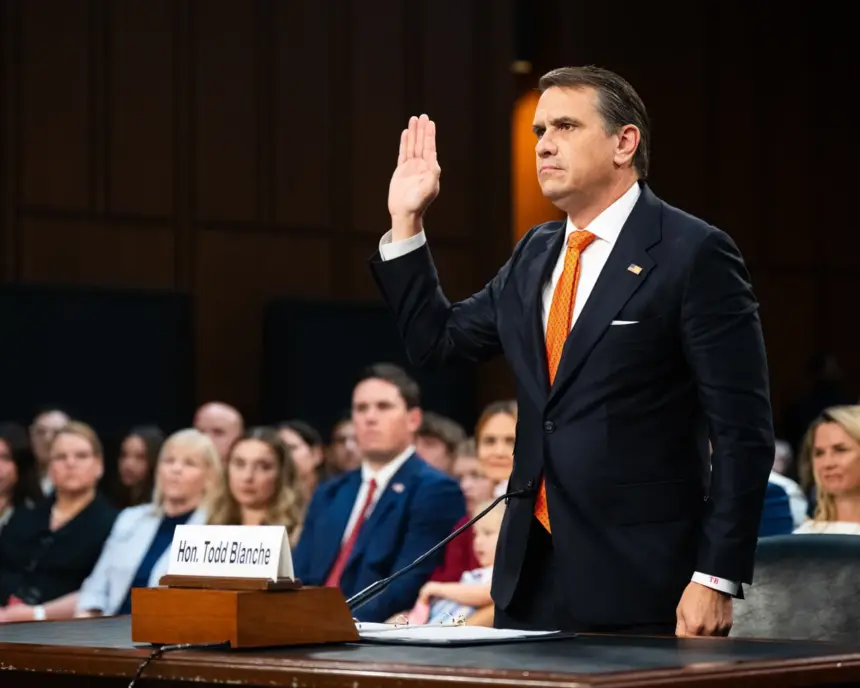
In the early hours of August 8, 2026, the US Senate confirmed Todd Blanche, President Donald Trump’s former personal lawyer, as Attorney General by the narrowest of margins—50 votes to 49. Two Republican senators, Susan Collins and Lisa Murkowski, joined every Democrat in voting against him. Blanche had already been serving in an acting capacity since the dismissal of Pam Bondi in April. His confirmation followed weeks of intense debate over the independence of the Department of Justice, a controversial “anti weaponization” fund that raised fears it would be used to compensate Trump allies, and tax settlements linked to the president and his family.
What makes this appointment troubling is not merely the razor thin margin by which it passed, but the fact that Blanche was, by almost any conventional measure, among the weakest candidates available for this sensitive post. He lacked a distinguished judicial or senior administrative record that would typically qualify someone to lead the world’s most powerful legal institution. Instead, his credentials rested almost entirely on his role as Trump’s personal defence counsel across a series of criminal and civil cases. Blanche represented the president in the New York trials involving classified documents and the election related “storm” cases, standing beside him at the most legally precarious moments. It was this deep personal relationship—not institutional experience—that ultimately secured his nomination. Even within the Republican Party, several senators expressed explicit reservations about whether a man so closely bound to the president could maintain professional distance from the White House. His selection signals that the traditional standard of competence has been displaced by the more immediate criterion of personal loyalty.
This appointment is not merely a change in leadership. It represents another chapter in a broader process that began with Trump’s return to the White House: the deliberate redefinition of the relationship between the executive branch and institutions that are supposed to operate with a measure of independence. In July, I wrote that Trump was rewriting the rules of American politics in a way that elevates personal loyalty as the primary measure of institutional fitness. Today, with his former lawyer installed at the head of the Justice Department, that process appears to be approaching its first stage of completion.
The Department of Justice is not an ordinary administrative agency. It is the legal arm of the state, charged with upholding the rule of law, prosecuting federal crimes, and representing the United States in its most consequential legal matters. Historically, administrations of both parties—even in periods of intense polarization—have sought to preserve some distance between the White House and the Department, recognizing that its credibility at home and abroad depends on that separation. The decision to place a man whose professional identity has been defined by defending the president in personal legal battles sends an unmistakable signal: the boundary between political interest and the public interest has grown narrower than at any recent point.
The consequences do not stop at America’s borders. The Middle East, currently engaged in open conflict with Iran and grappling with tensions stretching from the Gulf to the Red Sea, is watching these developments closely. The United States remains the region’s most significant military power and the primary guarantor of energy security and freedom of navigation through the Strait of Hormuz. Yet Washington’s ability to serve as a credible mediator or reliable security partner depends heavily on the perceived integrity of its institutions. When the Justice Department begins to appear more like a political instrument than a neutral institution, America’s allies in the Gulf, Egypt, and Türkiye start asking practical questions: How dependable are long term American commitments if the institutions that shape those commitments are increasingly subject to the fluctuations of personal loyalty?

In the context of the war with Iran, the timing is especially revealing. Negotiations over reopening the Strait of Hormuz continue to move slowly, and the United States is being asked to provide complex security and economic guarantees. At the same time, the region is experimenting with new security arrangements, such as the Mecca Joint Defence Agreement between Saudi Arabia, Türkiye, and Pakistan, with the possible eventual inclusion of Egypt. These arrangements do not necessarily signal a rejection of Washington, but they do reflect a growing desire for additional options. The clearer the signs that American decision making is becoming more tightly bound to narrow domestic calculations, the more attractive these regional alternatives become.
The issue is not that Trump seeks greater control over the machinery of government. Every American president attempts this to one degree or another. The issue lies in the method and its consequences. When the decisive criterion for selecting an Attorney General becomes the depth of personal proximity to the president rather than experience managing a complex legal institution or the capacity to safeguard its independence, the message that reaches both allies and adversaries is that American policy has grown less predictable and more vulnerable to abrupt shifts that accompany electoral cycles or the mood of the White House.
This does not mean the United States will abandon its role in the Middle East tomorrow. American military and economic capabilities remain formidable. Institutional trust, however, is a different matter. Regional allies construct their strategies on the assumption that American commitments rest on relatively stable institutions rather than the will of a single individual. When that assumption erodes, they begin diversifying their security and economic partnerships—exactly as we have observed in recent years with closer Gulf China ties and expanding cooperation among Türkiye, Pakistan, and Saudi Arabia.
Blanche himself stated after his confirmation that he felt honoured by the president’s trust and pledged to serve the national interest. History, however, teaches that personal intentions are insufficient to protect institutions. The independence of the Department of Justice has never been the product of individual virtue; it has been the result of accumulated traditions, practices, and political norms developed over decades. Once those traditions are deliberately weakened, restoring them proves far more difficult than dismantling them.
In the end, the narrow confirmation of Todd Blanche is not the conclusion of a story but the opening of a new chapter. The question it poses for the Middle East is not whether America will remain present, but what kind of America the region will be dealing with in the years ahead: an institutional America whose commitments can be relied upon, or a personal America whose priorities shift with every electoral cycle. The answer to that question will go a long way toward shaping the security alignments now taking form from Mecca to Cairo and from the Gulf to the Red Sea.
Dr. Marwa El Shinawy, Academic and writer

