

US President Donald Trump said on Monday he has instructed American representatives to firmly include compensation demands from Iran in any future negotiations, following claims by Iranian representatives for damages incurred during a five-month military conflict.
Writing on Truth Social, Trump described Iran’s request for compensation as an “interesting idea” and said he was counter-demanding compensation from Tehran for individuals killed or severely injured by roadside improvised explosive devices and various conflicts he blamed on Iran.
Trump stated that these operations were initially led by the late Iranian General Qasem Soleimani, adding that US demands encompass families of victims of the USS Cole attack and thousands of others fallen in battle. He added that compensation should also be paid to families of “hundreds of thousands of innocent protesters” killed by Iran over the past 50 years, as well as 52,000 people he claimed were killed over the past five months.
Trump stated that he directed his representatives to include these demands “firmly” in any future negotiations with Iran.
The US president is leaning towards escalating economic pressure on Iran rather than ordering a new military attack, as Tehran continues to defy Washington by stalling the announcement of an agreement with Oman regarding transit arrangements in the Strait of Hormuz and rejecting dialogue with the United States.
Meanwhile, Iranian Foreign Ministry spokesman Esmaeil Baghaei stated during a regular press conference on Monday that the opening of the Strait of Hormuz is “linked to conditions and Iran’s terms,” declaring: “As long as the war continues, we will not allow passage through the Strait.”
Baghaei described ongoing negotiations with Oman regarding the waterway as “constructive and positive” with the aim of determining a navigation route. He noted that while the issue of transit fees was not brought up during discussions with Oman, “it is natural to collect fees for services,” adding that the southern route of the Strait of Hormuz is “not safe.”
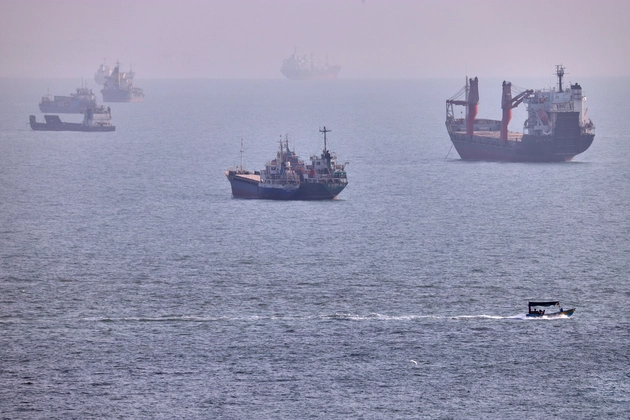
Maritime intelligence firm Kpler reported on Monday that traffic through the Strait of Hormuz weakened over the past week and dropped further over the weekend amid delays in announcing the Iranian-Omani navigation agreement. According to Kpler data reported by CNN, confirmed vessel crossings fell from 15 on Friday to 11 on Saturday and six on Sunday. About half of these trips used the northern route approved by Iran, while the route for 10 ships could not be determined.
Iranian Foreign Minister Abbas Araghchi affirmed Tehran’s determination to continue consultations with Oman regarding the strait, according to the Tasnim news agency. In a telephone call with Pakistani Foreign Minister Muhammad Ishaq Dar, Araghchi reviewed updates on bilateral talks between Iran and Oman to establish an appropriate route for safe passage, official news agency IRNA reported.
Separately on Monday, Iranian state television reported that Supreme Leader Mojtaba Khamenei issued decrees appointing senior commanders within the Armed Forces General Staff and the Islamic Revolutionary Guard Corps (IRGC).
The appointments include Ali Abdollahi as Chief of Staff of the Army, with Kioumars Heydari as his deputy. Ahmad Vahidi was appointed Commander of the IRGC, with Mostafa Izadi as deputy commander. Ali Ozmayei was named Commander of the IRGC Navy, and Hossein Taeb was appointed head of the Basij Organisation.


