

The war with Iran is no longer a limited confrontation between Tehran and its adversaries—it has become a genuine test of the resilience of the security order that has governed the Middle East for decades. As escalation spreads from the Gulf to the Red Sea and the Strait of Hormuz, one question has become increasingly urgent: how can the region be protected when external guarantees appear less certain, and when the costs of relying overwhelmingly on American power are higher than they once were?
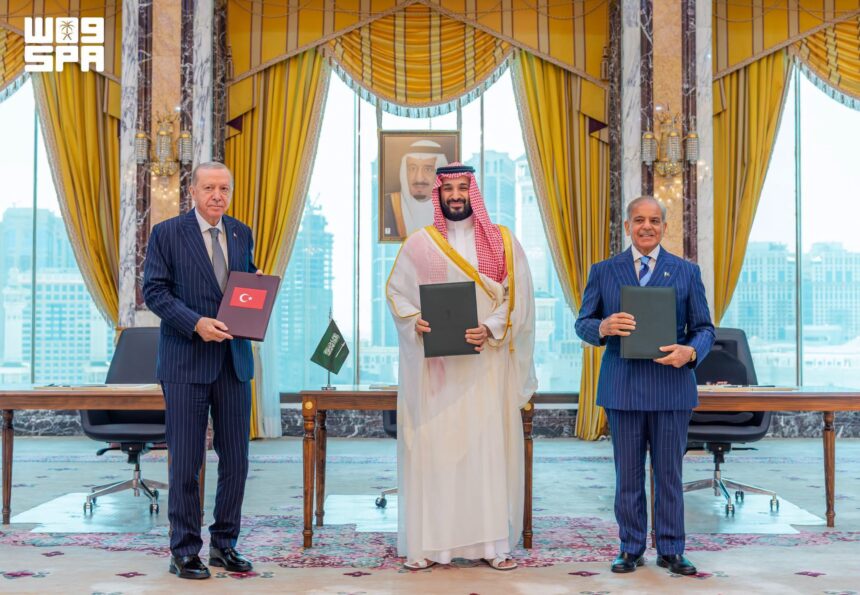
Against this backdrop, Saudi Arabia, Türkiye, and Pakistan signed the “Mecca Joint Defence Agreement” on 7 August 2026, stipulating that an armed attack against any one of the three countries would be regarded as an attack against all. The following day, Turkish Foreign Minister Hakan Fidan announced that the agreement mirrors the principle of collective defence enshrined in Article 5 of the NATO Treaty, and that Egypt is a candidate for joining once a limited number of technical issues are resolved, describing Cairo as a natural partner.
The speed with which Egypt’s name was put forward is revealing: any new regional security architecture would be difficult to complete without Cairo. Egypt controls a geographical nexus linking the Mediterranean and the Red Sea, commands the Suez Canal, and daily manages issues tied to Gulf security, the Red Sea, the Eastern Mediterranean, Libya, Sudan, and Gaza. Anyone seeking to build a genuinely regional security framework cannot overlook this strategic position.
Yet the deeper transformation lies not in the text of the agreement itself, but in the environment in which it emerged. The war has once again exposed the fragility of energy security and maritime navigation, demonstrating that a single threat—whether a missile, a drone, or the closure of a maritime passage—can transmit its effects within hours from the Gulf to global markets. In this context, the agreement does not necessarily appear to be an attempt to push Washington out of the region. Rather, it reflects a growing desire among regional powers to secure an additional margin for manoeuvre, so that their security does not remain dependent on a single source of power.
The region is not moving from alliance with the United States to an alliance against it. Instead, it is gradually shifting from unilateral dependence towards diversified security partnerships.
Türkiye stands at the heart of this dual equation. In late June 2026, ahead of the NATO summit in Ankara, President Recep Tayyip Erdoğan called for the creation of an unconditional security and defence network extending “from Texas to Ankara,” stressing that excluding Turkish capabilities from European security initiatives because of narrow political interests serves no one.
At the Ankara summit itself in July, the United States made efforts to improve its defence relationship with Ankara, including discussions over a potential return to the F 35 programme and the facilitation of engine supplies for Türkiye’s KAAN fighter aircraft. Yet Ankara did not wait for these tracks to mature. It moved in parallel to build security and economic circles across the Middle East and Asia, making the Mecca Agreement a logical extension of its ambition to remain a major member of the Western security architecture in Europe, while acting as an independent regional power in the Middle East.
From this perspective, Fidan’s announcement regarding Egypt is not a passing diplomatic detail. Cairo represents the geographical bridge between the Gulf, the Red Sea, the Mediterranean, and North Africa. Should Egypt join, the agreement would evolve from a trilateral arrangement into a network with a broader Arab and Islamic reach.
From Egypt’s perspective, however, the calculations are considerably more complex. Traditional Egyptian policy has been built around maintaining strategic relations with the United States, strong partnerships with Saudi Arabia and the Gulf states, and developing relations with Türkiye, while preserving open channels of communication with various regional actors, including Iran, and avoiding automatic military commitments in conflicts that do not directly affect Egyptian national security.
For this reason, Egypt’s question will not be, “Whom do we confront?” but rather, “What are we guaranteeing, for whom, and under what conditions?” Cairo may welcome enhanced Red Sea security, the countering of non traditional threats, the protection of maritime navigation, intelligence sharing, training, and defence industrial cooperation. Yet it is likely to remain cautious about any formula that imposes automatic commitments to enter a war.

Nor can this Turkish project be separated from the parallel dimension of the defence industry. Ankara is not seeking merely a security umbrella; it is also attempting to transform its manufacturing capabilities into economic and strategic influence. Türkiye’s KAAN fighter aircraft represents a bet on entering the region’s air security market in the coming decades, competing with European platforms such as France’s Rafale.
The Gulf is therefore gradually becoming an arena in which not only states, but also competing models of strategic autonomy, vie for influence. France seeks to preserve its European industrial independence; Türkiye seeks to demonstrate that a regional power outside the European Union can build a competitive military industrial base; while Gulf states increasingly seek partnership and local production rather than simply purchasing weapons. In this way, arms have become a language of political influence, rather than merely a military instrument.
The paradox is that this trilateral alliance has emerged precisely at the moment when the United States is attempting to redefine its role in the region. Washington remains the world’s pre eminent military power, and no regional arrangement can afford to ignore its presence. Yet successive wars and pressure on allies to increase their defence contributions have prompted regional states to ask a question long postponed: what if the region is forced to rely more heavily on its own capabilities?
Even within NATO itself, burden sharing was at the heart of the Ankara summit. Thus, the picture is taking shape on two parallel levels: Washington is demanding that its allies assume greater responsibility, while America’s Middle Eastern partners are themselves searching for regional mechanisms through which they can shoulder a greater share of that responsibility.
Are We Looking at a Middle Eastern NATO? The answer, for now, is: no.
The comparison with Article 5 is useful for understanding the concept of collective defence, but it does not mean that the Mecca Agreement has become a military institution comparable to NATO. NATO possesses decades of institutional development, integrated command structures, joint planning mechanisms, and established budgets, whereas the Mecca Agreement remains at an early stage of formation.
Its political significance, however, may exceed its current institutional structure. It sends a clear message that regional security is no longer an issue to be managed entirely from outside the region. Even with Türkiye and Pakistan emphasising that the agreement is defensive and directed against neither Iran nor any specific country, its timing makes it difficult to separate it entirely from the current war and tensions. The mere existence of a collective defence mechanism alters the calculations of both adversaries and allies.
If the Turkish proposal formally reaches Cairo, Egypt’s decision will not simply concern whether to join an alliance. It will concern what kind of regional order Egypt wants to inhabit over the coming decade.
Strategically, the most prudent course for Cairo would be to use its position to expand its room for manoeuvre among competing powers, while tying any new defence cooperation to clearly defined priorities: Red Sea security, the protection of maritime navigation, combating terrorism and arms smuggling, intelligence sharing, defence industrial cooperation, and joint training.
Egypt’s strength lies not only in the size of its military, but also in its ability to serve as a balancing point between competing strategic circles. If Cairo manages this moment effectively, it could become the capital that connects Gulf security with the Red Sea, Arab security with the Mediterranean, and Western partnerships with emerging regional arrangements.
The Middle East is not expelling America; it is learning not to wait for it.
The Mecca Agreement is one component of a broader process through which the region is rediscovering the concept of self reliant security. The war with Iran has accelerated this process, tensions in maritime corridors have exposed the fragility of dependence on external guarantees, and competition over arms production has opened a new front between regional powers and European states, while Washington has pushed its allies to shoulder greater burdens.
Amid these transformations, Türkiye is positioning itself as one of the architects of the emerging order, Saudi Arabia is seeking broader security guarantees, while Pakistan adds a different form of military weight.
The Egyptian question, however, remains the most consequential: will Cairo join a system now taking shape, or will it prefer to remain a balancing power outside any closed alliance?
The answer may determine not only the future of the Mecca Agreement, but also the shape of the region’s security map after this war.
The next battle will not be fought solely over who possesses the most powerful missile or the fastest aircraft. It will also be fought over who has the capacity to build the security network that will determine the shape of the region once the war subsides.
From Texas to Ankara, and from Mecca to Cairo, the question is no longer, “Who protects the Middle East?” but rather: “Is the Middle East finally beginning to build its own security architecture?”
Professor Hatem Sadek, Helwan University
