

Bahrain announced on Monday that it would host a joint military exercise involving the armed forces of Gulf Cooperation Council (GCC) member states, while Saudi Arabia said it had intercepted drones launched from Iraq that attempted to strike oil facilities, underscoring mounting security tensions across the region.
Bahrain’s Defence Force said the “Bahrain Shield” exercise would take place from Tuesday to Thursday with the participation of forces from Saudi Arabia, the United Arab Emirates, Kuwait, Oman, Qatar and Bahrain. It did not disclose further details about the scale or objectives of the drills.
The announcement came after Saudi Arabia’s Ministry of Defence said its air defence systems had intercepted and destroyed several drones targeting petroleum facilities in the Eastern Province and Riyadh.
Defence Ministry spokesperson Major General Turki Al-Malki said the drones had been launched from Iraqi territory by what he described as Iran-backed militias, adding that the kingdom reserved the right to respond “at a time and place of its choosing.”
Qatar condemned the attempted attacks, describing them as a violation of Saudi Arabia’s sovereignty and a threat to the kingdom’s security and stability. Doha reaffirmed its full support for all measures taken by Riyadh to safeguard its territory.
Meanwhile, Yemen’s Houthi movement said it had launched several drones targeting oil supply and transport routes linking eastern Saudi Arabia with the Red Sea port city of Yanbu. The group said the operation was carried out in response to what it described as repeated Saudi drone incursions into Yemeni airspace.
Jordan’s military also said its air force had intercepted and shot down two drones targeting the kingdom, reporting no casualties or material damage. The military did not identify the origin of the drones.
The military developments coincided with continued disagreement over the status of the Strait of Hormuz.
Iranian Foreign Ministry spokesperson Esmail Baghaei said the strategic waterway remained closed because of what he described as US actions and denied reports that Tehran was engaged in negotiations with Washington.
Baghaei said Iran and Oman had held several rounds of technical discussions on managing navigation through the strait, describing the issue as a bilateral matter between the two coastal states.
Iran’s Foreign Ministry also said the current situation could not be characterised as a ceasefire, warning that any renewed US military action would be met with a firm response. The ministry also rejected reports claiming that Tehran and Washington had agreed to a 10-day truce.
Oman said it was continuing regional diplomatic efforts aimed at reaching political understandings that would safeguard freedom of navigation and ensure the uninterrupted flow of trade and global supply chains through the Strait of Hormuz.
Separately, Iranian authorities said US air strikes had caused extensive damage to water infrastructure in the southern province of Hormozgan. Officials said 18 facilities had been damaged, including 10 that were completely destroyed, while a desalination plant on Qeshm Island had been knocked out of service, disrupting water supplies to around 120,000 people.
A spokesperson for Iran’s Revolutionary Guards described attacks on water facilities and hospitals as war crimes and warned that any country supporting military action against Iran would be considered a legitimate target. The spokesperson also made claims regarding US military casualties that could not be independently verified.
Iranian Kurdish opposition groups also reported drone strikes on their positions in Iraq’s Kurdistan region, while a senior Iranian lawmaker warned that Ukraine could face consequences for any action against Tehran.
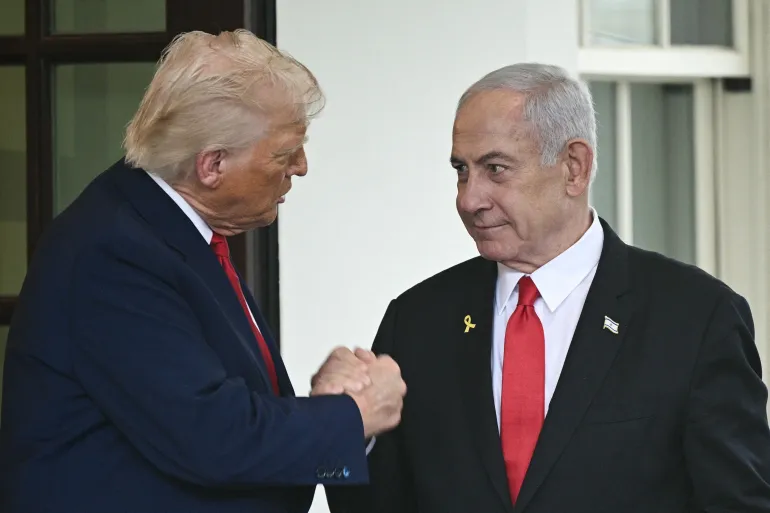
Israeli Prime Minister Benjamin Netanyahu said he would discuss Iran with US President Donald Trump during a visit to Washington, alongside Israel’s security situation and efforts to expand regional peace agreements.

