

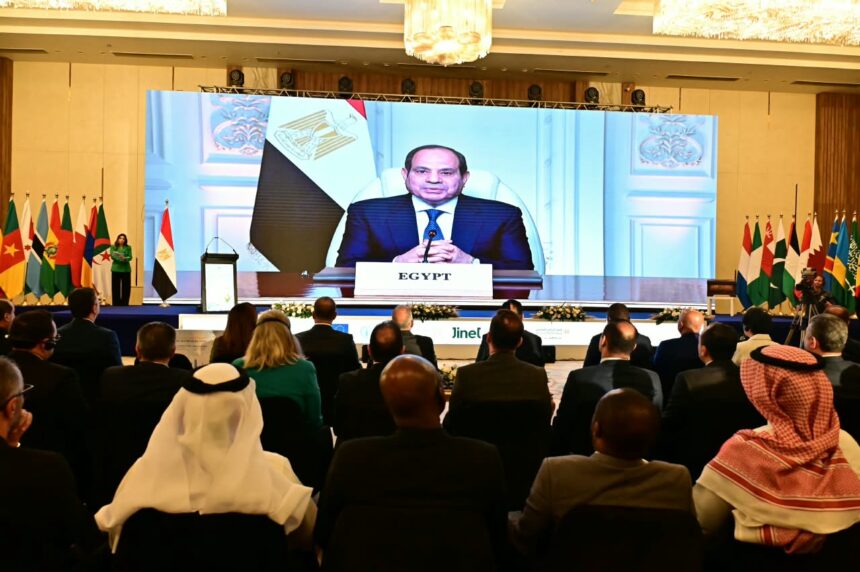
Egyptian President Abdel Fattah Al-Sisi said on Sunday that Egypt would not accept a fait accompli or compromise its water security, stressing that the right of Nile Basin countries to development must not come at the expense of other states or cause them harm.
In a recorded address at the opening of the ninth Cairo Water Week, Al-Sisi said the Nile provides more than 98% of Egypt’s renewable water resources, as the country faces mounting pressure from population growth, rising water and food demand, and climate change.
“Any bet on Egypt accepting a fait accompli, or compromising its water security, is a losing bet,” Al-Sisi said, adding that the presence of a river’s headwaters within one country does not give it the right to exercise unilateral control over a resource shared by several peoples.
The president said Egypt recognised and supported the right of all Nile Basin countries to development and to use their natural resources, provided that this was done responsibly, in accordance with international law and without harming other states.
He pointed to Egypt’s cooperation with southern Nile Basin countries on energy, agriculture and irrigation projects, saying prior notification, the exchange of studies and consultations had helped build trust and mobilise financing.
Al-Sisi said Cairo wanted to see the same approach applied in the eastern Nile Basin in a manner that served the interests of Egypt, Sudan and Ethiopia.
Egypt had chosen dialogue and cooperation to address water disputes, he said, but would continue to protect its interests and water rights. He called for the basin’s resources to be managed in a way that maximised shared benefits and made the Nile a source of development and stability.
The ninth Cairo Water Week opened on Sunday under the theme “Water as a Catalyst for Peace, Shared Prosperity and a Sustainable Planet” and will run until October 29, with the participation of 21 ministers, 23 high-level delegations and representatives of international organisations.
Water Resources and Irrigation Minister Hani Sewilam told the opening session that Egypt had chosen to make water “a bridge for cooperation”. He highlighted efforts to improve water-use efficiency, expand treatment and reuse, upgrade infrastructure and protect coastlines under the ministry’s “Water System 2.0” programme.
Sewilam also presented the ministry’s work on the Ismailia Canal, where it has introduced artificial intelligence and a digital twin, using drones, Internet of Things technologies and camera-based flow measurements to monitor water movement and test operational decisions before implementation.
He said Egypt’s message to Nile Basin countries was “one river, one basin, one future”, calling for greater use of rainfall, agricultural land, solar and wind resources through rainwater harvesting, rain-fed agriculture, clean-energy projects and regional electricity interconnections.
Sewilam also highlighted Egypt’s role in the African Ministers’ Council on Water and the African Water Facility, as well as its co-chairmanship with Japan of the “Water for the Planet” dialogue at the 2026 UN Water Conference.

