

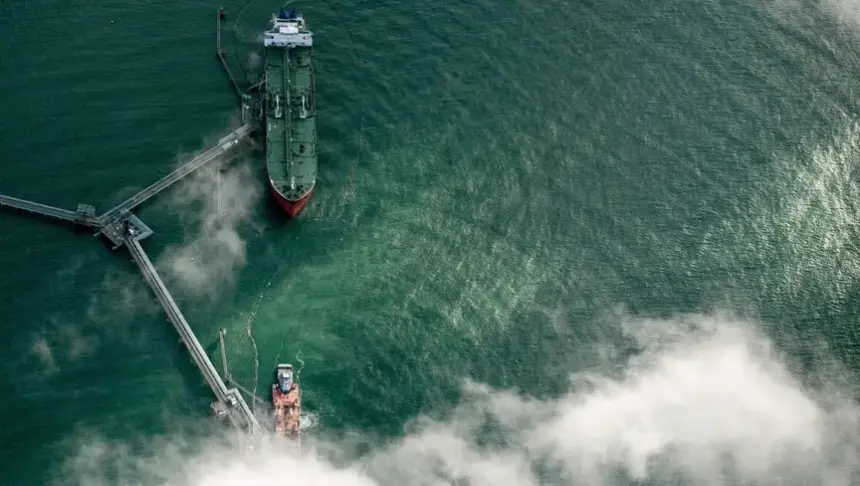
An unusual series of military fuel shipments scheduled to sail from the United States across the Pacific exposes the widening impact of the Iran war on global oil supply chains.
A solicitation issued Thursday seeks the transport of 235,000 barrels of aviation fuel from a BP refinery at Cherry Point in Blaine, Washington, to Subic Bay in the Philippines by early June, according to a document seen by Bloomberg. A separate tender seeks to move 260,000 barrels of military jet fuel or diesel from Cherry Point to Yokosuka and Sasebo in Japan for voyages in May and June.
The shipments highlight a growing trend of redirecting US fuel to the Asia-Pacific, a region traditionally reliant on crude and fuel flows through the Strait of Hormuz, which has been severely restricted by the Middle East conflict.
Bradley Martin, a senior policy researcher at the RAND Corporation and former US Navy captain, said the traditional supply route—moving Middle Eastern crude to refineries in countries like Singapore and South Korea—has been deeply disrupted. Consequently, the US is relying on unconventional commercial routes to send JP-5 aviation fuel and F-76 naval diesel directly to defence support points in Asia for fleet distribution.
Data underscores the rarity of these movements. Energy analytics firm Kpler recorded only four JP-5 cargoes leaving the US since 2017. Vortexa data shows just a single 93,000-barrel commercial jet fuel shipment from the US to the Philippines on record.
A spokesperson for the US Transportation Command declined to comment on the proposals, stating only that the military frequently uses different routes to test new paths or reach specific delivery points. BP and the US Navy’s 7th Fleet also declined to comment.
The redirection of domestic exports comes amid a global aviation fuel crisis that has grounded flights and raised ticket prices worldwide. Furthermore, West Coast diesel shipments to Australia have reached record highs since the war began, squeezing local supplies in a region that lost several California refineries over the past year.
The logistical pivot coincides with an entrenched US naval blockade of Iranian ports. US Defence Secretary Pete Hegseth announced Friday that the military will soon deploy two aircraft carriers to enforce the blockade of the Strait of Hormuz. President Donald Trump stated on social media this week that he ordered the Navy to “shoot and sink” any boats planting mines in the waterway.
“All they have to do is give up nuclear weapons in meaningful, verifiable ways,” Hegseth said on Friday. “Or they can instead watch their regime’s fragile economy collapse under the relentless pressure of American power, and a blockade that lasts as long as it takes. It’s up to what President Trump decides.”
US sanctions Chinese refinery, Iran’s shadow oil fleet
Expanding its economic pressure, the US Treasury Department’s Office of Foreign Assets Control sanctioned Hengli Petrochemical Dalian Refinery on Friday, describing the Chinese facility as one of Tehran’s most important customers. The measures also targeted approximately 40 shipping companies and vessels involved in Iran’s unofficial oil fleet.
Treasury Secretary Scott Bessent warned that anyone facilitating these flows risks US sanctions. Separately, Trump told CNBC the US had seized a vessel carrying a “gift” from China, a remark widely interpreted as a reference to war supplies for Tehran.
Despite the blockade, which on Friday halted a supertanker carrying sanctioned Iranian oil, there are renewed diplomatic efforts to reopen the strait. White House Special Envoy Steve Witkoff and Jared Kushner are travelling to Pakistan this weekend for talks with Iranian officials. The New York Times reported that Iranian Foreign Minister Abbas Araghchi plans to deliver a new written response to a US peace proposal during the visit, though US sources indicated that mediation efforts have been hindered by Trump’s social media posts and the ongoing blockade.
The prospect of talks briefly eased markets, with West Texas Intermediate (WTI) crude falling by up to 1.5% before paring losses to trade near $94 a barrel. Prices remain up 13% this week, the largest increase since the initial surge following the war’s outbreak in late February.
Thierry Wizman, global currency and interest rate strategist at Macquarie Group, said recent developments “suggest that traders are becoming more comfortable with the idea that the military phase of the conflict between the United States and Iran is nearing an end, or perhaps has already ended, and that an economic war is taking hold.”
However, analysts caution that supply chain damage will linger. Goldman Sachs expects Gulf oil production to fall by 14.5m barrels per day in April. Ole Hansen of Saxo Bank noted that even with a full reopening, it will take several months for flows to return to normal, creating “further pressure, especially in diesel and jet fuel, and forcing countries and companies to cut demand.”

