

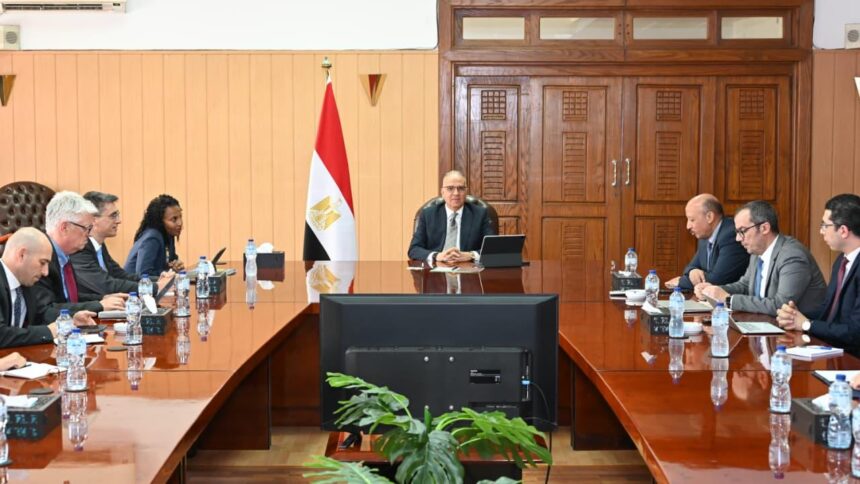
Egypt’s Minister of Water Resources and Irrigation, Hani Sewilam, held talks with World Bank officials on strengthening cooperation in water management, climate adaptation, and sustainable development, as the country continues to face mounting pressure on its limited water resources.
According to a ministry statement, Sewilam met with Meskerem Brhane, the World Bank’s Regional Director for Sustainable Development (Planet) for the Middle East and North Africa, Afghanistan, and Pakistan, to review strategic areas of cooperation and explore opportunities for future collaboration.
During the meeting, Sewilam highlighted the challenges facing Egypt’s water sector, noting that the country depends on the Nile River for more than 98% of its renewable water resources. He added that annual per capita water availability has declined to around 490 cubic metres, significantly below the internationally recognised water poverty threshold, while total water demand has risen to approximately 120 billion cubic metres per year.
The minister explained that Egypt is addressing the growing gap between available water resources and rising demand through a range of measures, including the reuse of treated water, agricultural drainage water treatment, and the import of food commodities that effectively provide “virtual water.”
Sewilam also reviewed the country’s second-generation Water 2.0 programme, which is being implemented within the framework of Egypt’s National Water Resources Plan 2037 and Water Strategy 2050. The programme seeks to enhance water management through digital transformation, smart technologies, advanced monitoring systems, and decision-support tools.
As part of efforts to strengthen water governance and improve resource management, the minister noted that Egypt has established more than 6,400 water user associations to promote participatory management, improve irrigation efficiency, and support sustainable agricultural development.
He further highlighted several major national projects in water treatment and reuse, including the Bahr El Baqar and Al Mahsama treatment plants, as well as projects linked to the New Delta agricultural expansion programme, which are designed to maximise the use of non-conventional water resources and support food security objectives.
The discussions also covered the World Bank’s “Water Forward” initiative and a proposed Water Compact framework. Sewilam welcomed international efforts aimed at supporting water-scarce countries but stressed the importance of ensuring that such initiatives align with national priorities and focus on practical implementation, financing mechanisms, technical assistance, and capacity-building programmes.
The two sides explored opportunities for future cooperation in several priority areas, including irrigation modernisation, sustainable groundwater management, wastewater treatment and reuse, the development of non-conventional water resources, digital water management systems, private-sector participation, and climate-resilient infrastructure.
According to the ministry, the discussions form part of Egypt’s broader efforts to strengthen water security, improve resilience to climate change, and support sustainable development amid increasing water challenges and growing demand for resources.


