Egypt’s Minister of Planning and Economic Development, Ahmed Rostom, said the government is targeting economic growth of between 4.8% and 5.2% in fiscal year 2026/27, adopting a cautious approach amid ongoing regional instability and global economic uncertainty, while laying the groundwork for growth to accelerate to between 6.2% and 6.8% by 2029/30.
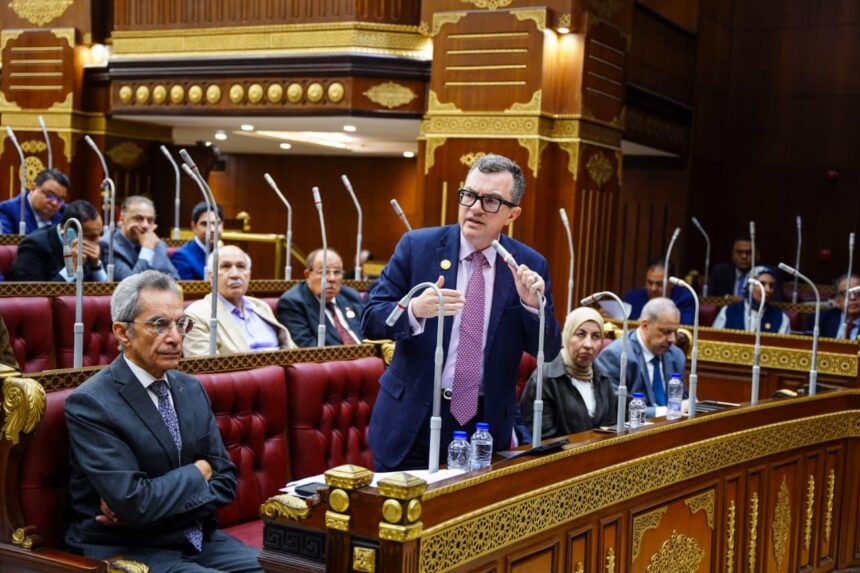
Speaking before a plenary session of the Senate for the second consecutive day, Rostom said economic management in a period marked by geopolitical tensions and market volatility requires flexible policies capable of managing risks and identifying emerging opportunities.
The session, chaired by Senate Deputy Speaker Essam El-Din Farid and attended by Minister of Parliamentary Affairs Hani Hanna Azer, reviewed the main features of Egypt’s economic and social development plan for FY 2026/27 and the medium-term framework covering the period from 2026/27 to 2029/30.
Rostom described the new development plan as a “dynamic action plan” designed to respond to global shocks and rapidly changing conditions. He noted that, for the first time, the plan was formulated using measurable general equilibrium models and integrated implementation monitoring mechanisms.
According to the minister, the plan takes into account multiple geopolitical scenarios, including potential disruptions to global shipping routes and sharp increases in energy and food prices. This approach informed the decision to adopt a conservative growth target for FY 2026/27 before pursuing a gradual and sustainable acceleration in economic activity over the medium term.
Rostom also outlined a package of structural reforms introduced by the ministry to improve the efficiency of public investment planning and project implementation.
The reforms include a comprehensive performance measurement system covering all executing entities, linking project funding and disbursements directly to implementation progress on the ground. The new framework also limits advance payments during the final quarter of the fiscal year and imposes tighter controls on the transfer of funds between projects.
In addition, the ministry has introduced a new evaluation mechanism for ongoing projects based on implementation timelines, funding allocations, and completion rates, ensuring that projects with the strongest execution performance receive priority funding.
The reform package also includes a fully integrated digital framework linking the Ministries of Finance and Planning to strengthen expenditure governance during FY 2026/27. The system is expected to expand in FY 2027/28 to include the National Investment Bank as part of the government’s transition toward programme- and performance-based budgeting.
To strengthen institutional capabilities, the ministry is developing a comprehensive training programme for implementing agencies, focusing on economic feasibility studies, project monitoring, and evaluation methodologies.
Other measures include stricter governance rules for signing project implementation protocols to ensure the creation of productive public assets, the introduction of quantitative tools to support the equitable distribution of government investments across governorates according to development needs, and enhanced oversight of local spending in cooperation with the Ministries of Local Development and Environment.
Rostom said the government is also introducing incentive mechanisms to reward high-performing governorates and improve the efficiency of local development programmes.
On human development, the minister revealed that allocations for health, education, scientific research, and Al-Azhar institutions have increased by between 11% and 27.6%, with these sectors fully exempted from government expenditure rationalisation measures.
He also announced the launch of the second phase of Egypt’s comprehensive health insurance system in six additional governorates. The expansion is expected to benefit more than 12 million citizens, bringing the total number of beneficiaries under the first and second phases to approximately 17 million by 2030.
Regarding rural development, Rostom said annual investments worth EGP 600m have been incorporated into the current and upcoming fiscal plans through governorate budgets to finance 367 projects, the majority of which focus on paving internal village roads.
These investments complement projects implemented by central government ministries, including the construction of schools and health units, as well as the expansion of utility networks. Natural gas connectivity investments have increased by 556%, while investments in internet infrastructure have risen by 81%.
Rostom added that implementation of the first phase of the Decent Life initiative has surpassed 91%, with work currently focused on completing and operationalising the remaining projects during the current fiscal year.
He stressed that the government’s medium-term strategy seeks to balance fiscal discipline with continued investment in human capital, infrastructure, and productive sectors, supporting sustainable economic growth while enhancing resilience to external shocks.