

Egypt’s Minister of Transport, Kamel Al-Wazir, witnessed the launch of commercial trial operations at the new Safaga 2 Multipurpose Terminal, marking a significant milestone in the country’s strategy to position itself as a regional hub for transport, logistics, and transit trade.
The launch comes in line with directives from President Abdel Fattah Al-Sisi and forms part of the ongoing development of Greater Safaga Port, one of Egypt’s most important maritime infrastructure projects on the Red Sea. The event also reflects the growing strategic partnership between Egypt and Abu Dhabi Ports Group.
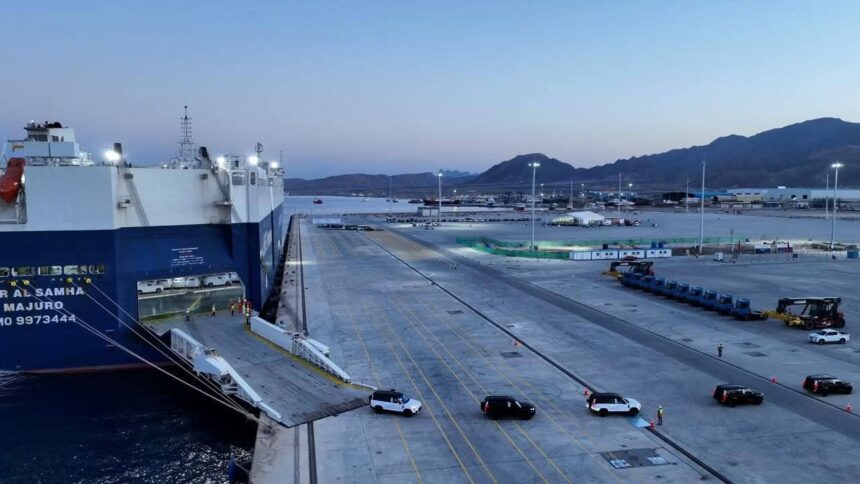
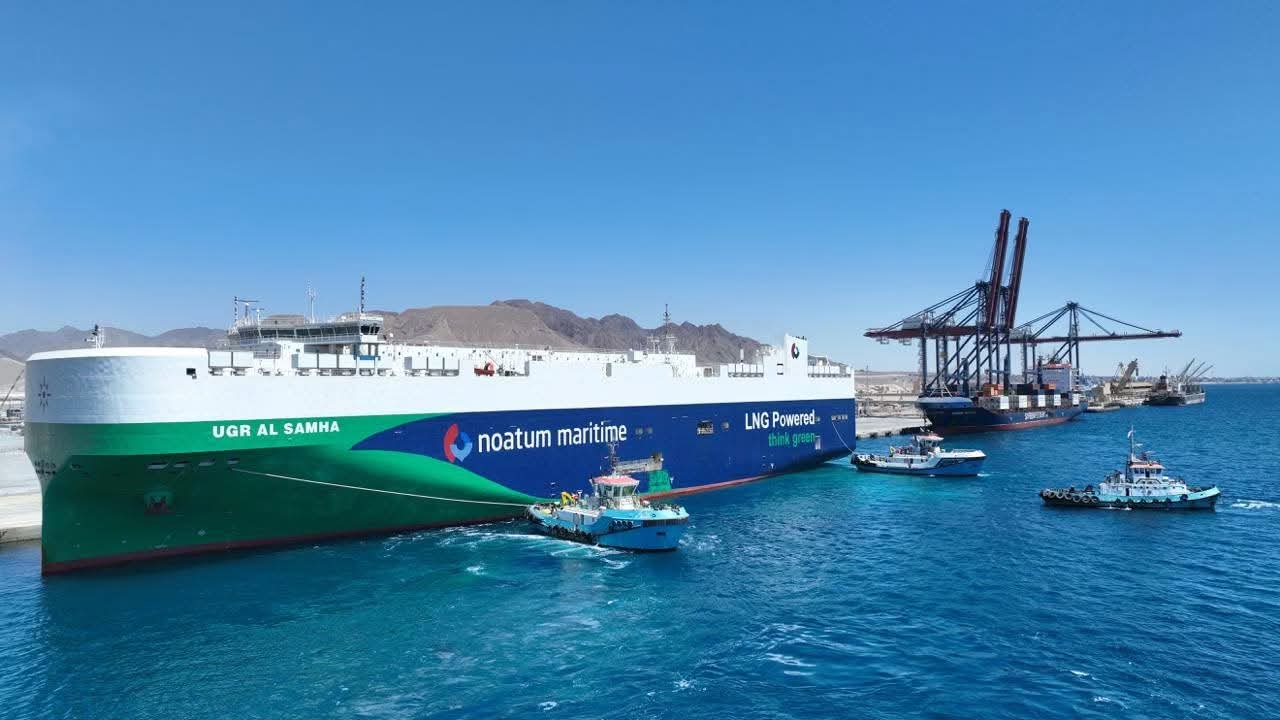
Commercial trial operations began with the arrival of the terminal’s first two vessels. The UGR Al Samha, arriving from Singapore, carried 5,000 vehicles, while the Sven Prosper arrived from King Abdullah Port carrying 2,642 TEUs.
The ceremony was attended by Red Sea Governor Walid Abdel Azim, Abu Dhabi Ports Group Managing Director and CEO Captain Mohamed Juma Al Shamisi, Deputy Minister of Transport for Maritime Transport Major General Nehad Shahin, Red Sea Ports Authority Chairperson Major General Mohamed Abdel Rahim, and Mohamed Fathy, Adviser to the Minister for Maritime Transport.
During the visit, Al-Wazir toured the terminal’s facilities and reviewed container-handling operations, including the operation of three ship-to-shore (STS) cranes and six hybrid rubber-tyred gantry (RTG) cranes. The equipment incorporates advanced smart systems for container positioning and yard management, enhancing operational efficiency while reducing human error.
Describing the occasion as “an important day for Egypt’s maritime transport sector,” Al-Wazir said the terminal spans 776,000 square metres and includes a 1,100-metre quay with a depth of 17 metres.
The facility has an annual handling capacity of 450,000 TEUs, expandable to 2 million TEUs, in addition to accommodating up to 7 million tonnes of dry and general cargo, 1 million tonnes of liquid cargo, and 50,000 vehicles annually.
The minister noted that the terminal was constructed by Egyptian engineers and workers and equipped with state-of-the-art cargo-handling technologies, making it the first facility of its kind in Upper Egypt.
He added that Safaga 2 represents a central component of the integrated Safaga–Qena–Abu Tartour logistics corridor, one of eight international logistics corridors being developed to strengthen Egypt’s position as a regional logistics and transit trade hub.
According to Al-Wazir, the terminal will serve as a primary gateway for the economic development of Upper Egypt by supporting mining activities in the Golden Triangle region, facilitating import and export operations, and enhancing connectivity with industrial zones, development projects, and free zones across northern, central, and southern Upper Egypt.
The project is also expected to stimulate industrial investment, logistics services, warehousing activities, and value-added industries, while encouraging greater use of rail freight transport, including future integration with Egypt’s high-speed electric rail network.
Al-Wazir highlighted the terminal’s strategic importance within the Southern Arab Trade Corridor, which links Egyptian Mediterranean ports with Safaga Port before extending to NEOM, Jeddah, and Gulf markets, ultimately connecting Gulf economies with Europe through Egypt.
He added that the facility will strengthen trade links with East African countries through the international logistics zone designated for African partners, supporting exports and re-exports of both containerised and non-containerised cargo.
The minister also pointed to Egypt’s growing role in global maritime connectivity, noting that the country currently ranks 19th globally, first in Africa, and second in the Arab world in international trade connectivity. He said the Ministry of Transport is targeting a place among the world’s top 15 countries in maritime connectivity by 2030.
Al-Wazir praised the partnership with Abu Dhabi Ports Group, describing it as a key component of Egypt’s strategy to attract international private-sector investment and leading global port operators. Such partnerships, he said, contribute to improving operational efficiency, attracting major shipping lines, and supporting national economic growth.
He also outlined Egypt’s broader maritime transport development strategy, which is based on four pillars: developing seaports, modernising the national maritime fleet, establishing strategic partnerships with leading global port operators and shipping lines, and advancing legislative reforms, digital transformation, and yacht tourism initiatives.
For his part, Mohamed Juma Al Shamisi, Managing Director and CEO of Abu Dhabi Ports Group, reaffirmed Egypt’s importance within the group’s international portfolio, describing the country as a key gateway within its global network spanning Asia, the Middle East, Africa, and South America.
He said the new Noatum Ports – Safaga Terminal, with its strategic location on the Red Sea, will further strengthen the group’s role as a global trade enabler along one of the world’s most important maritime corridors.
Al Shamisi added that the company looks forward to the terminal reaching full operational capacity later this year as part of its ongoing collaboration with Egyptian partners.
Greater Safaga Port is being developed as an integrated maritime complex comprising the existing Safaga Port (Safaga 1), the Safaga 2 Multipurpose Terminal, the Safaga 3 Dry Bulk and Ro-Ro Terminal, and Safaga 4, which will feature three new berths extending two kilometres, a 17-metre draft, and a commercial ship-repair yard.


