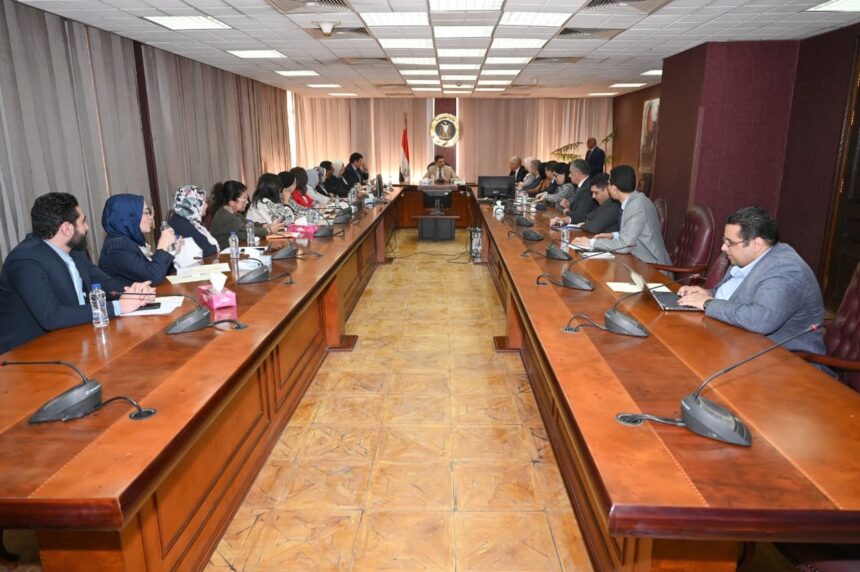
Minister of Industry Khaled Hashem held an expanded meeting with Mohamed El-Sewedy, Chairperson of the Federation of Egyptian Industries, and members of the Handicrafts Chamber, headed by Mohamed Sakr, to discuss mechanisms to develop Egypt’s handicrafts and heritage industries and enhance their competitiveness in global markets.
During the meeting, participants reviewed key challenges facing the sector, including the limited availability of production inputs, high customs duties, and the lack of formalisation among a large number of artisans and workshop owners.
They also highlighted licensing complexities, a shortage of qualified trainers in traditional crafts, and the need to expand participation in exhibitions while strengthening the sector’s presence in retail outlets at airports and museums.
In addition, the chamber underscored the importance of establishing a permanent exhibition for handicrafts and improving access to financing for its members.
Hashem reaffirmed the government’s commitment to developing handicrafts and heritage industries, describing them as a vital component of Egypt’s national identity with significant social and cultural value.
He noted that the ministry aims to support and expand existing craft clusters across all governorates by providing technical assistance, enhancing artisans’ capabilities, and facilitating knowledge transfer to ensure the sustainability of traditional professions.
The minister stressed the importance of upgrading training frameworks by aligning them with global design trends to meet diverse consumer preferences and boost exports of products that reflect Egypt’s cultural heritage. He also encouraged the use of such products as official gifts and souvenirs during events and celebrations held in Egypt.
Hashem pointed to the “Productive Villages” initiative as a key opportunity for chamber members, noting that it forms part of the ministry’s broader strategy to promote balanced industrial development. The initiative aims to curb irregular migration and internal displacement by leveraging each governorate’s comparative advantages, establishing small-scale workshops and industrial complexes, and offering concessional financing to small investors.
He added that the initiative will provide technical support to integrate small workshops with small and medium-sized factories, strengthening supply chain linkages through a national industrial map that identifies the competitive strengths of each village. The programme will be implemented in cooperation with relevant ministries under the presidential Decent Life initiative, starting with one or two pilot villages before scaling up nationwide.
The minister directed the chamber to submit a comprehensive report outlining required production inputs—including customs codes and indicative prices—alongside detailed licensing challenges and target museums and exhibitions for expanded presence. This will enable the ministry to coordinate with relevant authorities to address these issues.
For his part, El-Sewedy emphasised the importance of the Handicrafts Chamber as one of the largest employers, particularly in rural areas, as well as a key user of recycled materials in production. He noted that Egyptian handicraft products have strong potential to compete with imports, given their unique cultural identity, which enhances their appeal in international markets.