

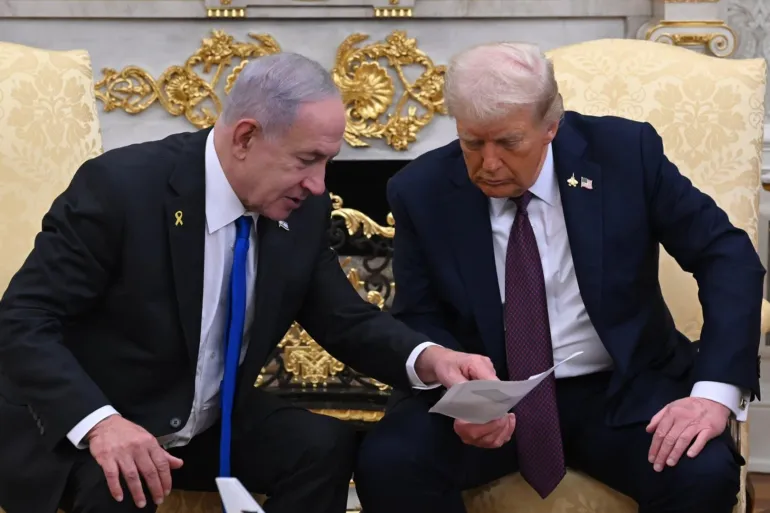
US President Donald Trump intensified pressure on Iran by announcing tougher naval measures and threatening further interceptions of Iranian oil shipments, while Tehran accused Washington of violating the ceasefire and international law. Iran’s Islamic Revolutionary Guard Corps (IRGC), meanwhile, warned that any new attack on the country would have consequences beyond the region.
Speaking at the White House on Wednesday, Trump said the United States “will not allow Iran to obtain a nuclear weapon,” adding that Washington had “strong support” for its position. He announced what he described as a strengthened naval blockade, referred to as the “Steel Wall.”
Trump said the United States would “seize more Iranian oil tankers,” adding that “no one can break through the naval blockade” imposed on Iran and that additional Iranian vessels “will be intercepted unless Tehran shows real commitment and changes its behaviour.”
Addressing lawmakers at the White House, Trump also said the United States would “end the war very quickly” with Iran, reiterating that Tehran would not be permitted to possess nuclear weapons.
Iran’s foreign ministry, however, said Tehran was currently focused on “ending the war on all fronts, especially Lebanon,” while insisting it continued negotiations “in good faith.” The ministry said Washington must demonstrate seriousness in any diplomatic process.
The ministry described the US naval measures as “a violation of the ceasefire and contrary to international law,” dismissing discussions of ultimatums or deadlines imposed on Iran as “ridiculous.”
It added that coastal states have the right to prevent “aggressor states” from crossing the Strait of Hormuz and called for mechanisms regulating passage through the strategic waterway to ensure maritime security and environmental protection. Tehran also demanded the release of frozen Iranian assets and an end to what it described as “maritime piracy against Iranian shipping.”
In a further escalation, Iran’s Revolutionary Guards warned that any renewed attack on Iran would not remain confined within its borders. In a statement carried by Tasnim news agency, the Guards said the “American-Zionist enemy” had failed to learn from repeated strategic defeats, adding that Iran had “not yet used all of its capabilities” despite confronting the United States and Israel.
Iranian state television later reported that five large oil tankers had received authorisation from the Revolutionary Guards to pass through the Strait of Hormuz, highlighting continued tensions surrounding one of the world’s most critical energy shipping routes.
Elsewhere in the region, Jordan’s military said it had shot down an unidentified drone that entered the country’s airspace over Jerash province on Wednesday morning, adding that there were no casualties and only minor material damage.
In the Gulf, the United Arab Emirates called on Iraq to prevent “any hostile acts” launched from its territory following a recent drone attack targeting the UAE’s Barakah nuclear power plant. In a statement, the UAE Ministry of Foreign Affairs urged Baghdad to take immediate and unconditional action to prevent “all hostile acts originating from its territory” and address the threats responsibly in accordance with international law.


