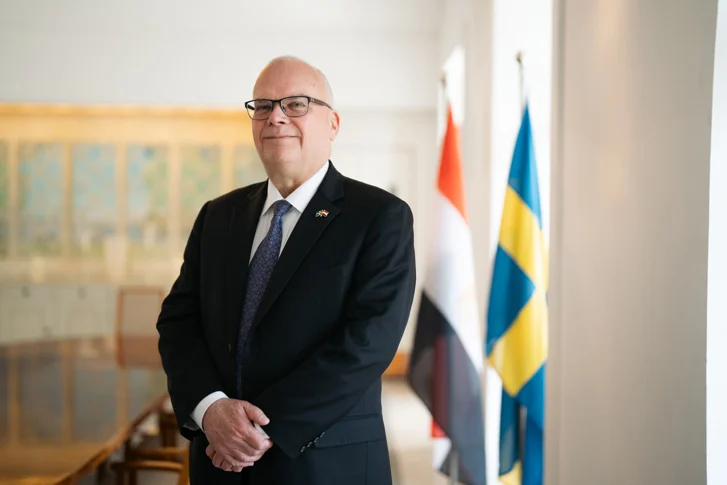
Economic relations between Egypt and Sweden are entering a new phase of expansion, driven by clean energy cooperation, rising trade volumes and deeper private sector engagement, according to Dag Juhlin-Dannfelt, Ambassador of Sweden to Egypt.
The ambassador described bilateral ties as “broad, strategic and steadily expanding”, particularly in sectors aligned with sustainability and long-term economic resilience.
In remarks to Daily News Egypt, Juhlin-Dannfelt stressed that Swedish engagement in Egypt is largely private-sector-led, with the Embassy of Sweden in Cairo and the Swedish government acting as facilitators rather than direct investors.
“Energy – especially renewable and clean energy – is a cornerstone of our cooperation,” he said. “Swedish companies bring advanced technologies and decades of experience in sustainable energy solutions, while Egypt offers scale, strong potential and regional connectivity. This creates a natural and mutually beneficial partnership.”
Energy cooperation
Among the most prominent joint projects is the high-voltage direct current (HVDC) electricity interconnection between Egypt and Saudi Arabia, implemented by Hitachi Energy, a global leader in power transmission technology with Swedish roots.
Valued at approximately $1.8bn and signed in 2021, the project is being rolled out in phases, with several stages already operational and supplying electricity. The initiative marks a milestone in regional energy integration and highlights Sweden’s technological leadership in high-voltage transmission systems.
Looking ahead, the ambassador revealed that discussions are ongoing regarding the possible extension of the interconnection to Europe, either through Greece or Italy. Such a move would enable Egypt to export electricity to the European market, reinforcing its ambition to become a regional energy hub. While negotiations remain at an early stage, he said the talks reflect a shared strategic vision for stronger energy connectivity linking Africa, the Middle East and Europe.
Financial support mechanisms
Sweden’s economic model, Juhlin-Dannfelt explained, is centred on private enterprise. The government does not directly invest in overseas projects but supports companies through financial instruments provided by institutions such as the Swedish Export Credit Corporation (SEK).
These institutions provide export credit guarantees and structured financing for projects involving Swedish firms, subject to commercial viability standards. In most cases, at least 30% Swedish content is required for guarantees to be granted, ensuring economic value and long-term sustainability.
“This approach supports international partnerships while maintaining strong accountability and transparency,” the ambassador noted.
Geothermal energy potential
Beyond solar and wind, geothermal energy is emerging as a promising new area of cooperation. Juhlin-Dannfelt confirmed that a Swedish company is exploring geothermal investment opportunities in Egypt and has initiated discussions with the Ministry of Electricity and Renewable Energy and the New and Renewable Energy Authority.
Egypt’s geological profile, characterised in some areas by a relatively thin earth’s crust, could allow geothermal resources to be accessed at shallower depths compared with Sweden, where drilling can reach up to 2,000 metres. Shallower drilling would significantly reduce development costs.
Feasibility studies are currently under way to assess the technical and commercial viability of potential projects. While Swedish government agencies may support preliminary assessments, any future investment would be undertaken by the private sector. If realised, the project could mark Egypt’s first geothermal power plant, representing an important step in diversifying the country’s renewable energy mix.
Strong and diversified corporate presence
Sweden’s corporate footprint in Egypt is well established, with around 27 Swedish companies operating across sectors including energy, healthcare, transport, manufacturing, packaging and information and communications technology.
Major players include Ericsson, Electrolux, Volvo, Tetra Pak and IKEA. Many of these firms use Egypt not only as a domestic market but also as a manufacturing and export base serving regional and international destinations.
A recent example is the Volvo-MCV electric bus factory, established with investments of approximately EGP 3bn. The facility manufactures electric buses in Egypt for export to Europe, underlining investor confidence in Egypt’s industrial capabilities and export potential.
Trade growth and investment climate
Bilateral trade between Sweden and Egypt currently stands at around €2bn annually, with Swedish exports accounting for the larger share. While Egyptian exports to Sweden remain comparatively modest, the ambassador expects trade volumes to grow steadily, potentially by around 10% per year under favourable economic conditions.
He added that official trade data may understate the true scale of economic exchange, as many Swedish products enter Egypt through European distribution hubs rather than directly from Sweden.
On the investment climate, Juhlin-Dannfelt described Egypt’s economic trajectory as positive, particularly in light of recent reviews by the International Monetary Fund and financial support from European partners. Infrastructure upgrades and large-scale industrial developments, including the Suez Canal Economic Zone, were highlighted as encouraging signs.
At the same time, Swedish companies continue to point to bureaucracy and lengthy administrative procedures – particularly in licensing, permits and residency processes – as areas requiring improvement. Predictability, efficiency and transparency, he stressed, are essential for countries competing globally to attract foreign investment.
Long-term outlook
Despite these challenges, the ambassador expressed strong optimism about the future of Sweden-Egypt economic relations. Swedish companies typically adopt long-term strategies, and several – including Electrolux – have expanded their operations in Egypt even during periods of economic strain.
“If Egypt continues reforms that empower the private sector, ensure fair competition and streamline procedures, we can expect deeper cooperation, stronger trade growth and increased Swedish investment,” he concluded.
For Sweden, Egypt represents not only a large and dynamic market but also a strategic regional partner linking Africa, the Middle East and Europe – a positioning that, he said, lays the groundwork for sustained expansion in the years ahead.