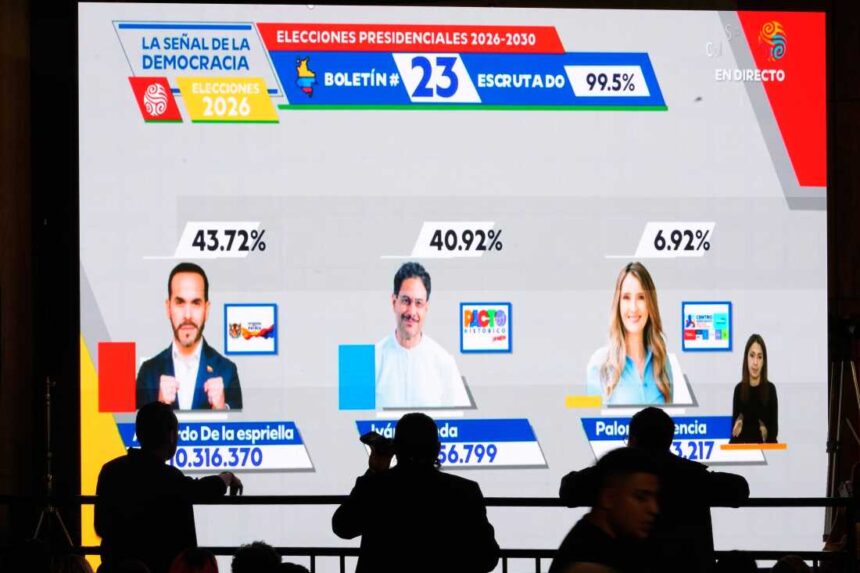
Pro-Donald Trump conservative lawyer Abelardo de la Espriella unexpectedly topped the first round of Colombia’s presidential election, prompting incumbent left-wing President Gustavo Petro to question the preliminary results and the victor to accuse the government of planning a coup.
The independent conservative candidate is now in a strong position to win the June 21 runoff against left-wing Senator Ivan Cepeda, a close ally of Petro. According to official results with most ballots counted, de la Espriella secured 43.7% of the vote, while Cepeda came second with 40.9%. Conservative Senator Paloma Valencia placed third with 6.9%, subsequently announcing her support for de la Espriella in a speech following the vote.
Highlighting the intense rivalry, de la Espriella called on the military and the international community to protect Sunday’s election results from what he termed “miserable criminals,” following scepticism from both Petro and Cepeda regarding the count. He also requested that the United States supervise the second round of voting.
“Turn your eyes to Colombia. Petro, who is planning a coup, intends to cling to power, ignoring the will of the people,” de la Espriella said, speaking from a stage behind bulletproof glass.
President Petro stated on Sunday that he did not accept the preliminary vote tally, writing in a post on the X platform that he will not recognise unofficial results until the formal audit by judges is completed. Senator Cepeda affirmed he would accept the results only after a review of alleged electoral irregularities. Furthermore, Cepeda accused Ecuadorian President Daniel Noboa of electoral interference, alleging Noboa lowered tariffs on Colombian goods following a conversation with de la Espriella two days before the vote.
Voter turnout reached approximately 58% on Sunday, marking the highest participation rate in the history of Colombian presidential first rounds.
Before the vote, most opinion polls indicated de la Espriella would trail Cepeda. However, forecasts now suggest the runoff may be a formality; the Polymarket platform gives de la Espriella an 81% chance of winning the presidency, compared to 18% for Cepeda.
According to Bloomberg, Colombian assets are likely to rise on Monday, as many investors feared a new left-wing administration would increase debt and undermine central bank independence. Over time, markets have come to view de la Espriella as an alternative to Valencia and the best opportunity to unseat Petro’s political movement. Colombian public debt rose slightly in the week preceding the election, bolstered by de la Espriella’s growing popularity, while dollar-denominated bonds gained nearly 2% last week as peso-denominated bond yields declined.
De la Espriella has pledged to strengthen relations with U.S. President Donald Trump, reduce government spending and taxes, and launch a military campaign against the militias involved in cocaine smuggling that control vast areas of the country. Conversely, Cepeda is sceptical of U.S. intervention in Latin America, seeking instead to increase social spending and extend negotiations with illegal armed groups.
At polling stations across the capital, Bogota, many voters, alongside their children and pets, wore the yellow Colombian national football team shirt, which became a prominent symbol of de la Espriella’s campaign. Despite this, Cepeda prevailed in the capital, securing approximately 42% of the vote compared to his rival’s 38%. The runoff is likely to be determined by de la Espriella’s ability to attract Valencia’s supporters and either candidate’s success in courting centrist voters.
The results dealt a blow to Colombia’s traditional conservatives who sought to propel Valencia to the presidency. Her failure to surpass 10% of the vote reflects the waning influence of the political current associated with former President Alvaro Uribe, who dominated politics for two decades before Petro became the country’s first left-wing president in 2022.
Although de la Espriella initially described Valencia as an ally, tensions between them had escalated before the election. Nevertheless, her subsequent support, along with Uribe’s endorsement, dispels concerns regarding the political right’s ability to unite against Cepeda in the runoff.
The vote takes place as Latin America trends towards a new wave of highly polarised elections between candidates with contrasting ideological orientations, Bloomberg reported. In Peru, a June 7 runoff will feature Keiko Fujimori, daughter of former President Alberto Fujimori, against anti-establishment left-winger Roberto Sanchez. In Brazil, President Luiz Inacio Lula da Silva faces a conservative movement led by right-wing Senator Flavio Bolsonaro, son of former President Jair Bolsonaro.
Reacting to the Colombian vote, Argentine President Javier Milei congratulated de la Espriella in a post on X, praising the determination of Colombian voters to “put an end to the failed socialist model that has caused significant damage to our region, and to Colombia in particular, over the past four years.”