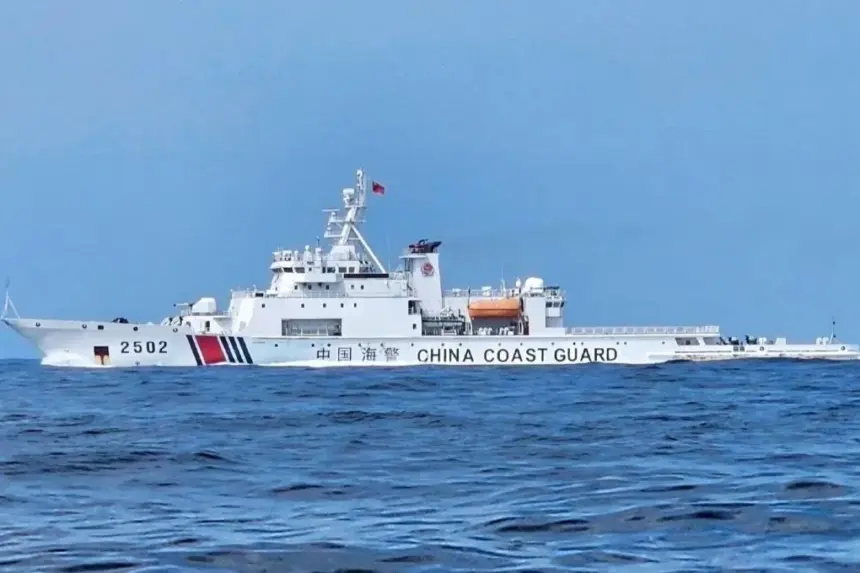
China announced on Monday that it conducted naval patrols in the waters east of Taiwan in direct response to a decision by Japan and the Philippines to launch talks on demarcating their maritime boundaries, according to the South China Morning Post.
A statement issued by the Chinese Coast Guard detailed that a group of vessels, led by the ship Daishan, executed the patrols on Monday in the waters east of Taiwan “in accordance with the law.”
Chinese Coast Guard spokesperson Jiang Luye described the deployment as “a necessary measure in response to the unilateral announcement by Japan and the Philippines on the start of negotiations to demarcate maritime boundaries in the waters east of China’s Taiwan island, which seriously violates China’s territorial sovereignty and maritime rights and interests.”
“We urge Japan and the Philippines to immediately stop all illegal acts that violate China’s sovereignty and rights,” Jiang added, noting that the coast guard will continue to strengthen its control and management of the relevant waters and take concrete actions to “resolutely defend China’s territorial sovereignty and maritime rights and interests.”
The patrols follow a meeting in Tokyo on Thursday between Japanese Prime Minister Sanae Takaichi and Philippine President Ferdinand Marcos Jr., during which the two Asian nations elevated their relations from an enhanced strategic partnership to a comprehensive partnership. According to Bloomberg, this signifies an effort to deepen cooperation not only in defence but also across the economy, technology, and artificial intelligence.
Driven by shared concerns over China’s growing influence, the two leaders agreed to commence negotiations on an agreement to facilitate the exchange of military information and to open discussions on demarcating their shared maritime boundaries, specifically regarding their exclusive economic zones (EEZ) and the continental shelf.
Announcing the partnership, Takaichi stated: “This demonstrates our countries’ determination to continue strengthening our relations as like-minded nations at various levels, without being affected by changes in the international environment.”
Marcos Jr., speaking at a joint press conference, highlighted the strategic importance of the agreements. “These are crucial steps to enhance our defence cooperation and support the rules-based maritime order. These steps will strengthen mutual trust between our two countries,” he said.
“We affirm our deep respect for sovereignty and territorial integrity, and our firm belief that all nations, regardless of their size or power, are equal, have a voice that is heard, and have the freedom to pursue development in accordance with international norms and law,” Marcos added. “In an increasingly complex Indo-Pacific region, where tensions test the resilience of the rules-based order, our two countries remain steadfast in their commitment to upholding international law, promoting stability, and advocating for the peaceful settlement of disputes.”
Prior to Monday’s patrols, Chinese Foreign Ministry spokesperson Mao Ning stated on Friday that Beijing strongly condemns and opposes the boundary negotiations.
During a regular press conference, Mao specified that the area Japan and the Philippines intend to demarcate lies east of China’s Taiwan island. She asserted that China possesses an EEZ and a continental shelf in this region under Chinese domestic law and international law, including the United Nations Convention on the Law of the Sea (UNCLOS).
Mao described the boundary talks as a serious violation of China’s maritime rights, UNCLOS, and other fundamental norms governing international relations, adding that Beijing had lodged strong official protests with both Tokyo and Manila. She stressed that the so-called demarcation talks are “illegal and completely null and void” and will have no impact on China’s claims or the exercise of its legitimate rights in the region.
Beijing considers Taiwan to be a part of its territory and maintains that it will reunify the self-governed island with the mainland by force if necessary. Although most nations, including the United States, Japan, and the Philippines, do not recognise Taiwan as an independent state, Washington opposes any attempt to seize control of the island by force and remains committed to supplying it with weapons.