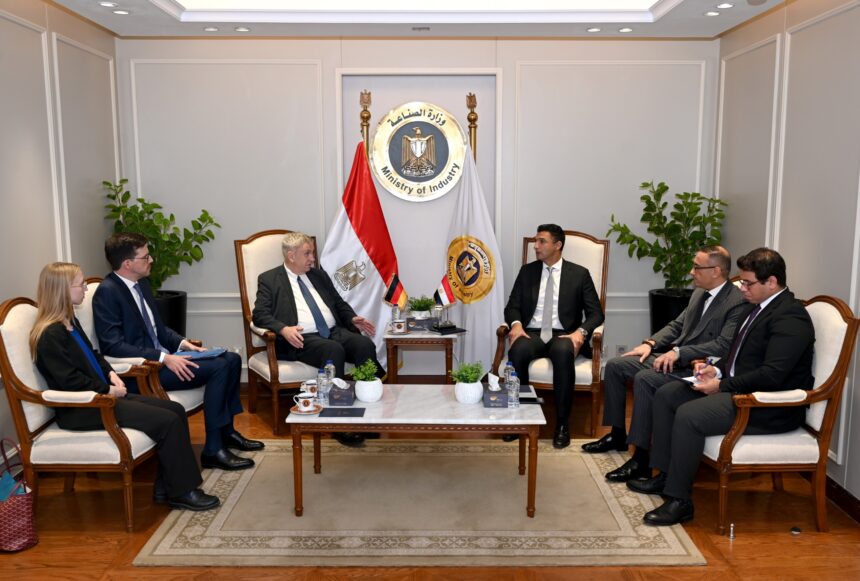
Egypt’s Ministry of Industry held a roundtable with German industrial companies operating or seeking to invest in the Egyptian market to discuss expansion plans, challenges, and potential solutions, as part of efforts to strengthen industrial and investment cooperation between the two countries.
The meeting was chaired by Minister of Industry Khaled Hashem and attended by German Ambassador to Egypt Jürgen Schulz and Mustafa El-Bagoury, Chairman of the German-Arab Chamber of Industry and Commerce in Egypt.
Hashem said Egypt aims to attract more German companies, particularly small and medium-sized enterprises (SMEs) and firms specialising in advanced technologies, to support technology transfer, enhance local industrial efficiency, and establish stronger partnerships between companies in the two countries.
He highlighted Egypt’s developed infrastructure, free trade agreements, skilled workforce, and strategic geographic location as advantages that could facilitate German companies’ access to Middle Eastern and African markets.
The minister said the ministry is implementing a programme to develop local suppliers and enhance their capabilities across various feeder industries. The programme provides incentives for major companies to participate in qualifying local suppliers to meet their requirements and integrate into global supply chains.
The ministry is also developing a “Qima” certificate to assess industrial establishments and link incentives to factories’ efforts to increase local content, deepen manufacturing, develop suppliers, invest in technology and research and development (R&D), and recruit and train workers.
Hashem also highlighted the National Automotive Industry Development Programme (AIDP) as a key tool for attracting major global automotive brands and localising the automotive and feeder industries.
The programme links investment incentives to the level of local content and the localisation of supply chains for conventional and electric vehicles, he said, adding that several global companies have recently announced new investments in Egypt in tyre manufacturing, electric vehicle batteries, and production lines.
German Ambassador Jürgen Schulz said Germany is keen to expand economic and industrial cooperation with Egypt and support the expansion of German companies in the Egyptian market.
Trade between Egypt and Germany reached around €6bn last year, Schulz said, adding that German companies are interested in Egypt’s investment opportunities and are looking to make new investments that would contribute to developing human capital and localising industry and technology.
El-Bagoury said German companies have operated in Egypt for more than 100 years, while the German-Arab Chamber of Industry and Commerce is marking its 75th anniversary this year. He highlighted the role of German companies and the chamber in technology transfer, skills development, and job creation.
The roundtable brought together 11 companies, including Bavaria Egypt, BSH Home Appliances, DMG MORI, Heidelberg Materials, Knauf, Kurz, Leoni Egypt, Mercedes-Benz, Siemens, Villeroy & Boch, and Cube Bikes.
Hashem welcomed the companies’ expansion plans and said the ministry would work to address their challenges and support the expansion of their operations.
Separately, Hashem and Schulz met with the German-Arab Chamber of Industry and Commerce to discuss strengthening its role in attracting German investors. The two sides agreed to explore providing the chamber with a list of priority sectors identified by the ministry to help target German companies specialising in those industries.