

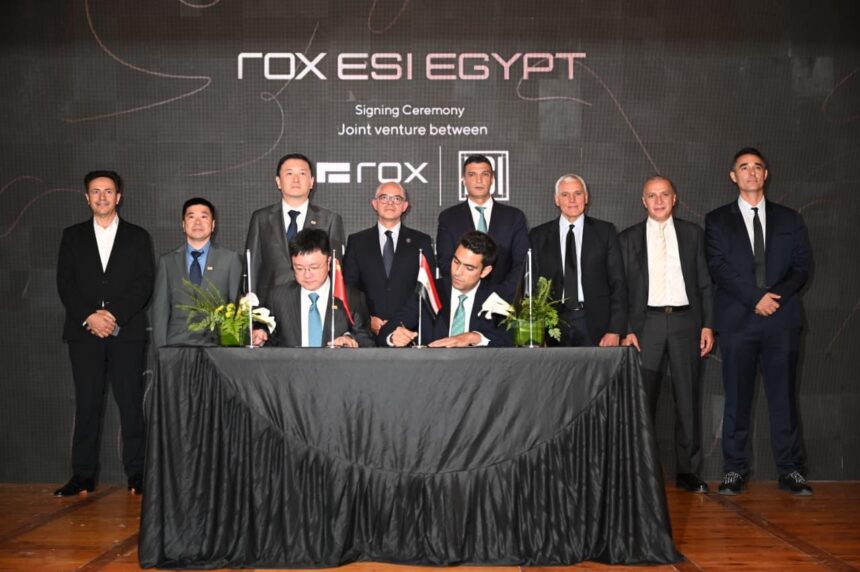
Egypt has taken another step toward becoming a regional hub for advanced automotive manufacturing after the launch of a strategic partnership between Ezz Elarab Elsewedy Investments (ESI) and global new-energy vehicle manufacturer ROX Motor to establish ROX ESI Egypt and begin local production of ROX REEV vehicles.
The agreement was signed in the presence of Minister of Industry Khaled Hashem and Minister of Investment and Foreign Trade Mohamed Farid, alongside ROX Motor Founder and CEO Jarvis Yan, ESI Chairperson Hisham Ezz Elarab, and Group Founder and Partner Ahmed Elsewedy.
The partnership forms part of Egypt’s broader strategy to localize advanced industries, attract export-oriented investments, and strengthen the country’s position as a regional manufacturing and export base for new energy vehicles.
Speaking during the signing ceremony, Investment and Foreign Trade Minister Mohamed Farid said the partnership represents a sophisticated model of technology-driven investment and knowledge transfer, reflecting growing confidence among global companies in Egypt’s economic prospects and investment climate.
He noted that the project aligns with the government’s efforts to attract productive industrial investments capable of deepening local manufacturing, increasing value addition, boosting exports, and integrating Egypt more effectively into global value chains.
“This partnership reflects the state’s vision of attracting technology-based investments that support industrial development and export growth,” Farid said. “It also demonstrates the increasing confidence of international companies in Egypt’s economy and competitive advantages.”
The project will leverage the existing industrial platform of the Ezz Elsewedy Automotive Factories (ESAF), which has attracted investments exceeding $100m and currently possesses an annual production capacity of approximately 40,000 vehicles. Expansion plans are expected to increase production capacity to more than 80,000 vehicles annually in future phases.
According to the implementation timetable, production of ROX vehicles in Egypt is scheduled to begin during the second or third quarter of 2027, with production volumes gradually increasing to approximately 10,000 vehicles annually within the first three years.
More than half of the first phase of production is expected to be allocated for export to Gulf and African markets starting in the second half of 2027, supporting Egypt’s ambitions to become a regional center for the manufacture and export of new energy vehicles.
Farid emphasized that Egypt possesses significant competitive advantages, including its strategic location linking Africa, the Middle East, and Europe, an extensive network of free trade agreements, a large domestic market, and an expanding industrial base capable of supporting advanced manufacturing industries.
He described new energy vehicles as one of the government’s priority sectors due to their potential to facilitate technology transfer and increase local content. He also highlighted investment opportunities across automotive supply chains, including batteries, sensors, electronic systems, wiring harnesses, tires, glass products, plastics, rubber components, displays, and other high-value automotive technologies.
The minister noted that the government continues to coordinate closely with the Ministries of Industry and Finance to update the National Automotive Industry Development Program, increase local content ratios, and expand the supplier ecosystem supporting the sector.
He added that Egypt offers a comprehensive package of investment incentives, including those available under Presidential Decree No. 218 of 2022 governing the National Automotive Industry Development Program, as well as customs and investment law incentives covering machinery imports, production lines, reduced tariff rates, and export rebate mechanisms.
Farid stressed that the Ministry of Investment and Foreign Trade is committed to simplifying licensing procedures and improving investor services through an integrated framework that supports companies from establishment and licensing to production and access to international markets.
For his part, Industry Minister Khaled Hashem described the agreement as a tangible outcome of Egypt’s National Automotive Industry Strategy and evidence of a fundamental transformation in the country’s investment environment.
“After years of presenting plans and visions to convince global manufacturers that Egypt is the ideal regional investment hub, we are now witnessing major international companies establishing direct investments and genuine partnerships,” Hashem said. “This marks a transition from promotion to implementation and from planning to realizing results on the ground.”
The minister noted that the project is fully aligned with the government’s strategy to localize manufacturing and maximize value addition, particularly in strategic sectors such as automotive production and clean-energy transportation technologies.
Hashem highlighted the automotive industry as one of Egypt’s top industrial priorities under the national program aimed at increasing domestic vehicle production to 100,000 vehicles annually by 2030. He noted that the government is supporting this objective through a comprehensive package of incentives and facilitation measures designed to attract investment and accelerate industrial growth.
He emphasized that deepening local manufacturing remains the primary objective of the current phase, describing the partnership between ROX Motor and Ezz Elarab Elsewedy as arriving at an ideal time to create a meaningful transformation in Egypt’s automotive sector.
“The project has the potential to meet growing domestic demand while strengthening Egypt’s export capabilities and expanding the presence of Egyptian-made vehicles in international markets,” Hashem said.
The minister also called on the company to develop a clear roadmap for increasing local content and value addition as production expands, emphasizing the importance of creating a robust domestic supply chain and maximizing the transfer of advanced manufacturing technologies.
Concluding his remarks, Hashem expressed appreciation to both ROX Motor and Ezz Elarab Elsewedy for their commitment to investing in Egypt and reaffirmed the government’s support for projects that contribute to industrial localization, technology transfer, and sustainable economic growth.
The launch of ROX ESI Egypt is expected to further strengthen Egypt’s automotive ecosystem, attract additional component manufacturers and suppliers, and support the country’s long-term goal of becoming a leading regional production and export hub for next-generation vehicles.


