

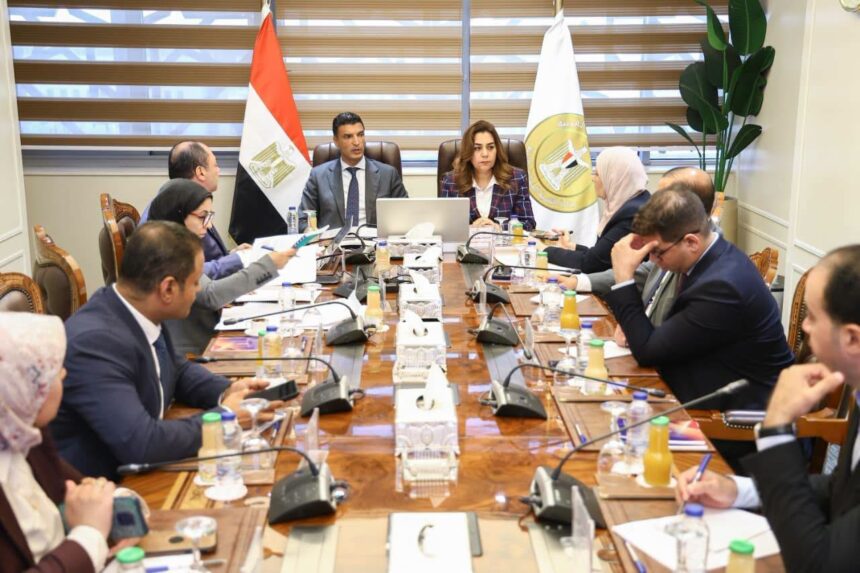
Egyptian Minister of Local Development and Environment Manal Awad and Minister of Industry Khaled Hashem held a meeting with Amr Abdel Moneim, Chairperson of the Upper Egypt Development Authority, to discuss mechanisms for supporting the authority’s industrial and development projects across Upper Egypt.
The meeting was attended by Nahed Youssef, Chairperson of the Industrial Development Authority, and Saeed Abdel Khalek, Head of the Integrated Planning and Local Development Sector.
During the meeting, Abdel Moneim presented an overview of the factories and industrial complexes being developed by the Upper Egypt Development Authority across several governorates. The projects span a range of export-oriented food-processing industries and are being implemented in partnership with private investors in sectors including date production, dairy processing, onion dehydration and pomegranate concentrate manufacturing.
He highlighted the need to expedite approvals and licensing procedures through the Industrial Development Authority, including operating licences, to accelerate project implementation, create employment opportunities for residents of Upper Egypt and increase foreign currency earnings through exports.
Awad reaffirmed the ministry’s commitment to supporting the Upper Egypt Development Authority and other relevant institutions in advancing comprehensive and sustainable development across the region, contributing to improved quality of life, economic growth, job creation and higher living standards, in line with the president’s directives.
She instructed the ministry’s relevant departments to maintain close coordination with the Upper Egypt Development Authority, the Ministry of Industry and the concerned governorates to remove obstacles facing the authority’s projects and accelerate their implementation.
Awad added that these efforts aim to maximise the benefits of Upper Egypt’s competitive advantages, local resources and human and natural assets, while supporting economic clusters, agro-industrial development and manufacturing, creating employment opportunities and improving living standards.
The meeting also included a presentation on the authority’s efforts to establish small handicraft complexes in villages across Upper Egypt. The projects are designed to create employment opportunities for women in partnership with the National Council for Women while producing traditional handicrafts and heritage products.
Abdel Moneim also announced that the authority will organise the Upper Egypt Bazaar in August under the patronage of the prime minister, inviting both the Minister of Local Development and Environment and the Minister of Industry to attend the opening ceremony.
The bazaar forms part of the government’s efforts to support small-scale producers and women artisans by providing marketing opportunities through exhibitions and bazaars across the governorates, helping them expand their businesses, create jobs and promote women’s economic empowerment.
The ministers also reviewed the latest preparations and coordination efforts between their ministries and other government entities ahead of the launch of the Productive Village initiative. Discussions covered the findings of field visits carried out by joint working groups to inspect sites and facilities in several villages, as well as progress in resolving obstacles facing a number of industrial zones under governorate administration, including infrastructure-related challenges, with the aim of supporting industrial development and creating employment opportunities.
For his part, Hashem stressed that the Egyptian government attaches great importance to the development of Upper Egypt, placing the region and its young people among the country’s highest priorities during the current phase.
He said development efforts are being pursued through an integrated approach that combines industrial support, skills development and the promotion of productive and handicraft activities, enabling greater utilisation of Upper Egypt’s economic and human resources while creating new employment opportunities.
Hashem added that the Ministry of Industry is working closely with relevant authorities to monitor the implementation of industrial and handicraft complexes established by the Upper Egypt Development Authority, review licensing procedures and address implementation challenges to accelerate project delivery.
He noted that these efforts complement the Productive Village initiative, which aims to support production-oriented villages by linking local skills with industrial and handicraft activities, while also developing traditional crafts and skills centres to preserve Egypt’s heritage industries and enhance the economic value of their products.
Hashem further stressed that traditional handicrafts represent one of the key pillars of economic development in Upper Egypt, given their historical and cultural significance and their ability to generate sustainable employment, particularly for women and young people.
He said supporting traditional skills development centres helps build human capital, improve product quality and strengthen market access, thereby increasing the contribution of handicraft industries to household incomes and local economic development, in line with the state’s vision of maximising the value of each governorate’s resources and comparative advantages.


