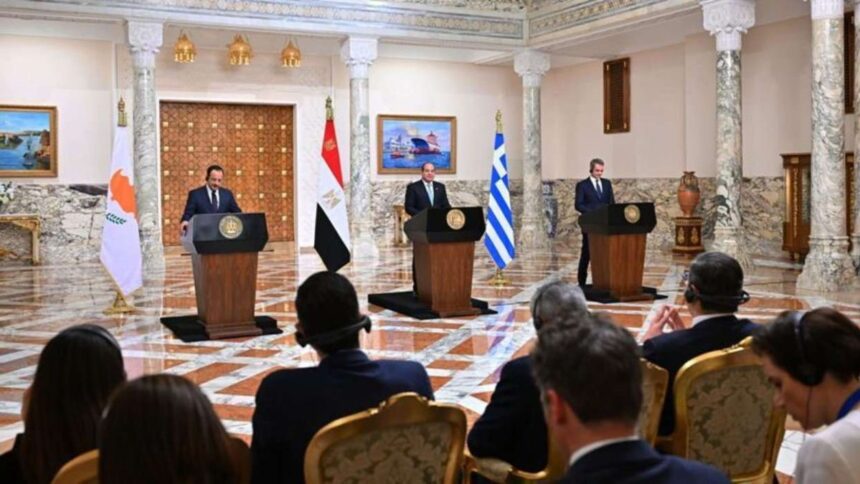
Egyptian President Abdel Fattah Al-Sisi, Cypriot President Nikos Christodoulides, and Greek Prime Minister Kyriakos Mitsotakis convened for a trilateral summit in Alamein on Tuesday, focusing on deepening energy cooperation, strengthening regional security, and addressing escalating conflicts in the Middle East.
In a joint declaration concluding the summit, the three leaders reaffirmed their commitment to the trilateral cooperation mechanism—established in Cairo in November 2014—as a successful model for regional integration. They agreed to activate a permanent secretariat for the mechanism, to be based in Nicosia, Cyprus.
Sisi stated during a joint press conference that energy remains at the forefront of the tripartite relationship. The leaders expressed their intent to advance electricity interconnection projects, particularly the GREGY interconnector between Egypt and Greece, which aims to link the Eastern Mediterranean with European markets.
The summit also highlighted strategic cooperation in natural gas. The leaders called for the swift completion of plans to link Cypriot gas fields with Egyptian infrastructure for liquefaction and re-export to Europe, describing it as a vital step for regional and European energy security.
Beyond energy, the talks explored avenues to enhance economic, commercial, and investment ties. Sisi highlighted investment opportunities in Egypt across sectors including information technology, tourism, industry, health, education, and construction. The leaders also agreed to expand cooperation on regular migration, facilitating organised employment opportunities for Egyptian workers in Greece and Cyprus under relevant bilateral agreements.
Addressing regional stability, the three nations emphasised the need to de-escalate tensions in the Middle East. They reaffirmed their firm support for a two-state solution to the Israeli-Palestinian conflict, calling for the establishment of an independent Palestinian state on the June 4, 1967 borders with East Jerusalem as its capital.
The joint declaration expressed deep concern over the humanitarian situation in Gaza, urging the safe, rapid, and large-scale delivery of aid. The leaders backed advancing the second phase of President Donald Trump’s comprehensive plan to end the conflict and UN Security Council Resolution 2803 to facilitate early recovery and reconstruction in the enclave. They also rejected any attempts to forcibly displace the Palestinian population or sever the geographic connection between the West Bank and Gaza.
On Lebanon, the leaders called for the full implementation of UN Security Council Resolution 1701, the cessation of attacks, and the withdrawal of Israeli forces from Lebanese territory. They stressed the importance of strengthening Lebanese state institutions, primarily the Armed Forces.
The summit also addressed the situation in Libya, with the leaders reiterating their support for a Libyan-led political process without foreign interference and the withdrawal of all foreign forces and mercenaries.
Regarding Egypt’s water security, Greece and Cyprus voiced their support for Cairo’s position on the Nile waters, which Sisi described as an existential issue and a matter of national security. The joint declaration stressed the need for full compliance with international law regarding the Ethiopian dam, affirming the principles of “no harm,” prior notification, and the avoidance of unilateral actions.
Before the tripartite summit, Sisi held separate bilateral talks with Mitsotakis. According to the Egyptian presidency, the two leaders discussed bilateral cooperation in tourism, transport, and technology, alongside regional developments, including the situations in Libya, Syria, and Lebanon, and the necessity of maintaining freedom of navigation in international maritime corridors.