

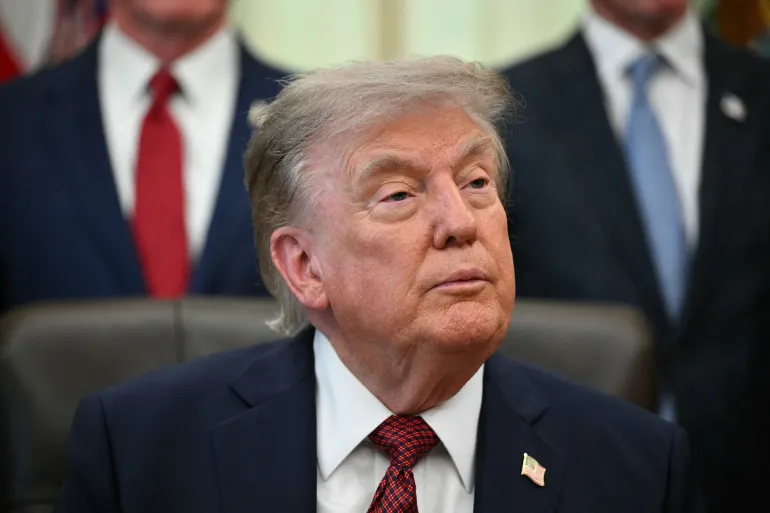
Egypt and Jordan on Tuesday called for an immediate halt to military escalation and renewed their support for political and diplomatic solutions, as US President Donald Trump warned that Washington could resume military action against Iran if negotiations failed and said the United States was enforcing a powerful naval blockade.
The Egyptian and Jordanian position was outlined during a telephone call between Egyptian Foreign Minister Badr Abdelatty and Jordanian Foreign Minister Ayman Safadi, held as part of ongoing consultations on regional developments.
According to Egypt’s Foreign Ministry, the two ministers condemned continued Israeli violations in the occupied West Bank, Gaza Strip, and East Jerusalem. They stressed the importance of consolidating the ceasefire, ensuring the uninterrupted delivery of humanitarian aid, and advancing the next phases of the US-backed peace plan for Gaza.
The ministers also discussed the broader regional situation and warned against further military escalation that could widen the conflict. Abdelatty reaffirmed Egypt’s full solidarity with Jordan and reiterated Cairo’s rejection of any threat to the kingdom’s sovereignty, security, or stability.
Separately, Gulf Cooperation Council foreign ministers held a virtual consultative meeting to discuss ongoing diplomatic efforts, regional de-escalation, and the security of navigation through the Strait of Hormuz. The ministers called for enhanced regional coordination, confidence-building measures, and political solutions acceptable to all parties.
In an interview with Fox News, Trump said the United States had held “good talks” with Iran and that reaching an agreement would be preferable to launching further attacks. However, he warned that Washington remained prepared to resume military operations if Tehran failed to reach a deal.
Trump said the United States had significantly degraded Iran’s air defences, naval capabilities, and military infrastructure, and claimed it was enforcing a naval blockade that no vessel could penetrate. He added that while Washington wanted to avoid targeting Iranian power stations and bridges because of the potential humanitarian consequences, those options remained under consideration.
Iran responded by warning that any country or company receiving frozen Iranian assets as compensation for vessels damaged during the conflict would be prohibited from transiting the Strait of Hormuz. Iran’s Khatam al-Anbiya Central Headquarters also rejected Trump’s proposal to use frozen Iranian funds to compensate affected shipping companies.
Meanwhile, sources told Reuters that Oman had presented Tehran with a proposal to establish a joint regional mechanism for managing navigation through the Strait of Hormuz, including voluntary transit fees and limits on Iran’s unilateral control over the strategic waterway. A senior Iranian official said Tehran had yet to respond to the proposal.
Iranian Foreign Minister Abbas Araghchi held separate telephone conversations with his Omani and Saudi counterparts to discuss diplomatic efforts aimed at restoring stability and ensuring the security of navigation in the strait, which Tehran said had been undermined by recent US military actions.
Elsewhere, Jordan’s armed forces said they had intercepted and shot down a drone that entered the kingdom’s airspace over the eastern desert.
The Arab Parliament also condemned drone attacks targeting Saudi Arabia, describing them as a serious violation of the kingdom’s sovereignty and a threat to regional security and stability.
A consultancy report said Saudi Aramco had shut down its 400,000-barrel-per-day Jazan refinery after an attack damaged parts of the facility, with preliminary operations expected to resume by August 15.
In Iraq, a joint committee began investigating Saudi allegations that drones targeting the kingdom had been launched from Iraqi territory. Separately, drones targeted Erbil, where local media reported that aircraft from the US-led coalition intercepted several before they reached the vicinity of the US consulate.
Iran’s government said Bushehr Airport had been completely disabled by recent US strikes and that a newly acquired passenger aircraft had been destroyed in the attacks.
Israeli Defence Minister Israel Katz said US fighter jets were taking off from Israel to conduct strikes against Iran. He added that Israel sought to target Iranian energy infrastructure but that Washington was not currently authorising such operations.