

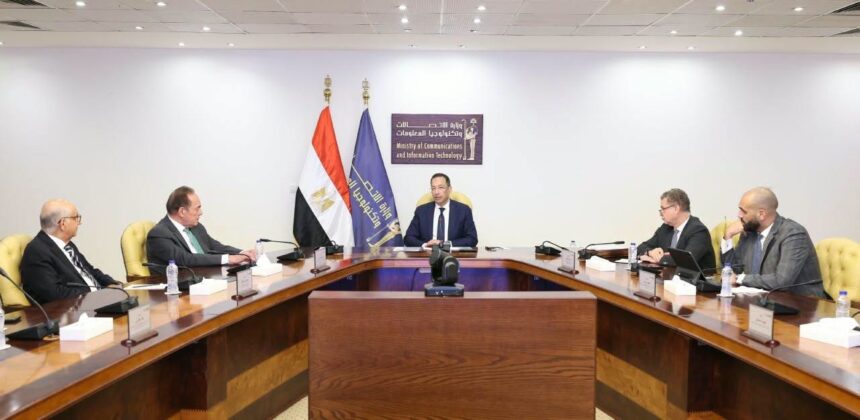
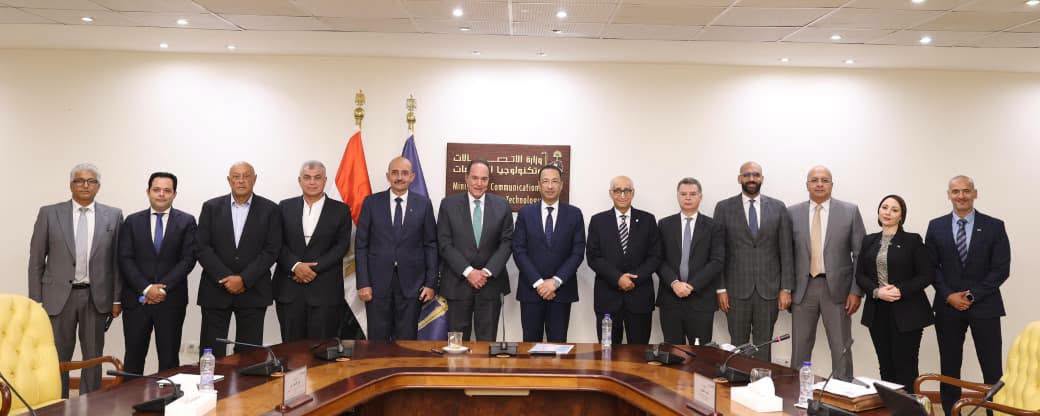
Minister of Communications and Information Technology Raafat Hendy held an extensive meeting with a delegation from the Egyptian Businessmen’s Association, headed by Fathallah Fawzy, the association’s Vice-Chairperson and Chairperson of its Real Estate Development and Contracting Committee.
The meeting was attended by Ahmed El-Zaher, CEO of the Information Technology Industry Development Agency (ITIDA), and Mahmoud Badawy, Assistant Minister of Communications and Information Technology for Digital Transformation Affairs.
Discussions focused on ways to strengthen cooperation and expand areas of partnership between the ministry and the association, explore investment opportunities in the outsourcing industry, and review a number of digital transformation projects.
During the meeting, Hendy said around 245 digital services have so far been made available through the Digital Egypt platform, with the ministry aiming to increase the number to more than 400 services by 2030.
He also pointed to the launch of the Digital Identity platform, which enables citizens to complete transactions requiring personal identity verification, such as powers of attorney and notarisation, entirely electronically without having to visit government offices in person.
Hendy said mobile phone production in Egypt increased from 3 million handsets in 2024 to around 10 million in 2025, with production targeted to rise to between 14 million and 15 million handsets this year. This would cover most domestic demand, estimated at around 18 million to 20 million handsets, while paving the way for exports.
He added that the ministry continues to increase the number of beneficiaries of its digital training and capacity-building initiatives targeting all age groups and areas of specialisation, with the aim of preparing young professionals for the domestic and international labour markets.
Hendy also pointed to the launch of innovative Egyptian applications using artificial intelligence technologies to support “digital sovereignty”. These include the Karnak Chat application, as well as the BelMasry system, which enables text-to-speech and speech-to-text conversion in Arabic and Egyptian colloquial Arabic across 50 international languages, and the Loghat application for learning English.
Regarding efforts to develop telecommunications infrastructure, Hendy said the ministry is continuing to implement a plan to expand fibre-optic network coverage across Egypt’s governorates, alongside projects to extend fibre-optic cables to villages covered by the presidential Hayah Karima initiative.
He added that preparations are under way to launch an integrated data centre strategy by the end of this year, in cooperation with relevant ministries and authorities, stressing that cybersecurity remains one of the ministry’s top priorities to protect the country’s digital systems and infrastructure and safeguard the gains of Egypt’s digital transformation.
Hendy said outsourcing industry exports grew to $5.1bn by the end of 2025, adding that the ministry aims to increase outsourcing exports to $8bn by 2028.
He said the outsourcing industry offers promising investment opportunities amid growing interest from global outsourcing companies in expanding their operations in Egypt.
For his part, ITIDA CEO Ahmed El-Zaher said Egypt’s outsourcing industry is witnessing rapid and broad-based growth, with the number of people employed in the sector rising from around 90,000 professionals in 2021 to more than 195,000 at present.
He said the figures reflect the significant development the industry has undergone in recent years, with plans to build on this momentum and achieve higher growth rates in the coming period.
El-Zaher said ITIDA works with local and international companies engaged in the export of outsourcing services through cooperation agreements aimed at expanding their operations and increasing employment. The most recent agreements were signed with 55 global companies and aim to create around 75,000 new jobs.
He added that growth in Egypt’s outsourcing industry is not concentrated solely in Cairo but extends across the country’s governorates, allowing companies to access a broader pool of skilled professionals and talent while supporting a wider geographical distribution of jobs and investment associated with the industry.
During the meeting, officials also reviewed the National Real Estate Identification Number system as part of newly introduced digital mechanisms aimed at protecting state assets and facilitating the provision of services to citizens.
Mahmoud Badawy, Assistant Minister of Communications and Information Technology for Digital Transformation Affairs, said the National Real Estate Identification Number Law assigns every property, residential unit or plot of land in Egypt a unique and standardised identification code, preventing duplicate transactions and ensuring the integrity of ownership records.
He added that the ministry has already succeeded in generating national identification numbers for all buildings across Egypt, as well as covering a large proportion of real estate units nationwide by linking the system with utility data.
Members of the Egyptian Businessmen’s Association delegation praised the leading and pivotal role played by the Ministry of Communications and Information Technology in delivering significant advances in the country’s digital infrastructure.
They said the ministry’s role is not limited to managing the telecommunications sector but extends to leading the integration of technology across government bodies and institutions, paving the way for the elimination of paper-based transactions and facilitating the business environment.
The delegation also praised the government coordination overseen by the Communications Ministry to connect all relevant authorities through a single digital window, helping eliminate bureaucracy and protect the rights of both developers and investors.


