

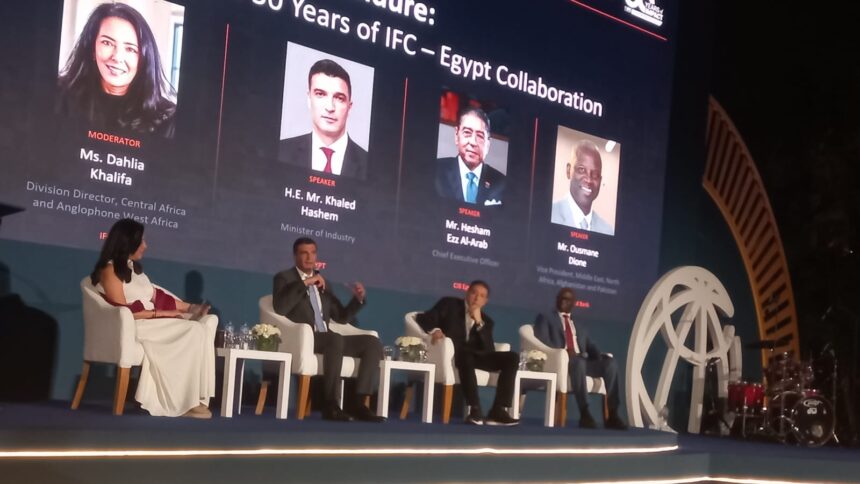
Egypt aims to become one of the top five players globally across seven shortlisted industrial sectors by 2035 through deep integration into global supply chains, the country’s industry minister announced during an event marking 50 years of collaboration with the World Bank Group.
Khaled Hashem, Minister of Industry, stated that the government’s strategy is shifting away from merely reducing imports towards targeted industrial integration based on scientific criteria. He emphasised a focus on technology, know-how, and high-quality human capital over traditional foreign direct investment. “The private sector is the key solution for all our problems; it is the most efficient and fastest vehicle for transformation,” Hashem said, adding that he wants to see more artificial intelligence and the Internet of Things implemented within the industrial sector.
The panel discussion highlighted the historic relationship between Egypt and the International Finance Corporation (IFC), which has contributed approximately $10bn in mobilised financing over the past 50 years, including through public-private partnerships.
Ousmane Dione, Vice President for the Middle East and North Africa at the World Bank—who previously oversaw a nearly $18bn portfolio as country director for Eritrea, Ethiopia, South Sudan, and Sudan—outlined a unified platform strategy for future growth. Dione stated that the International Bank for Reconstruction and Development (IBRD) will focus on upstream policy reforms and asset monetisation, while the IFC translates those reforms into bankable transactions and the Multilateral Investment Guarantee Agency (MIGA) provides guarantees. Dione identified strengthening sector confidence, mobilising long-term capital, and accelerating the climate transition as the most binding constraints to Egypt’s next phase of transformation. Summarising his vision for the next 50 years, Dione used the acronym “EGYPT” to stand for “Eagerness for Growth Yielding Prosperity and Transformation for all Egyptians”.
Addressing the financial sector, Hesham Ezz Al-Arab, Chief Executive Officer of CIB Egypt, detailed his institution’s 25-year relationship with the IFC. The IFC was a shareholder when CIB was first listed on the stock exchange and returned as an investor in 2005 following the privatisation of remaining government holdings. Ezz Al-Arab noted a strategic shift from financial inclusion to financial empowerment, stating that CIB has exceeded the regulatory requirement of dedicating 25% of its loan portfolio to small and medium-sized enterprises (SMEs) by targeting youth and women. Looking ahead, Ezz Al-Arab identified Africa as the single boldest opportunity for Egypt’s private sector.
A closing speaker reflected on the long-term impact of the 50-year partnership, noting that early policy conversations about feed-in tariffs laid the groundwork for the Benban solar installation, while the establishment of a credit bureau helped drive Egypt’s financial inclusion rates from 27% to over 76%. With up to 1.3m young Egyptians entering the labour market annually, the speaker called for large-scale mobilisation from the international donor community to support the country’s demographic dividend. “The question is not whether Egypt is ready; the question is how fast we can move together to meet it,” the speaker concluded.


