

U.S. President Donald Trump said that “Tuesday is Iran’s deadline,” adding that the conflict could end “very quickly” if Tehran complies with U.S. demands, while reiterating that the central objective remains preventing Iran from acquiring a nuclear weapon.
Trump noted that U.S. officials, including special envoy Steve Witkoff and Jared Kushner, are engaged in ongoing talks with Iranian counterparts, with Vice President J.D. Vance potentially joining the discussions, even as military operations continue and signs of further escalation intensify.
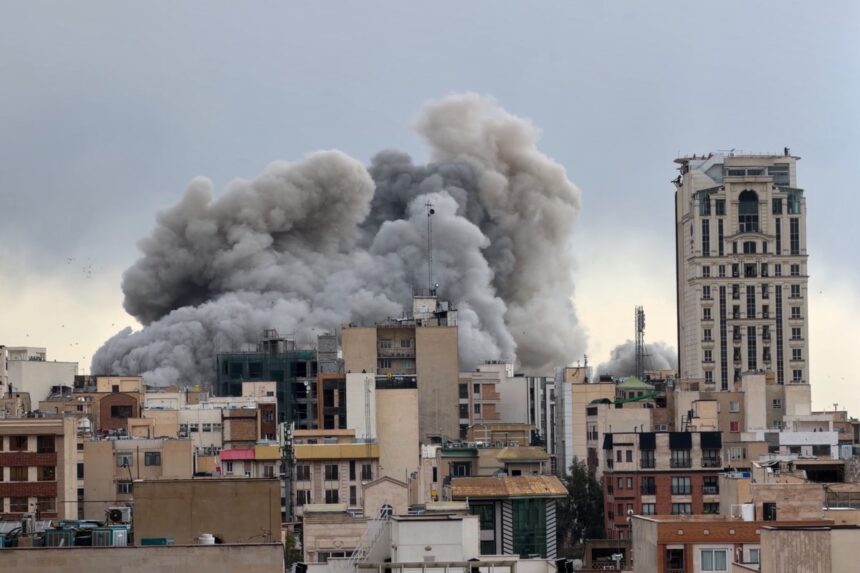
On the ground, Israel said it had killed Asghar Bagheri, identified as the commander of a special operations unit within Iran’s Quds Force, in a strike on Tehran. The Israeli military said he had coordinated operations against Israeli and U.S. targets, though there was no independent confirmation from Iran.
Israeli Defence Minister Israel Katz said the military had struck the South Pars petrochemical complex in Assaluyeh and ordered continued attacks on what he described as Iran’s “national infrastructure”. Iranian media reported explosions at the site.
In a sensitive development, the International Atomic Energy Agency said it had detected signs of recent strikes near Iran’s Bushehr nuclear power plant, but confirmed that the facility itself was not damaged. It added that one strike occurred approximately 75 metres from the plant’s perimeter.
Israeli media reported that two missiles were launched from Iran towards Tel Aviv, with debris falling across dozens of locations. Emergency services said one person was injured, while other reports cited additional casualties and damage at around 20 sites.
Further reports indicated that air defence systems intercepted drones entering Israeli airspace from the east, although their origin remained unclear.
Iran’s Islamic Revolutionary Guard Corps (IRGC) said they had downed advanced drones, including an MQ-9, and destroyed a U.S. cruise missile—claims that could not be independently verified. An Iranian military spokesperson said Tehran aims to push its “enemy” to a “point of regret” in order to reinforce deterrence.
The escalation has widened across the Gulf. The UAE said it intercepted 12 ballistic missiles, two cruise missiles and 19 drones, while Kuwait reported dealing with 14 ballistic missiles and 46 drones within 24 hours, with injuries caused by falling debris. In Jordan, a missile and a drone strike resulted in two injuries and material damage.
Highlighting ongoing risks to maritime trade, Turkey said a Turkish vessel had safely crossed the Strait of Hormuz, even as the number of Turkish ships in the area declined amid mounting concerns over threats to energy supplies and shipping routes.
Inside Iran, the IRGC said their intelligence chief was killed in U.S.-Israeli strikes, while local officials reported that nine people, including four children, were killed in an attack on a residential area near Tehran.
Meanwhile, Reuters cited a source as saying that Iran and the United States had received a two-stage proposal to end the conflict, beginning with an immediate ceasefire followed by a comprehensive agreement that could pave the way for reopening the Strait of Hormuz. There was no immediate official comment from either side.


