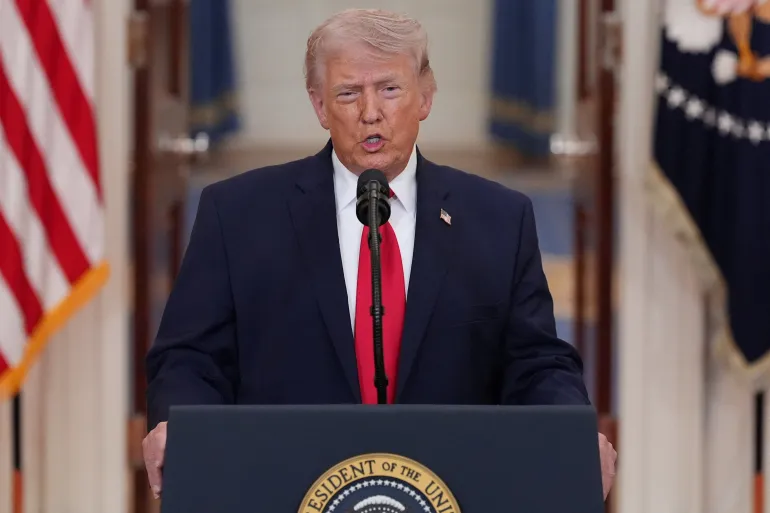
U.S. President Donald Trump escalated his rhetoric against Iran on Sunday, warning that power plants and bridges could be targeted if Tehran continues to keep the Strait of Hormuz closed, as concerns mounted over a wider regional spillover and Egypt stepped up diplomatic efforts to contain the crisis.
In a post on Truth Social, Trump said Tuesday would be “Power Plant Day” and “Bridge Day” for Iran, demanding the reopening of the strait. The remarks mark the latest escalation more than five weeks into the conflict. He also reiterated praise for the reported rescue of a U.S. crew member from a downed warplane in Iran, an incident described differently by Washington and Tehran.
The Islamic Revolutionary Guard Corps said on Sunday it had targeted petrochemical facilities in the United Arab Emirates, Kuwait and Bahrain, warning of further attacks on U.S. economic interests across the region if strikes on what it describes as civilian sites inside Iran persist. According to Reuters, Bahrain’s Gulf Petrochemical Industries Company reported a fire in some operating units following an Iranian drone strike, which was later contained without injuries. Other reports suggested broader damage to Gulf facilities, though these could not be independently verified.
The developments highlight growing risks to critical infrastructure across the Gulf. Qatar had earlier warned against targeting energy and water facilities, as well as the broader implications for shipping security and global energy flows. Separate reports indicated that both the UAE and Bahrain issued alerts on Sunday over incoming missile and drone threats.
In Israel, the health ministry said the number of people evacuated to hospitals since the war began on Feb. 28 had risen to 6,833, including 108 in the past 24 hours, while local media reported Iranian missile strikes in the south.
In Iran, state news agency IRNA said U.S.-Israeli strikes had hit Ahvaz airport in the southwest. A government spokeswoman added that the conflict had damaged tens of thousands of housing units, as well as hundreds of health centres, schools and universities. Reuters said it could not independently verify the full extent of the reported damage or several competing claims from both sides.
On the diplomatic front, Egypt intensified its engagement. The Ministry of Foreign Affairs said Foreign Minister Badr Abdelatty held a series of calls with U.S. envoy Steve Witkoff, alongside counterparts in Gulf states, Turkey, Pakistan and Iran, as well as the head of the International Atomic Energy Agency.
According to Reuters, Egypt is pushing for de-escalation amid mounting concern over the potential economic and geopolitical fallout, including risks to energy security and global shipping routes.