

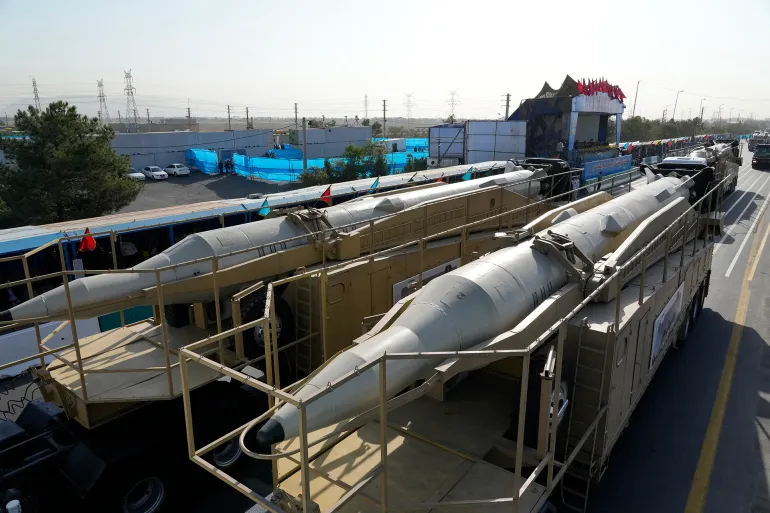
The military confrontation involving the United States and Israel on one side and Iran on the other entered its 17th day, with missile strikes and air raids intensifying across the region and raising international concern over the potential impact on Gulf security and global energy supplies.
Iran’s Islamic Revolutionary Guard Corps (IRGC) said it launched a new round of missile attacks on Israel as part of the 55th wave of “Operation True Promise 4.” The group also claimed it targeted U.S. military facilities at Al Dhafra Air Base in the United Arab Emirates and Sheikh Isa Air Base in Bahrain, as well as the U.S. naval base in Naval Support Activity Bahrain.
Israeli media reported that some of the missiles fired by Iran carried cluster munitions, with one causing material damage at eight sites in central Israel. Israel’s Health Ministry said 142 people were admitted to hospitals over the past 24 hours following the attacks.
Fragments from an Iranian missile also struck a house in the town of Shoham near Ben Gurion Airport east of Tel Aviv, causing property damage but no casualties, according to videos circulating on social media. Israeli Channels 12 and 13 reported that cluster-type warheads landed at multiple locations across the greater Tel Aviv area.
In Iran, Agence France-Presse reported hearing powerful explosions in Tehran on Monday, hours after Israel said it had carried out large-scale overnight air strikes. Air defence systems were activated in central Tehran, although the exact targets were not immediately clear.
The Israeli military said it had struck a facility in Tehran that it alleged was being used to develop offensive capabilities targeting satellites.
Meanwhile, United States Central Command said American forces continue to conduct “precision strikes” inside Iran, adding that operations were making progress. The command said U.S. pilots had conducted more than 6,000 combat missions and sorties over Iranian airspace and destroyed a significant number of Iranian warships during the campaign. It also reported that U.S. forces struck 19 military targets on Kharg Island last Friday.
Gulf security concerns intensify
Fears of a widening conflict in the Gulf have grown after several countries reported missile and drone attacks in recent days.
Qatar’s Ministry of Defence said its armed forces intercepted a missile targeting the country, while the Interior Ministry raised the national security threat level to “high,” urging residents to remain indoors temporarily.
Bahrain said it had intercepted and destroyed 129 missiles and 215 drones targeting its territory since what it described as Iranian attacks began on 28 February.
In Saudi Arabia, the Defence Ministry said three drones were intercepted and destroyed over the Riyadh and Eastern regions.
Authorities in Abu Dhabi in the United Arab Emirates reported that a Palestinian national was killed after a missile struck a civilian vehicle in the Al Bahia area. In Dubai, a fire caused by a drone attack near Dubai International Airport was extinguished without casualties. Flights were briefly suspended before airport operations resumed, while police closed several nearby roads.
Energy market concerns
As the conflict intensifies, pressure is mounting on global energy markets amid the continued closure of the Strait of Hormuz, one of the world’s most critical oil shipping routes.
Donald Trump, President of the United States, called on countries that benefit from the waterway to “fight and defend it,” saying military operations inside Iran were progressing “very well.”
The news outlet Axios reported that Trump hopes to announce a coalition of countries later this week aimed at reopening the strait to commercial shipping.
Iran’s Revolutionary Guards warned that any attack on Kharg Island—one of the country’s key oil export terminals—could create a “new and harsh equation” for global energy prices and distribution.
Despite the risks, maritime tracking service MarineTraffic said the first non-Iranian oil tanker had crossed the Strait of Hormuz while broadcasting its tracking signal since the war began on 28 February. The medium-sized tanker Karachi, carrying Das crude from Abu Dhabi, crossed the strait with its Automatic Identification System active, suggesting that some shipments may have been granted negotiated safe passage.
Diplomatic efforts and economic costs
Iranian government spokesperson Fatemeh Mohajerani said more than 61,000 civilian facilities had been damaged by attacks in recent weeks, including over 18,000 residential apartments and commercial shops.
Diplomatically, Qatar and Saudi Arabia renewed their condemnation of Iranian attacks during a phone call between Qatari Prime Minister and Foreign Minister Mohammed bin Abdulrahman Al Thani and his Saudi counterpart.
Qatar’s Foreign Ministry spokesperson Majed Al Ansari said Doha is seeking to help de-escalate tensions in the region, noting that the recent visit of Badr Abdelatty, Egypt’s foreign minister, to Qatar included discussions on diplomatic efforts to contain the crisis.
In Washington, Kevin Hassett, Director of the United States National Economic Council, said the war against Iran had already cost the United States at least $12bn as of Sunday, highlighting the growing economic burden of a conflict that risks escalating into a broader regional confrontation.
