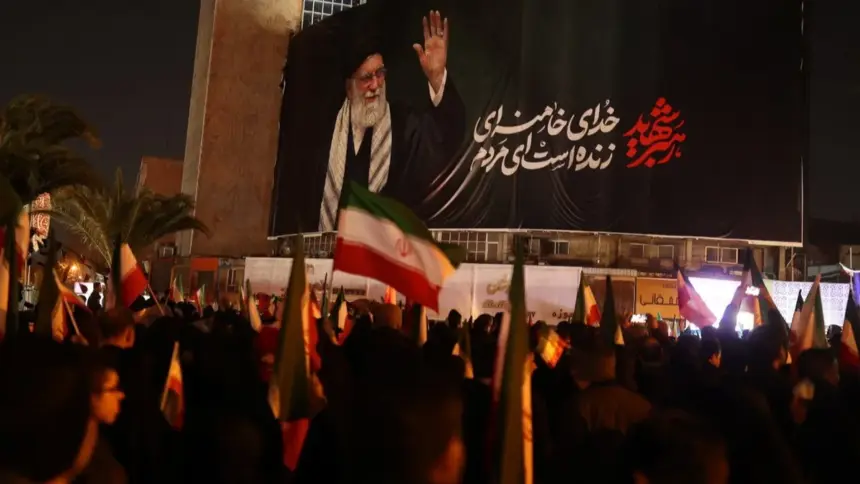
The black flags of mourning have been hoisted over the turquoise domes of Qom, but behind the closed doors of Iran’s administrative halls, the atmosphere is one of frantic calculation rather than quiet grief. For the first time since 1989, the seat of the Supreme Leader sits empty, following the assassination of Ali Khamenei in a series of coordinated American and Israeli air strikes. The vacuum left by the man who served as the ultimate arbiter of Iranian life for over three decades has plunged the Islamic Republic into a constitutional and existential crossroads.
As smoke cleared from the sites of the strikes, a temporary leadership council was hastily convened. President Masoud Pezeshkian, alongside Guardian Council member Alireza Arafi and Judiciary Chief Gholamhossein Mohseni-Ejei, now holds the reins of a nation under fire. This triumvirate faces the unenviable task of maintaining internal stability while foreign munitions continue to degrade the country’s military infrastructure, leaving the future of the 1979 Revolution hanging in the balance.
The sudden removal of the pivot around which Iranian theocracy has turned for 35 years comes at a moment of unprecedented military vulnerability, forcing a transition that will either solidify the hardline “Velayat-e Faqih” system or see it succumb to internal fractures. With the Assembly of Experts required to name a successor within three months, the choice of the next Supreme Leader is no longer just a theological debate; it is a battle for the survival of the state itself.
The Constitutional Mandate and the Assembly of Experts
The Iranian political system, established by Ruhollah Khomeini, operates on the principle of Velayat-e Faqih(Guardianship of the Jurist). This doctrine dictates that until the return of the “Hidden Imam,” supreme authority must be exercised by a high-ranking cleric. This individual wields constitutional power over the presidency, the parliament, and the armed forces.
The responsibility for filling this role falls to the Assembly of Experts, a body of approximately 90 senior clerics elected every eight years. However, the current military environment complicates this process. “With ongoing strikes and the disruption of communication lines, it remains unclear how or when the Assembly can safely convene to deliberate,” noted one regional analyst.
While Khamenei never publicly designated a successor, the influence of seasoned power brokers like Ali Larijani—a veteran advisor to the late leader—is expected to be decisive. Larijani is widely regarded as the ultimate “kingmaker” in Tehran, possessing the political capital to bridge the gap between the clerical establishment and the security apparatus.
Candidates for the Supreme Leadership: Reformists vs Hardliners
The list of potential successors has been dramatically thinned by recent events. For years, Mojtaba Khamenei, the late leader’s son, was whispered to be a primary contender. However, his standing is now shrouded in uncertainty following the confirmed death of his wife in an air strike in Iraq on Saturday. With no confirmed reports on Mojtaba’s own condition, the spotlight has shifted to other figures.
- Hassan Khomeini:The grandson of the revolution’s founder, Hassan Khomeini, has emerged as a significant possibility. Closely aligned with reformist factions that have sought to modernise Iran’s stance, he is viewed by some as a figure capable of tempering Western hostility and placating a domestic population increasingly disillusioned with the clerical status quo.
- The Hardline Guard:In contrast, Alireza Arafi and Gholamhossein Mohseni-Ejei represent the “Old Guard.” Mohseni-Ejei, in particular, carries a reputation for iron-fisted governance, having overseen the suppression of the 2009 election protests during his tenure as Intelligence Minister.
- The Outsiders:Other influential figures include Ahmad Alamolhoda and Mohsen Araki, both high-ranking hardliners within the Assembly. Conversely, former President Hassan Rouhani, though a senior cleric, remains distrusted by the influential hardline factions that control the vetting process.
The Diminishing Shadow of the IRGC
Historically, the Islamic Revolutionary Guard Corps (IRGC) was expected to be the silent hand directing the succession. Unlike the regular military, the IRGC reports directly to the Supreme Leader and controls a massive economic empire such as the Khatam al-Anbiya construction firm.
However, the IRGC’s ability to influence the transition has been severely compromised. Years of targeted strikes have decimated its leadership, starting with the 2020 killing of Qasem Soleimani and culminating in the death of IRGC commander Mohammad Pakpour this past Saturday.
With its top brass depleted, the IRGC may focus more on preserving its economic interests and internal security through the Basij paramilitary forces rather than dictating the theological direction of the next Leader. The loss of Pakpour and other senior officers during the brief “Summer War” has left the organisation’s hierarchical structure in disarray.
Public Disillusionment and the Road Ahead
While the clerical elite debates the future of the Velayat-e Faqih, the Iranian public appears increasingly detached from the process. Although early revolutionary periods saw high voter turnout, participation in recent elections has plummeted. The Guardian Council’s rigorous vetting process ensures that only those loyal to the core tenets of the regime can run for office, a reality that has alienated many younger Iranians.
President Pezeshkian, though a member of the temporary leadership council and a noted moderate, remains constrained by the very system he now helps manage. Whether he can leverage this transitional period to push for broader institutional change remains a point of intense speculation among diplomats.
As the 90-day constitutional clock ticks down, the “Deep Dive” into Iran’s future reveals a nation at its most fragile. The next Supreme Leader will inherit not just a title, but a country reeling from military losses, economic sanctions, and a deepening rift between the mosque and the street. The decision made by the Assembly of Experts in the coming weeks will determine whether the Islamic Republic can evolve, or if the death of Ali Khamenei marks the beginning of the end for the system he spent 35 years defending.