

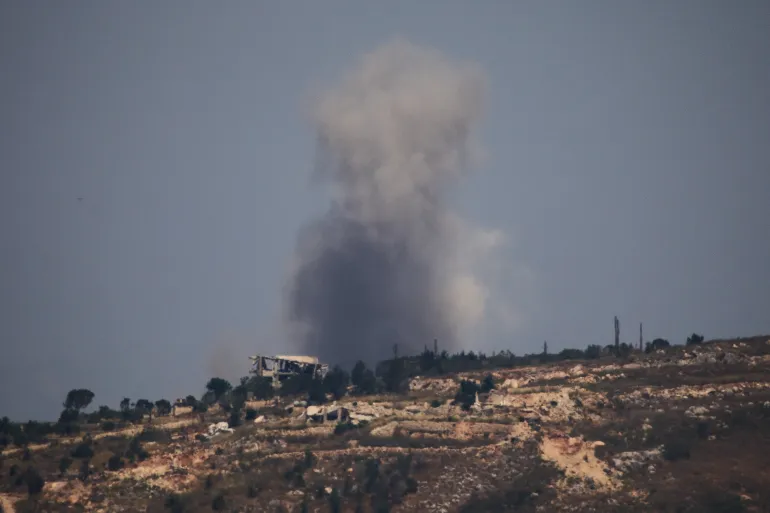
Tensions along the Lebanese-Israeli border escalated sharply on Tuesday as Israeli military operations continued in southern Lebanon and both Israel and Hezbollah exchanged threats, prompting intensified international diplomatic efforts to preserve the ceasefire and prevent a broader regional confrontation that could jeopardise ongoing negotiations between Iran and the United States.
Lebanon’s Ministry of Public Health said the cumulative death toll from Israeli military operations since 2 March has reached 3,468, with 10,577 people injured.
The ministry also reported that Israeli strikes near Jabal Amel Hospital in the southern city of Tyre on Monday killed four people and wounded 127 others, including 39 members of the hospital’s medical, nursing, and administrative staff.
According to the ministry, those injured included four doctors, 27 nurses, and eight employees, four of whom remain in critical condition. The strikes caused extensive damage to the hospital’s facilities and parking areas.
The ministry commended the hospital’s management and staff for continuing to provide medical services despite the attack, describing the strike as a further violation of international law and humanitarian norms.
Meanwhile, Hezbollah said in a series of statements that it had targeted three Israeli Namera armoured vehicles and a Merkava tank near the southeastern outskirts of the town of Zawtar al-Sharqiya using armed drones.
The developments came as Israeli Defence Minister Israel Katz issued a stark warning, stating that the United States had endorsed what he described as a “new equation” under which Israel would strike Beirut’s southern suburbs if attacks on northern Israeli communities continued.
Katz said the Israeli military would maintain its operations in southern Lebanon under all circumstances and was considering additional military measures. He added that Israel’s long-term objective remained the disarmament of Hezbollah, while its immediate goal was the removal of weapons from areas south of the Litani River.
According to the Israeli Defence Ministry, Katz said the Lebanese government had been informed of this policy and that the coming days would determine whether cross-border attacks cease or whether Israel expands its operations to include Beirut’s southern suburbs, Hezbollah’s principal stronghold.
Israeli Prime Minister Benjamin Netanyahu also escalated rhetoric toward Iran, stating that the eventual end of the Iranian regime would remove a major threat to Israel. He added that Iran would no longer be able to threaten Israel with nuclear weapons or ballistic missiles.
On the Lebanese side, President Joseph Aoun stressed the importance of preserving civil peace and preventing internal strife, warning that any attempt to inflame sectarian tensions would ultimately serve Israel’s interests.
Aoun said Lebanon had paid a heavy price during the conflict, citing more than 3,000 deaths, the displacement of over one million people, and the destruction of thousands of homes. He argued that Lebanon had no alternative but to pursue negotiations aimed at ending the crisis.
“The true strength is not in waging war, but in having the courage and wisdom to end it through negotiation,” Aoun said.
International concern over the situation continued to grow. French Foreign Minister Jean-Noël Barrot said there was “nothing that could justify” the continuation of military operations or a prolonged Israeli presence in Lebanon. He expressed hope that planned talks between the Lebanese and Israeli governments later this week would proceed under favourable conditions.
German Chancellor Friedrich Merz also warned that the escalation had reached an extremely dangerous level, urging all parties to continue negotiations and pursue de-escalation.
At the United Nations, Secretary-General António Guterres stressed the need to maintain a UN military presence in Lebanon after the current mandate of the United Nations Interim Force in Lebanon (UNIFIL) expires at the end of 2026. In a report submitted to the Security Council, Guterres argued that the peacekeeping mission remains essential to preserving stability in southern Lebanon.
In a related development, sources in Tehran said the Lebanese file and efforts to preserve the ceasefire have become a central issue in ongoing negotiations between Iran and the United States.
The diplomatic activity follows warnings from Iran’s Khatam al-Anbiya military headquarters, which threatened direct action against Israel if attacks on Beirut and its southern suburbs continue. International mediation efforts led by Qatar and Pakistan are reportedly underway to prevent further deterioration.
Turkish Foreign Minister Hakan Fidan, speaking to Bloomberg, said Ankara was supporting mediation efforts between Tehran and Washington and warned that Israeli escalation in Lebanon could jeopardise the negotiations.
Fidan said both the United States and Iran appeared committed to extending the ceasefire and preserving regional stability, but expressed uncertainty regarding Israel’s intentions.

