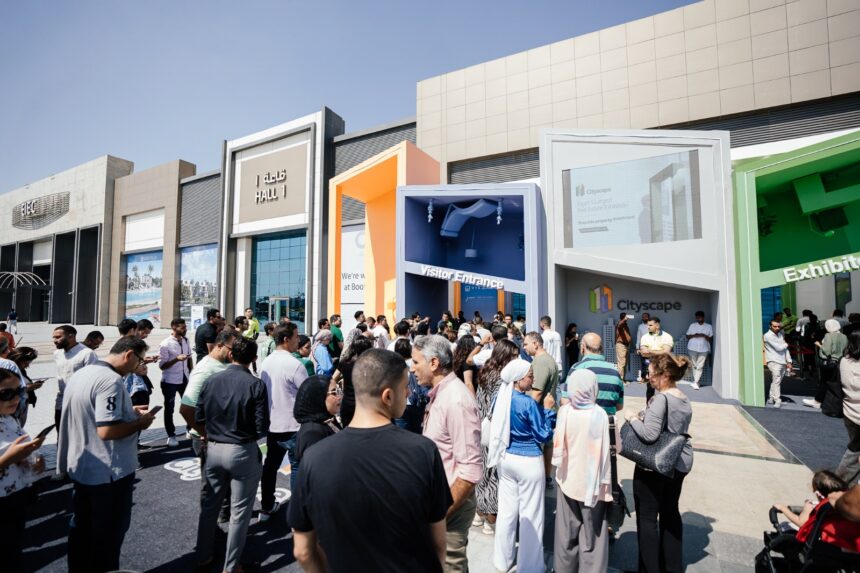
The decision to replace Cityscape Egypt’s 2026 real estate exhibition with a one-day forum has raised questions over whether the move reflects a broader shift in the Egyptian property market, as developers reassess marketing spending, sales strategies, and investment priorities amid rising costs and growing pressure to execute and deliver projects.
The organiser said the 2026 exhibition would not be held in its traditional format following consultations with key partners and stakeholders and in light of the complexities facing the Egyptian real estate market. Instead, Cityscape Egypt Forum is scheduled for November 16, while the full exhibition is set to return from September 29 to October 2, 2027.
While the decision does not amount to the end of Cityscape Egypt, the limited participation of developers in the planned 2026 edition has drawn attention to changing attitudes towards large-scale property exhibitions.
Market sources cited by local media said fewer than 40 companies were expected to participate, with several major developers absent. The reduced participation also reportedly resulted in a smaller exhibition footprint compared with previous editions.
For developers, the question increasingly appears to be one of return on investment. Exhibition participation involves not only the cost of renting exhibition space, but also spending on booth construction, staffing, marketing, promotions, and sales operations.
Alaa Fikry, first vice chairperson of the Real Estate Development Committee at the Egyptian Businessmen’s Association and chairperson of Beta Developments, said the cancellation of Cityscape Egypt 2026 should not be viewed as an indication of weaker real estate demand.
Instead, he attributed the move to changing customer behaviour and the need to reconsider how property exhibitions are organised, including the selection of participating developers and brokers.
Fikry also called for a more professional discussion of delayed deliveries, noting that some cases were driven by sharp increases in exchange rates and construction costs, while developers whose difficulties resulted from poor management or misuse of customer funds should be held accountable.
He said the focus should remain on identifying the causes of delays and developing solutions rather than turning the issue into a social media controversy.
Mohamed El-Bostany, head of the Association of Real Estate Developers, said the decision should not be interpreted on its own as evidence of a real estate crisis. He argued that developers are increasingly reassessing marketing expenditures and directing more resources towards project execution and delivery.
Ahmed El-Attal, chairperson of El Attal Holding and a member of the Real Estate Development Chamber, similarly said that changes in the way customers search for and purchase property were reshaping developers’ marketing strategies. Digital marketing, direct sales, targeted events, and broker networks have increasingly become alternatives to traditional exhibitions, particularly when their results can be measured more directly.
The cost of participation has also become a factor as developers compare the potential sales generated by a four-day exhibition with other marketing channels that can run for longer periods.
At the same time, the timing of the decision is significant. Egyptian developers are operating in a market where construction costs, financing expenses, and delivery obligations have become increasingly important considerations.
Fathallah Fawzy, head of the Real Estate Development Committee at the Egyptian Businessmen’s Association, linked the lower participation to developers’ focus on completing existing projects and meeting delivery commitments. This comes as the government increases its scrutiny of contractual relationships between developers and customers and stresses adherence to agreed delivery schedules.
That does not necessarily mean demand for real estate has disappeared. Rather, the market appears to be entering a period in which developers are becoming more selective about how they generate sales and where they allocate capital.
Ishak Anwar, founder and chairman of Prime Developments, has argued that the absence of Cityscape should not by itself be viewed as evidence of a severe market downturn.
He sees the period as one of market restructuring, in which developers with stronger execution capabilities and clearer business models are likely to gain a larger share of demand.
Cityscape Egypt’s return in 2027 will provide a test of whether the traditional exhibition model can regain its position, or whether the market will emerge with a more targeted approach to property marketing — one where execution, customer trust, measurable sales, and investment returns carry greater weight than the size of a developer’s exhibition stand.