

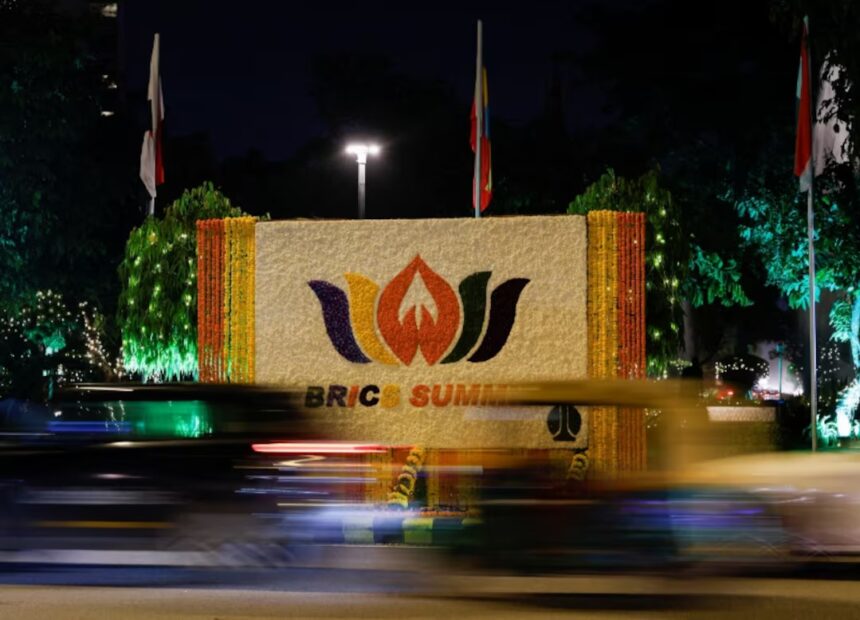
BRICS leaders adopted the consensus “New Delhi Declaration” on Saturday, calling for a structural update of the United Nations Security Council and an increased reliance on local currencies for intra-bloc trade instead of the US dollar.
Indian Prime Minister Narendra Modi announced the agreement of the consensus document during the group’s summit in New Delhi.
“Today’s discussions clearly showed that a changing world cannot be managed by outdated institutions, and that reforms have become necessary in terms of representation, response, and rule-making,” Modi said in his closing speech.
The declaration condemned “unilateral acts of war” and stressed the necessity of ensuring the safety of sailors and the security of commercial navigation amid ongoing military operations in the Middle East.
“The New Delhi Declaration that we adopted today provides a clear direction for our common will, and it is now our responsibility to turn these decisions into tangible results,” Modi said. He added that members also emphasised the need for the Global South to have equal participation in developing future technologies and their regulatory rules. Modi further urged BRICS members to enhance trade cooperation, ease barriers, and expand business opportunities.
During the summit, Chinese President Xi Jinping urged the bloc to act as a peacemaker in the ongoing Middle East conflict. State broadcaster CCTV quoted Xi as saying Beijing will work with other BRICS members to fulfil this role, as the war “does not serve the common interests of the international community.”
Xi described the bloc as a “pioneering group” of the Global South and a model for self-reliance among emerging and developing nations, which he said should promote innovation-driven development. He announced that China will assume the BRICS presidency next year and host the 19th summit.
BRICS seeks to elevate its status by influencing international rules and demanding reforms of institutions such as the World Bank, the International Monetary Fund, and the World Trade Organization, which some members view as being dominated by Western powers.
The group was established to challenge the world order dominated by the United States and its Western allies. According to the BRICS website, created by India during its presidency this year, the group currently focuses on political, security, economic, and financial cooperation, as well as enhancing people-to-people exchanges through annual meetings under a rotating presidency.
Among the bloc’s achievements is the 2015 establishment of the multilateral New Development Bank to finance infrastructure and sustainable development projects in emerging markets. According to its website, the bank has approved 139 projects worth approximately $43 bn, though it suspended new transactions in Russia due to sanctions.
Additionally, members are establishing the “BRICS Pay” system to link fast payment networks and enable cross-border transactions without relying on dollar-dependent banks. Members are also studying the integration of central bank digital currencies and increasingly settling trade in national currencies to find alternatives to dollar-based systems.
However, the bloc faces internal challenges, ranging from disagreements over its primary purpose to diverging member interests. While Russia and China view BRICS as a counterweight to the West, India and Brazil believe it should focus more on economic issues and reform.
The group’s recent expansions have complicated its consensus-based approach. Divergent foreign policy interests prevented the issuance of a joint statement during a BRICS foreign ministers’ meeting in New Delhi in May.
Most Western countries view BRICS cautiously, recognising it as a platform that could slowly shift the geopolitical balance of power. The bloc has repeatedly clashed with US President Donald Trump, who described it as “anti-American.” Trump has threatened to impose tariffs on member states if they attempt to create a new BRICS currency or support a dollar alternative. Brazil pitched the idea of a unified BRICS currency during its presidency last year, but it was later abandoned.
The acronym “BRIC” was coined in 2001 by Jim O’Neill, then chief economist at Goldman Sachs, in a research paper highlighting the growth potential of Brazil, Russia, India, and China. The nations formed a united bloc in 2009 and became BRICS with the addition of South Africa in 2011. The group expanded in 2024 to include Egypt, Ethiopia, Iran, and the UAE, followed by Indonesia in 2025. Collectively, its members represent more than 40% of the global population and about a quarter of the global economy.

