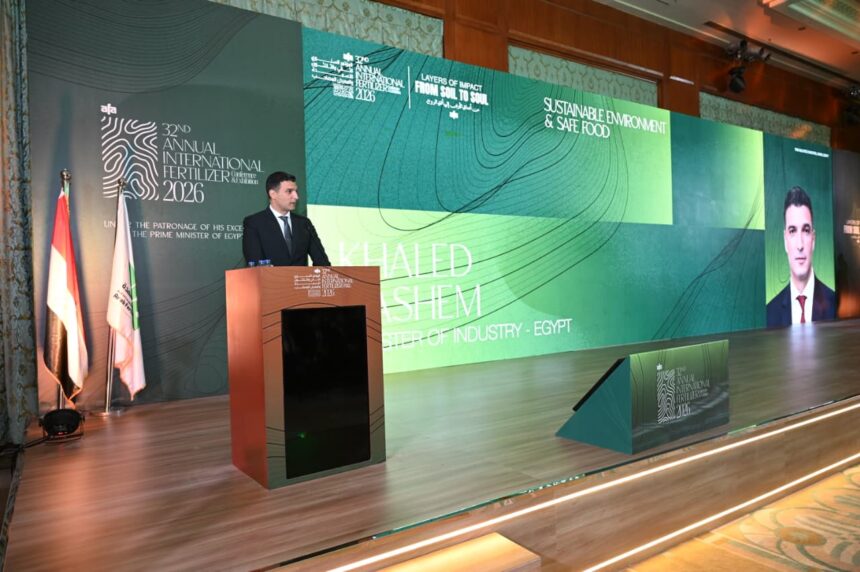
Egypt’s Minister of Industry, Khaled Hashem, participated in the opening of the 32nd Annual International Conference and Exhibition of the Arab Fertilizer Association (AFA), held under the patronage of Prime Minister Mostafa Madbouly and themed “Sustainable Environment and Safe Food.”
The event brought together government officials, industry leaders, international organizations, investors, and fertilizer producers to discuss the future of the sector amid growing global concerns over food security, environmental sustainability, and supply chain resilience.
Speaking at the conference, Hashem described the gathering as one of the region’s most important specialized events for the fertilizer industry, providing a platform for sharing expertise, showcasing technological advancements, and strengthening cooperation among stakeholders.
He stressed that the conference comes at a time when food security and sustainability have become central priorities worldwide, highlighting the critical role fertilizers play in boosting agricultural productivity, improving resource efficiency, and supporting global food production.
The minister noted that Egypt’s fertilizer industry has gained increasing strategic importance as the country expands its agricultural footprint through major national projects, particularly the New Delta Project and the Mostaqbal Misr Sustainable Development Project. Fertilizers, he said, are essential for maximizing the productivity of newly reclaimed lands and supporting sustainable agricultural growth.
Hashem also highlighted the government’s broader industrial strategy, which aims to increase Egypt’s industrial exports to $100bn by 2030 by attracting technology-driven investments, deepening local manufacturing, and integrating more closely into global value chains.
He emphasized that fertilizers are among Egypt’s priority industrial sectors, benefiting from the country’s strong production capabilities, advanced infrastructure, and strategic location connecting regional and international markets.
Addressing recent challenges in global energy markets, Hashem said the Egyptian government has worked closely with manufacturers and investors to ensure stable energy supplies for industrial operations despite geopolitical tensions in the region. These efforts, he noted, have enabled fertilizer plants to maintain production, meet domestic demand, and support export growth.
According to the minister, Egypt’s exports of chemicals and fertilizers reached approximately $9.4bn in 2025, representing a 7% increase compared with 2024. Major export destinations included Italy, Turkey, Brazil, Saudi Arabia, France, and Spain. He added that fertilizer exports account for nearly one-third of the country’s total chemical exports, reflecting Egypt’s strong position in global fertilizer markets.
Hashem also underscored the need for the industry to adapt to evolving international requirements by improving production efficiency, enhancing environmental performance, and complying with emerging regulations. In this context, the Ministry of Industry is supporting the transition towards sustainable manufacturing through improved energy efficiency, circular economy practices, and adherence to international environmental standards.
The ministry is also monitoring developments related to the European Union’s Carbon Border Adjustment Mechanism (CBAM) and working with industry stakeholders to ensure Egyptian manufacturers remain competitive in global markets.
In addition, Hashem highlighted ongoing efforts to strengthen technical education and vocational training to provide the skilled workforce needed for advanced manufacturing and digital transformation.
On the sidelines of the conference, the minister toured the accompanying exhibition, which featured fertilizer producers, technology providers, equipment suppliers, and chemical companies showcasing the latest innovations and solutions aimed at supporting the sector’s sustainable growth and competitiveness.