

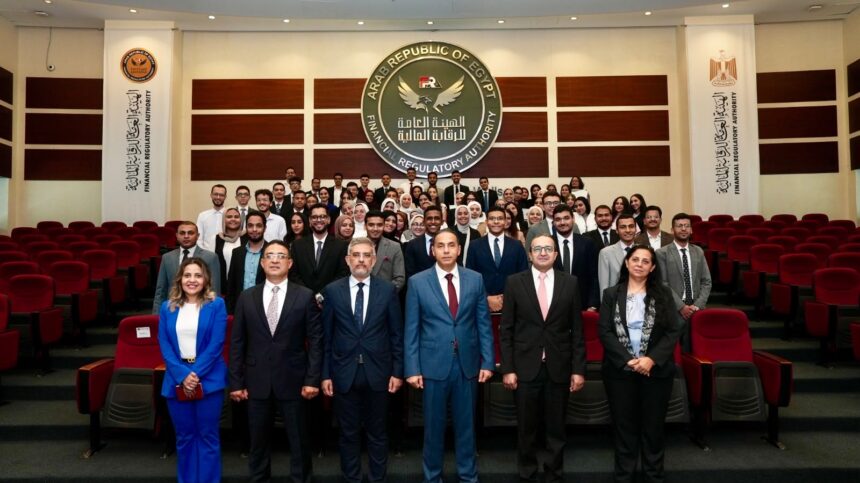
Islam Azzam, Chairperson of the Financial Regulatory Authority (FRA), reaffirmed the Authority’s commitment to expanding financial literacy and awareness programmes by bridging the gap between academic knowledge and practical experience for students and young people. He said this is being achieved through the “I Invest” platform and specialised training programmes for university students.
His remarks came during a meeting with students from the first cohort of the FRA’s Summer Internship Programme for Egyptian university students, launched this year as part of the Authority’s strategy to promote financial literacy, integrate young people into the non-banking financial sector, enhance their professional capabilities, and better prepare them for the labour market through hands-on training across the FRA’s various departments.
Azzam met with the students in the presence of Mohamed Abdel Aziz, Assistant to the FRA Chairperson, and Dalia Mounir, Acting Head of the Central Human Resources Department. During the meeting, the students expressed their appreciation for the practical experience they gained through the programme, saying it provided first-hand insight into the FRA’s regulatory mandate, supervisory responsibilities, and the sectors under its oversight, particularly the capital market, insurance, and other non-banking financial activities.
The students also highlighted their exposure to the latest developments in the digitalisation of financial services and products through financial technology (FinTech), as well as the FRA’s role in fostering innovation and supporting technology-driven solutions to enhance market development, improve customer experience, and protect the interests of market participants.
They further praised the programme’s educational value, noting that they were fully immersed in the Authority’s daily operations. They said the training structure placed them in departments aligned with their academic specialisations while allowing them to rotate across multiple divisions, helping them connect theoretical knowledge with practical application and gain a deeper understanding of the regulatory framework governing non-banking financial activities and the challenges facing the sector.
Azzam commended the students’ commitment, discipline, and enthusiasm for developing their skills and expanding their knowledge. He stressed that investing in human capital and preparing qualified professionals for the labour market remains a core responsibility of the FRA, contributing to the efficiency of non-banking financial markets and supporting the national economy.
He also highlighted the Authority’s ongoing efforts to modernise its information infrastructure, including a comprehensive electronic connectivity project linking the FRA with all federations and companies operating in the sectors under its supervision. The initiative is expected to improve the quality of market data, accelerate the production of accurate indicators, and enable companies to develop products that better reflect customer needs and market trends.
Azzam also discussed recent developments in Egypt’s capital market, inviting the students to observe a live trading session at the Egyptian Exchange. He explained the principles of futures trading, describing it as an important milestone in the development of Egypt’s financial derivatives market that provides investors with more effective risk management tools and diversified investment opportunities.
He further reviewed the FRA’s latest steps towards activating the securities lending and borrowing mechanism for short selling, noting that the updated regulatory framework is expected to be issued within days. The new framework aims to align the mechanism with international best practices in disclosure, transparency, and risk management, enhancing market liquidity, improving efficiency, and increasing the attractiveness of Egypt’s capital market for domestic and foreign investors.
Azzam said the steady rise in the number of young investors participating in the capital market and investment funds underscores the need to further expand financial education and provide reliable information that enables them to make more informed financial and investment decisions.
For his part, Mohamed Abdel Aziz, Assistant to the FRA Chairperson, said raising awareness among university students is a key pillar of the Authority’s financial literacy strategy. He added that the FRA plans to expand awareness initiatives targeting young people in the coming period.
He said every student who completes the internship becomes an ambassador for the Authority within their family, university, and wider community, helping raise awareness of the FRA’s role in regulating and developing non-banking financial markets while protecting the rights of citizens.
This year’s Summer Internship Programme attracted unprecedented interest, receiving 7,480 applications—more than double the number recorded last year. The FRA organised introductory awareness sessions attended by 441 trainees, followed by qualifying examinations for 333 candidates, before selecting 228 students for practical training across the Authority’s departments.
The internship is being delivered in three cohorts, with each group completing a month-long training programme.
The programme targets students from disciplines related to economics, statistics, and non-banking financial activities, including accounting, insurance, actuarial science, finance, computer science, media, public relations, and law, providing participants with practical workplace experience that supports the development of their professional skills.


