

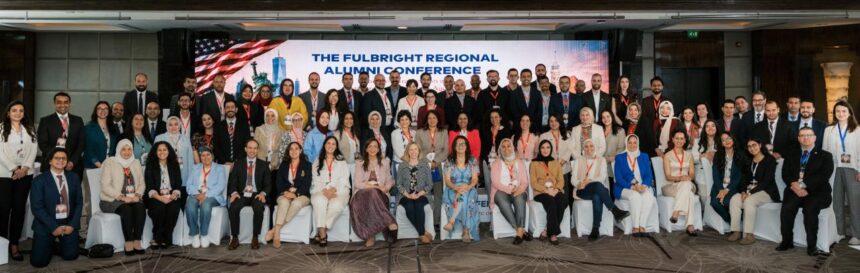
The Binational Fulbright Commission in Egypt (BFCE) and the US Embassy in Cairo hosted the Fulbright Regional Alumni Conference on “Education, Innovation, and Entrepreneurship in the Age of AI” from June 7 to 9, commemorating the 250th anniversary of the United States.
The conference explored how American AI technologies, standards, and governance models are driving innovation and contributing to regional development across education, research, business, and governance in Egypt, across the Middle East and North Africa (MENA) region, and around the world.
Sixty-one Fulbright alumni from across the MENA region who studied and trained in the United States delivered presentations showcasing the transformative potential of American AI as a catalyst for development and its far-reaching impact across numerous sectors. The conference concluded with a forward-looking dialogue on future US-MENA cooperation in artificial intelligence.
Marwa Abbas, General Manager and Technology Leader for North East Africa at IBM, delivered the conference’s keynote address, highlighting American investment in AI across the MENA region. She said: “Throughout my career, I’ve seen that the most successful transformations are never driven by technology alone. They are driven by people who are willing to learn, adapt, enhance, and embrace change. That is why education and skills development have become among the most important conversations of our time. Fulbright builds perspective, and IBM builds skills and capabilities.”
Ruben Harutunian, Acting Deputy Chief of Mission at the US Embassy in Cairo and Treasurer of the BFCE Board, reflected on the enduring strength of the Fulbright partnership. He noted: “The Fulbright Programme has been in Egypt for more than 75 years. It is a tremendous partnership that yields positive results for the people of Egypt and the people of the United States. Today, we stand at an exciting moment of possibility. As artificial intelligence continues to shape education, healthcare, and business, our task is to ensure that these tools expand opportunity, strengthen institutions, and help people solve real-world problems.”
Cari Graves, Senior Programme Officer for Middle East Affairs Fulbright Programmes at the US Department of State’s Bureau of Educational and Cultural Affairs, underscored the programme’s strategic value, noting that the Fulbright Programme “builds the trusted global and regional networks that drive innovation, economic growth, and security.”
Mostafa Rifaat, Secretary General of the Supreme Council of Universities and a BFCE Board member, highlighted the significance of the occasion, saying: “This conference is especially meaningful as it coincides with the celebration of the 250th anniversary of the independence of the United States of America. It is an opportunity to reflect on the enduring values of education, innovation, international cooperation, and the pursuit of knowledge.”
The Fulbright-Egypt team, led by Executive Director Maggie Nassif, welcomed Fulbright alumni from 11 Arab countries, alongside distinguished guests from academia, government, and the public and private sectors. In her remarks, Nassif warmly welcomed attendees to Om El Donya—Egypt—stating that the gathering celebrated American contributions to science and innovation, recognised US investment in young talent across the MENA region, and helped chart the course for the next chapter of US-MENA collaboration.
Established in 1949, the BFCE is the largest and oldest Fulbright programme in the MENA region. It has facilitated academic and cultural exchanges for more than 8,000 Egyptian and American scholars and students, making it a cornerstone of US-Egypt bilateral relations.


