World Football Day at the United Nations on May 25 underscores a compelling reality: the FIFA World Cup 2026™ stands as a powerful testament to what countries can achieve through sustained international cooperation. Canada, the United States, and Mexico will each host matches while jointly delivering the largest and most ambitious World Cup in history—an achievement that reflects not only regional coordination, but also the kind of partnership increasingly required to navigate a complex and interconnected world.
The tournament has already demonstrated that when countries align around a shared objective, meaningful progress follows. Cross-border cooperation has deepened, from enhanced security coordination to strengthened information-sharing and operational planning—all in pursuit of a safe and successful global event. Beyond sport, the World Cup offers a forward-looking model of collaboration: one rooted in openness, shared prosperity, and collective responsibility.
Canada approaches the FIFA World Cup 2026™ with a clear sense of purpose grounded in its values and international outlook. As one of only four countries to have hosted both the Women’s and Men’s FIFA World Cup, Canada brings experience, institutional strength, and a steadfast commitment to inclusive and responsible hosting. The tournament provides an opportunity to showcase Canada’s culture, the diversity of its communities, and its enduring respect for Indigenous Peoples, whose presence and partnership are central to hosting on this land. At its core, Canada’s approach is anchored in delivering a World Cup that is safe, welcoming, and grounded in mutual respect.
This effort also reflects Canada’s broader role on the global stage. Working closely with partners across borders, Canada contributes to strengthening systems that support security, economic resilience, and people-to-people ties. These are the foundations not only of a successful tournament, but of long-term stability and shared progress. Here in Egypt, we are a trusted partner, sharing priorities in promoting peace, stability and security, while strengthening trade and people-to-people ties.
Canada’s pragmatic, collaborative, and values-driven approach, on full display in the joint delivery of the FIFA World Cup 2026™, underscores its role as a partner others can depend on, whether advancing global initiatives, strengthening economic ties, or addressing shared challenges. The lesson of this historic tournament is clear: when trust is established, cooperation deepens—and with it, the foundation for lasting, shared success.
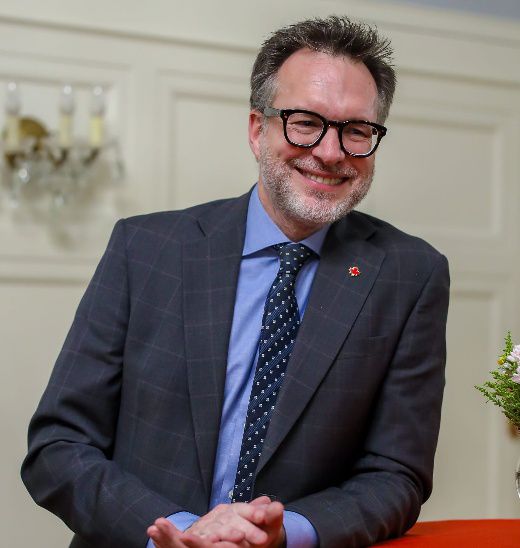
Ulric Shannon is a career diplomat in the Canadian Foreign Service who has specialised in stabilisation and conflict issues, mainly in the Arab and Muslim worlds. From 2016 to 2019, he served as Canada’s consul general in Istanbul, Turkey. From 2019 to 2021, he served as ambassador of Canada to the Republic of Iraq, overseeing one of Canada’s largest development, humanitarian, stabilisation, and military assistance programs anywhere in the world. From 2022 to 2024, he was the Director General for Peace and Stabilisation Operations at Global Affairs Canada. In 2013, he was awarded a Foreign Language Fellowship by Global Affairs to pursue an advanced level of proficiency in Arabic, and in2022, he received the department’s Foreign Language Award for his efforts to promote Canada’s interests in Iraq and to create high visibility for Canada’s contributions to development and stabilisation in Iraq, using his Arabic language skills with both traditional and social media. His previous postings have also included Egypt, the Palestinian Territories and Pakistan.