

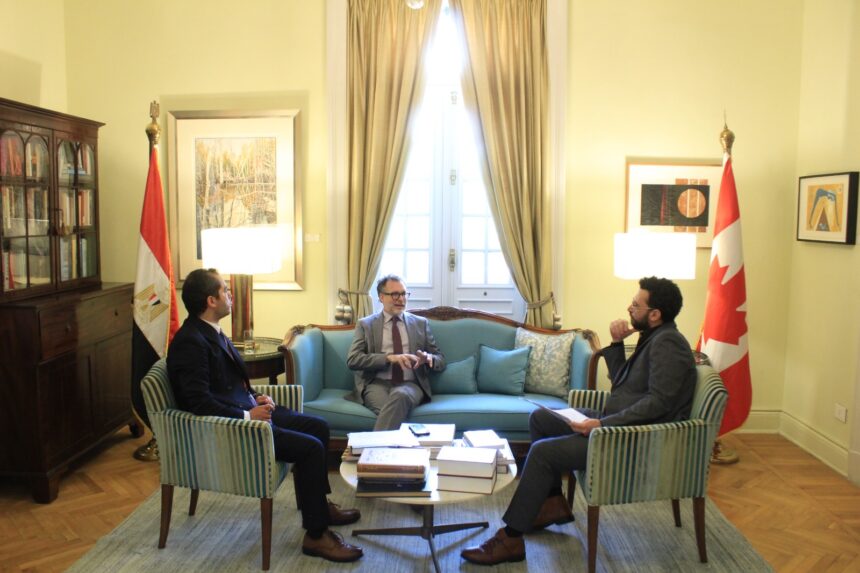
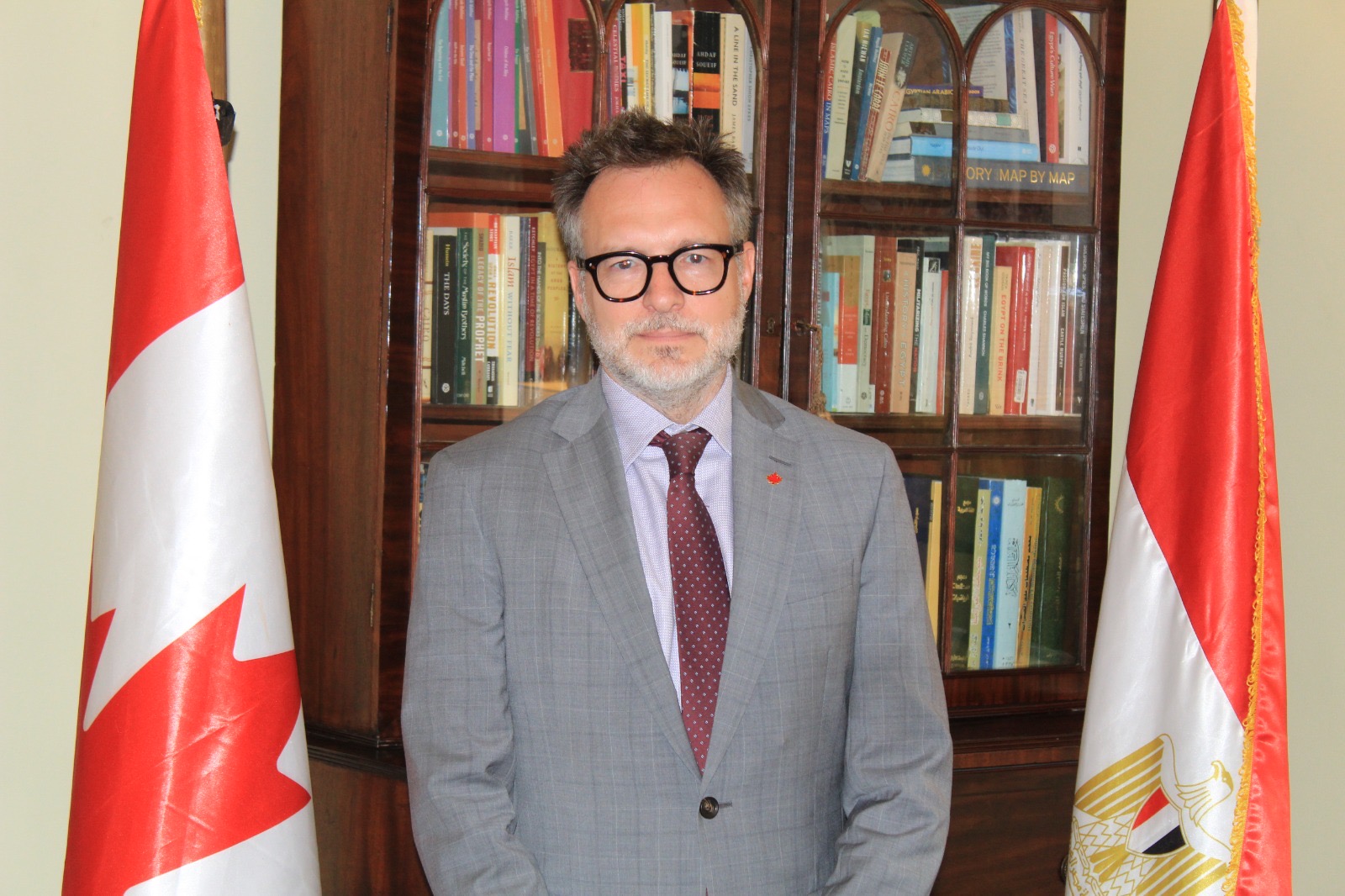
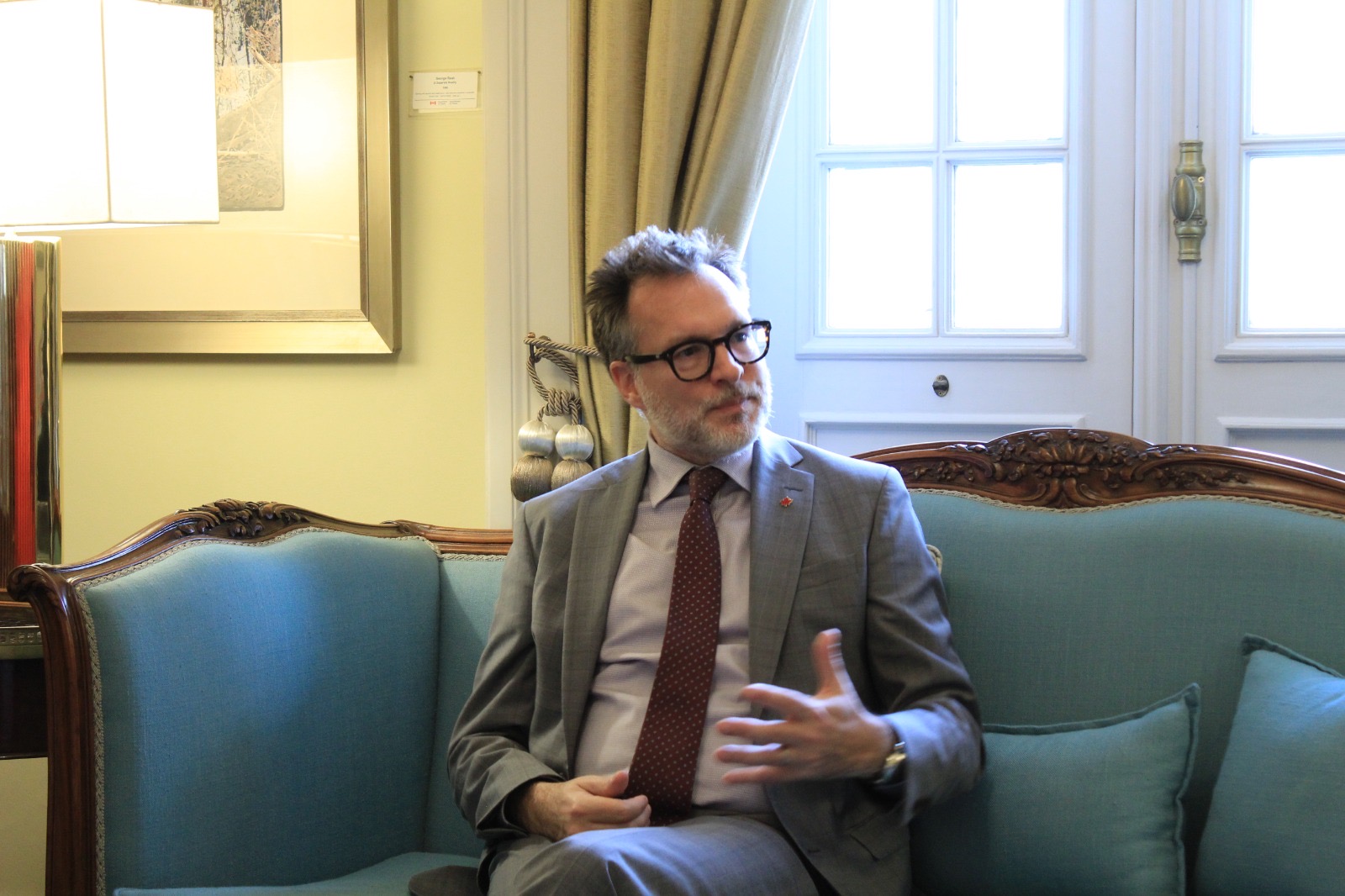
“Our positions on regional crises are more aligned than Egypt may realise,” Canadian Ambassador to Egypt Ulric Shannon said in an interview with Daily News Egypt, as Ottawa looks to work more closely with Cairo on the conflicts surrounding it.
Shannon said Egypt’s four-decade relationship with the United States meant it did not necessarily see Canada as a partner in stabilising the region, and that he wanted to change that during his posting through more consultation and coordination between the two capitals.
He said Canada would consider joining an international effort to secure navigation through the Red Sea and the Strait of Hormuz if a diplomatic consensus and security framework were agreed, while stressing that such efforts could not substitute for a negotiated solution. He acknowledged the pressure on Egypt from reduced maritime revenues and rising fuel and food prices.
On trade, the ambassador said Egyptian fruit exports to Canada have reached record levels, displacing some produce previously bought from the United States, as both countries look beyond their traditional markets. He identified agri-food, healthcare, renewable energy and information technology as the sectors with the greatest potential, along with joint ventures between Canadian and Egyptian companies in African markets.
On the Grand Ethiopian Renaissance Dam (GERD), Shannon said Canada would stay neutral on the legal claims of Egypt, Ethiopia and Sudan. Ottawa would, however, consider offering expertise drawn from managing hundreds of rivers shared with the United States if the three countries jointly requested it. “Simply backing one country against the others would not be constructive,” he said.
Over the course of the interview, Shannon also discussed the humanitarian crisis in Sudan, Canada’s support for refugees and host communities in Egypt, Ottawa’s position on Gaza and the outlook for Canada–Egypt relations, which he described as being at their most positive point in years.
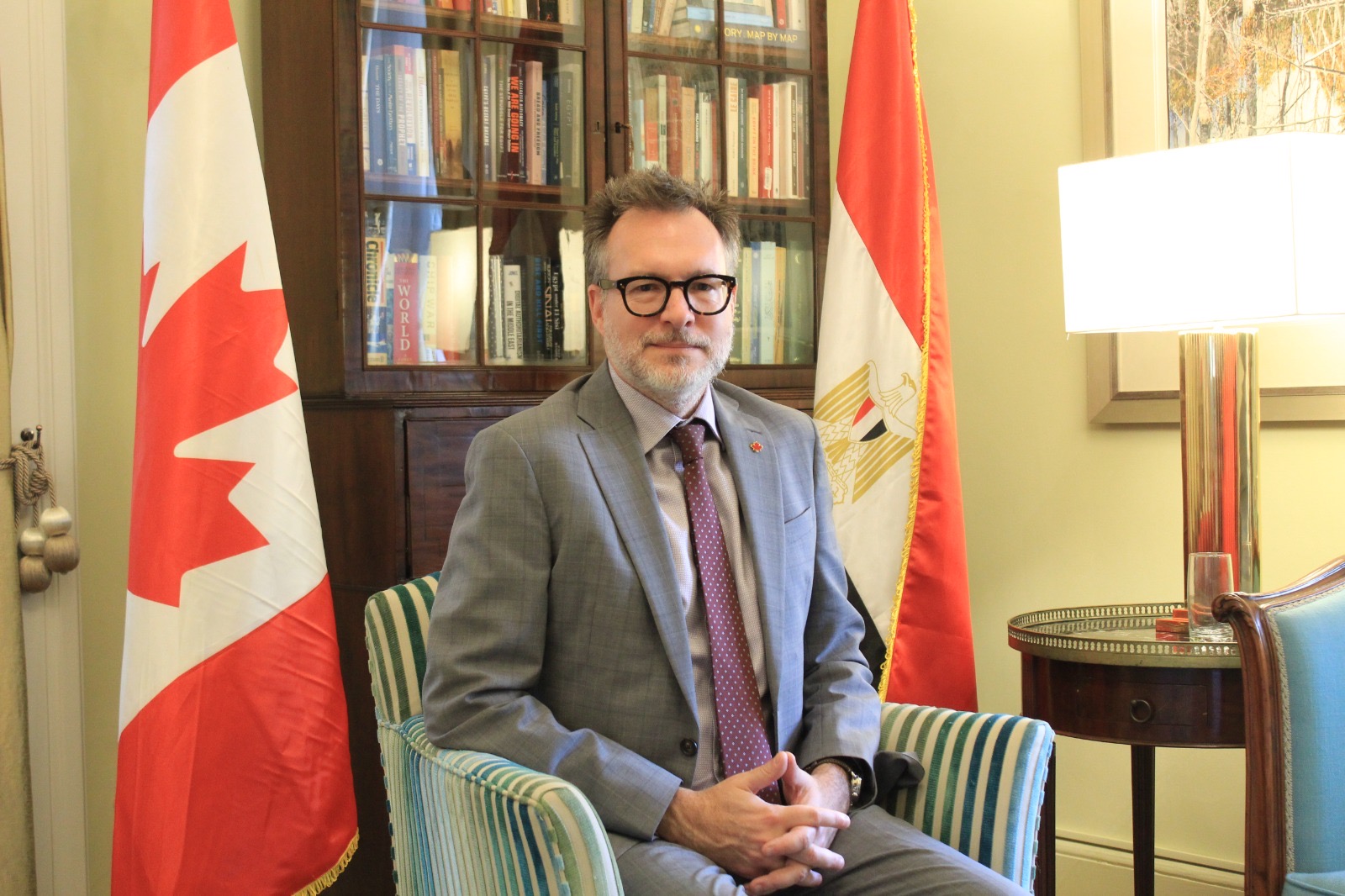
You previously served in Egypt earlier in your diplomatic career. How has the country changed since your last posting, and what has struck you most?
Egypt was my first diplomatic assignment, and your first posting is always special and close to your heart. After Egypt, I served in Palestine, Pakistan, Türkiye and Iraq before returning here in a different role.
I was in Egypt from 2004 to 2006 as the political officer responsible for domestic political affairs. It was an active period with the parliamentary elections, the Kefaya movement, and the 2005 presidential election.
Returning 20 years later, I am struck by how much Egypt has transformed, but also by how much the region around it has changed. Egypt is now surrounded by conflict. What stands out most is the greater focus on its regional leadership.
Canada appreciates Egypt’s role and sees it making responsible efforts to contain conflicts and violence. Egypt is diplomatically very active, promoting dialogue and peaceful solutions, while hosting large numbers of people who have crossed its borders seeking safety.
I believe Canada and Egypt are quite aligned on the regional situation, and we rely on Egypt’s advice to understand developments.
How would you assess the current state of Canada–Egypt relations, and where are the greatest opportunities to take the relationship to the next level?
Relations are in a very positive place, probably the most positive they have been in many years.
One reason is the large and active Egyptian community in Canada, which contributes professionally, supports bilateral trade and strengthens people-to-people ties. We joke that Abla Fahita has been in Canada; she has a significant audience there.
Officially, the census puts the Egyptian community at about 120,000, but the actual number is likely much higher because people may identify as Canadian rather than Egyptian. My Egyptian counterpart in Ottawa believes it could be close to half a million. A reasonable description is several hundred thousand, perhaps 300,000 to 500,000, including recent arrivals and families who have been in Canada for generations.
The greatest opportunity is trade and investment. Both countries are looking to diversify their trade relationships. Canada, particularly given developments in its relationship with the United States, is focusing on expanding partnerships beyond its traditional markets, including in Europe, Asia, the Gulf and the wider Middle East.
There is a mutual interest in increasing bilateral trade and investment.
Which sectors offer the greatest potential for Canadian companies in Egypt and Egyptian companies in Canada?
Agri-food is an obvious area. Egypt has concerns about food security and the cost of basic commodities, but it is also an exporter. One recent success is that Egypt is exporting record amounts of fruit to Canada, displacing some produce previously bought from the United States. Canadians who might once have bought oranges from Florida are buying Egyptian oranges instead.
Canada, meanwhile, has long been a leading supplier to Egypt of wheat, lentils and other food products. Demand and food-security interests create opportunities for both sides.
We are also making progress in health and life sciences. Canada is known for the quality of its healthcare system, while Egypt is investing in modernising its own. Canadian companies see opportunities in pharmaceuticals and specialised health services.
There is also potential in advanced technologies, renewable energy, data and information technology. Egypt has a highly trained, skilled young workforce, particularly in IT, and could use its cost advantages to serve as a hub for Africa and the Middle East.
How important is the Suez Canal Economic Zone to Canada’s efforts to diversify trade and investment?
There is not currently a commercial partnership underway between Canadian companies and the Suez Canal Economic Zone, but we are very interested. I hope to visit the zone with members of my team in the next few months to understand the opportunities.
Both countries are maritime nations. Canada is surrounded by three oceans and depends on international shipping to get its products to market. We share Egypt’s vision of itself as a hub for the Middle East and Africa, and we have a common interest in maritime security.
We are watching the pressure on Egypt and the challenges to freedom of navigation through the Suez Canal and the Red Sea. We are very interested in the maritime infrastructure being developed in Egypt.
What challenges do Canadian investors face in Egypt, and what improvements would they like to see?
Egypt has made real progress in modernising systems that affect business, including moving tax services online and reducing bureaucratic complexity. Egyptian bureaucracy has long been famous, so these are meaningful changes.
Canadian businesses have also tended to be risk-averse. For years, the United States, the world’s largest market, was next door, and around 75% of Canadian exports went there. Companies had less incentive to explore more challenging markets.
That is changing, and Canadian businesses increasingly understand the need to diversify into emerging economies, including the Middle East and the Gulf.
Egypt needs to make a clear business case to investors and demonstrate that they can compete on a level playing field. Investors compare Egypt with markets such as Singapore, South Africa and Brazil, so Egypt needs to explain its distinctive advantages. Its cost base, including relatively low labour costs, is one such advantage.
We encourage continued reforms to create a level playing field for private investors, Egyptian and foreign alike. The IMF has also noted the state’s significant role in the economy and the space occupied by state-owned and affiliated companies. We have supported, alongside the IMF and others, divestment and privatisation to create more room for foreign investors to enter and compete.
What role could Egypt play in Canada’s Africa strategy and in cooperation with the African Union?
Canada sees significant potential in Africa, one of the world’s fastest-growing continents by population. By 2050, one in four people globally is expected to be African.
Canada has been active in Africa for decades through development assistance, spending billions of dollars to help meet basic needs and build modern economies. In the future, however, engagement will rely less on traditional development and humanitarian assistance and more on commercial partnerships.
Egypt is a natural partner. It has a longer and deeper history in Africa, a substantial diplomatic presence and, I would say, a greater appetite for risk than Canada typically has. Partnerships between Canadian and Egyptian companies could help both sides pursue opportunities in third markets, including across Africa.
The model has worked before: when I served in Türkiye, we promoted partnerships between Canadian and Turkish companies on major infrastructure projects in Africa.
Egypt’s interest in maritime development and port infrastructure adds to the potential for trilateral cooperation. We share that interest.
Are there any specific projects or plans in the pipeline?
If there were, I probably would not talk about them, because it is a competitive environment. We compete with China, Russia and European partners, many of whom are geographically closer.
For now, this is more a conceptual model that we are looking to develop, although Canada is investing more diplomatic resources in Africa. We recently appointed an ambassador dedicated to the African Union and opened a new embassy in Benin last year. Our diplomatic presence is growing.
Given Egypt’s active role in the African Union, we will continue consulting it as we develop our commercial strategies for the continent.
How does Canada view the long-standing dispute between Egypt, Ethiopia and Sudan over the Grand Ethiopian Renaissance Dam, and what role could Canada play diplomatically?
Canada has good relations with all three countries. I am the ambassador to Egypt, not to Sudan or Ethiopia, but Canada has considerable experience managing transboundary water issues. We share hundreds of rivers with the United States and have developed sophisticated approaches over decades, using international law alongside informal mediation and coordination forums.
That model cannot simply be copied and pasted into another region. Our principles are based on cooperation. All states bordering a shared waterway, in this case the Nile, have legitimate interests in how its resources are managed.
We will not take a position on the specific legal claims made by Egypt, Sudan or Ethiopia. We have supported regional diplomatic efforts, mediation and negotiations. We do not see an immediate role for Canada, but if the countries involved jointly asked for our expertise or other assistance, we would be prepared to consider it.
Simply backing one country against the others would not be constructive.
How is Canada responding to Sudan’s humanitarian crisis, and how important is cooperation with Egypt in supporting Sudanese refugees and addressing the conflict’s wider consequences?
We share Egypt’s view that this is one of the world’s worst humanitarian catastrophes, and it is receiving insufficient attention.
Canada provided approximately C$54.3 million in international assistance to Sudan in 2023–2024, making it the seventh-largest donor to the country. In 2024–2025, Canada provided a further C$110.5 million in international assistance to Sudan.
Our support is delivered through experienced and trusted partners, including United Nations agencies, multilateral and international organisations, and Canadian civil society groups working closely with local NGOs. We do not provide funding directly to government institutions.
This is a man-made emergency caused by armed conflict, not a natural disaster, and outside parties are supporting the fighting. We have called for a diplomatic solution and the reunification of political power in Sudan under unified civilian leadership.
Egypt has been directly affected by the arrival of large numbers of refugees seeking safety. It deserves credit for meeting its responsibilities as a country hosting refugees. Canada is also among the world’s leading refugee-hosting and resettlement countries, so we sympathise with the burden Egypt faces.
Since the conflict began on 15 April 2023, Canada has been processing applications from people affected by the conflict through a family-based permanent residence pathway and other temporary and permanent immigration measures. As of 31 July 2026, 22,375 people had been approved for permanent residence, while 6,750 applications for temporary residence had been approved.
We are doing our part to help people affected by the conflict find safety, although resettlement is not a solution to the conflict itself. The root causes of insecurity in Sudan must be addressed.
Canada is working diplomatically with the African Union and regional leaders to build consensus around a political solution. We have not taken a position saying we support either the Sudanese Armed Forces or the Rapid Support Forces. Our position is that Sudan needs unified civilian leadership, achieved through negotiations and mediation, and that outside actors must play a more responsible role.
Does Canada provide support for Sudanese refugees in Egypt and for Egyptian efforts to host them?
Refugees are a priority within Canada’s development programme in Egypt. We support activities for refugees and Egyptian host communities in certain localities. Such work is undertaken in partnership with UNHCR and the Egyptian government.
This year, 2026, marks 50 years of Canadian support for sustainable development in Egypt. Over that period, Canada has provided more than C$1 billion in international assistance, including over C$100 million since 2017 alone.
Today, our bilateral development programme provides approximately C$8 million to C$9 million annually. Its priorities include gender equality, economic empowerment, reproductive health, climate resilience, food security and support for refugee communities in Egypt, with a particular focus on communities in Upper Egypt and the Nile Delta.
Our programmes have reached more than one million Egyptians and are aligned with Egypt’s Vision 2030 and Climate Change Strategy 2050. Canada is currently supporting seven projects across Egypt, working with Egyptian ministries, Canadian partners and UN agencies.
One example is the Canada-funded Comprehensive Support Package for Refugee Women & Girls, implemented by UNHCR Egypt and Plan International in Damietta and Alexandria. The project combines protection with economic empowerment through entrepreneurship training, seed funding, job placement and vocational skills development.
The initiative helps vulnerable refugees develop the skills and resources to establish income-generating businesses and become more self-reliant, while strengthening connections with their host communities.
Through the project, 265 refugees are developing entrepreneurial skills, while another 180 are receiving job-placement support. Women account for 60% of livelihood beneficiaries, reflecting the programme’s emphasis on economic empowerment as a means of building resilience and more sustainable futures.
We are looking for opportunities to ease some of the domestic burden on the Egyptian state and to support refugees and host communities in ways that create lasting opportunities.
One year after Canada recognised the State of Palestine, how would you describe Canada’s position on Gaza and the wider Palestinian issue?
Canada considers the humanitarian crisis in Gaza completely unacceptable. Humanitarian access remains compromised, and we have been vocal that Israel must meet its obligations to allow aid to reach people. The level of suffering is unacceptable.
Progress is also needed on the next phase of the ceasefire. Canada supports diplomatic efforts to move forward, whether through traditional multilateral channels such as the United Nations or other initiatives. We are not part of the Board of Peace, but we are willing to support efforts that can advance the process.
The next stage will require a new political formula for Gaza’s governance that does not include Hamas, followed by an administration able to lead reconstruction. Egypt is deeply involved in those negotiations.
We are still far from that point and, candidly, we are not optimistic that there will be substantial progress between now and the Israeli elections.
There is also insufficient attention to the West Bank. Canada has spoken out against unacceptable levels of violence by settler groups and the expansion of settlements in Jerusalem and the West Bank.
On the margins of the UN General Assembly in New York, our prime minister co-hosted a summit with the UK prime minister and French President Emmanuel Macron, with Egypt represented by Prime Minister Mostafa Madbouly. Canada and several other mainly European countries also announced new sanctions on products from settlements. Canada had already sanctioned several Israeli ministers associated with the settler movement.
We are applying diplomatic pressure with partners to help break the impasse. Canadians expect their country to maintain good relations with both Palestinians and Israelis, and there are strong communities in Canada that want that. We have historically seen ourselves as a friend of both sides, which we hope gives us credibility.
We are trying to use that role responsibly, while recognising that Canada alone cannot move the conflict in a meaningful direction. Joint efforts are essential, and we rely on Egypt’s advice in understanding the conflict.
With growing security challenges in the wider Middle East, including the US–Iran conflict and the closure of the Strait of Hormuz, how does Canada assess the situation and position itself?
It is a very complicated situation. Canada was not part of the US and Israeli decision to launch attacks against Iran. At the same time, we have consistently said that Iran must not possess a nuclear weapon and have advocated diplomatic solutions, including supporting negotiations around the Joint Comprehensive Plan of Action.
We have also made clear that attacks on civilian infrastructure are unacceptable and expressed solidarity with Gulf partners whose civilian infrastructure has been targeted.
We are seeing irresponsible behaviour with negative consequences for countries across the region, including Egypt. We recognise the pressure on Egypt from reduced maritime revenues and the effects on the cost of living, including fuel and food prices. We share Egypt’s concern about maritime security.
Our position is that a negotiated diplomatic solution is needed. We support regional efforts based on international law and freedom of maritime navigation, and ultimately a regional security framework that prevents Iran from acquiring a nuclear weapon.
Is Canada considering joining efforts to ensure security in the Red Sea or protect navigation through the Strait of Hormuz?
Canada has participated in military operations in the Red Sea in the past to protect freedom of navigation, including when international piracy was the main threat. We are watching the current discussions carefully and have said we are prepared to consider collective efforts to achieve an outcome.
But such efforts are not a substitute for a negotiated solution. If a diplomatic consensus and security framework were agreed, and an international security presence were required, Canada would be open to considering a role.
How does Canada approach human rights and press freedom in its relations with Egypt?
No country is perfect. We want Egypt to succeed internationally, and that means changing and modernising some of the perceptions that continue to surround it.
Investors want security when investing abroad, including confidence in an independent judiciary and impartial arbitration if a commercial dispute arises. Any perception that legal processes are influenced by politics can weigh on investor confidence. Coverage of Egypt in the Canadian press is not always positive, and that shapes how Egypt is seen abroad. Human rights issues are often featured which undermines Egypt’s image abroad and confidence in the rule of law. We follow developments affecting the media closely, as we do everywhere. In Canada, we believe in a free press and in the important role journalism plays in holding governments accountable.
These issues come up regularly in international forums. During the Universal Periodic Review at the UN Human Rights Council in Geneva, which takes place every three years, Canada has raised concerns about different human rights practices in Egypt each time.
That is not criticism for its own sake or an attempt to provoke. Canada has shortcomings too, including in its treatment of First Nations peoples, and we have faced criticism at the Human Rights Council. We regard that process as constructive criticism.
Does Canada raise these concerns directly with the Egyptian government?
Yes, we raise our concerns. The approach is not to tell Egypt what it must do or to suggest that Canada is better.
Rather, Egypt wants to build a positive international image as an economy, and part of that is having a rule-of-law system that people believe is independent. A strong judiciary and a free press capable of challenging the state are in Egypt’s own interests.
Which parts of the Egyptian government do you engage with on these issues?
We meet regularly with the Ministry of Foreign Affairs, the National Council for Human Rights and people in different ministries. We also speak with media representatives and influential Egyptians, both publicly and privately.
We have tried to avoid what we call “megaphone diplomacy”: making loud public statements that are not constructive or helpful.
What feedback do you receive from officials when you raise these issues?
Generally, government representatives point to the National Human Rights Strategy, the National Council for Human Rights and Egypt’s participation in good faith in the Universal Periodic Review. Those points are true.
The real test is how these efforts are felt by ordinary citizens, and we look forward to seeing that progress. We say this, hopefully, with humility.
People-to-people ties are an important part of Canada–Egypt relations. How important are the Egyptian Canadian community, tourism, cultural exchange and education, and what is the embassy doing to support them?
These ties are the backbone of the relationship. Whether the Egyptian Canadian community numbers 300,000, 400,000 or 500,000, there is substantial movement in both directions. There are direct flights between Cairo and Toronto, and demand for more.
A typical Egyptian Canadian may have moved to Canada as a student, acquired skills, found work, become a permanent resident and then a citizen, and built a family there. Many are professionals such as, pharmacists, doctors, academics, rather than people directly involved in business.
We have been working with the Egyptian Embassy in Canada to activate the community more fully, particularly because its contribution to bilateral trade could be greater.
Some Egyptian Canadian businesspeople trade with the Gulf, including Dubai, but not necessarily with Egypt because they feel it is easier to do business in Dubai. We would like to engage that business community more.
Cultural exchanges are ongoing. The Grand Egyptian Museum hosted Canadian singer Bryan Adams, and artists such as Abla Fahita travel in both directions. There is demand for more exchanges.
The embassy also promotes Canadian literature and film and has participated in the Cairo International Book Fair in recent years, including with Arab Canadian authors. Quebec novelist Kim Thúy was mentioned as a possible participant at the fair next year.
Education is another area of potential. Around 22,000 Egyptians are registered in Canadian educational programmes in Egypt, across schools, colleges and universities.
Canada has a strong reputation in education, and there is scope to expand its educational presence on a commercial basis. Egyptian students have performed very well in Canada and have been successful international students.
When you look back at the end of your posting, what outcomes would you most like to have achieved?
I would like to see trade and investment grow. There is also scope for more direct flights and greater traffic between Egypt and Canada.
But I would especially like to see stronger strategic alignment in our diplomacy. Canada and Egypt already have a very good diplomatic relationship, and Egypt is playing a leadership role in the region. I believe there is room for more consultation and exchange of views because our positions on regional crises are more aligned than Egypt may realise.
Egypt has had a privileged relationship with the United States for four decades, for well-known reasons. I do not think it necessarily sees Canada as a partner in efforts to stabilise regional conflicts. I would like to build a richer relationship in regional diplomacy and work more closely together.
Our foreign ministers speak regularly, and we hope to host Badr Abdelatty in Canada in the near future. That would be an opportunity to discuss bilateral issues, but I also see scope to deepen cooperation and align our positions on the region.


