

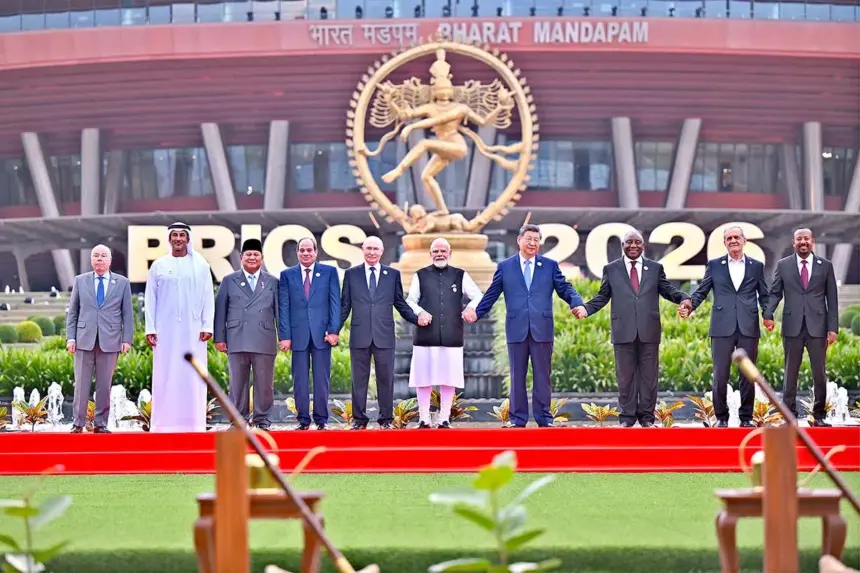
In New Delhi, the leaders of BRICS are not gathering to mark two decades of an idea born in an investment bank research note. They are testing whether the grouping’s growing economic and demographic weight can be converted into genuine institutional and political power. The 18th summit opens against the backdrop of open war in the Middle East, escalating US-Iran tensions, and a sustained US-China rivalry — while Iran and the United Arab Emirates sit together at the same table. Yet the leaders managed to adopt a joint New Delhi Declaration calling for maximum restraint, dialogue, and diplomacy, while registering objections to unilateral trade and economic measures. The consensus is not a strategic triumph. It is, however, a revealing illustration of what BRICS actually is: a highly diverse group learning, under pressure, how to manage its differences without collapsing.
BRICS did not begin as a project to overturn the international order. In 2001, Goldman Sachs economist Jim O’Neill — working at the heart of Wall Street, New York’s global financial centre — coined the term “BRIC” to describe Brazil, Russia, India, and China as rising economies that would reshape the global economy over coming decades. The concept moved from market classification to political coordination in 2006. The first formal leaders’ summit took place in Yekaterinburg in 2009; South Africa’s accession completed the acronym. In recent years, the group has expanded to include Egypt, Ethiopia, Iran, the UAE, and Indonesia. Today it comprises eleven countries that together account for roughly half the world’s population and around 40 percent of global GDP measured by purchasing power parity, according to Indian government figures and recent analyses.
Twenty years is not a long time in the life of international institutions. The G7, which emerged in the mid 1970s, has more than half a century of coordination and shared crises behind it. ASEAN, founded in 1967, has spent nearly six decades building gradual regional integration. Even the Shanghai Cooperation Organisation, established in 2001, remains in transition from a regional security framework to a broader political and economic platform. Comparing BRICS with these groupings is therefore not a comparison of like with like. Differences in age reflect differences in institutional maturity, not necessarily differences in historical significance.
The G7 is more politically and financially homogeneous and possesses exceptional capacity to coordinate sanctions and macroeconomic policy. ASEAN built its strength through shared geography, day to day economic interests, and cumulative institutions. BRICS operates on an entirely different logic: it brings together countries that need one another despite profound differences. China and India compete strategically and economically and still face an unresolved border dispute. Yet Narendra Modi and Xi Jinping met on the margins of the New Delhi summit in an effort to recalibrate bilateral relations. The ability to keep strategic rivals at the same table is a quality the G7 does not offer in the same way. It is also BRICS’s greatest structural vulnerability. The grouping’s potential strength lies in managing divergence, not eliminating it.

The most concrete institutional achievement remains the New Development Bank, established in 2015. After roughly a decade, it has become a functioning institution that has approved projects worth more than $40bn and has begun developing local currency financing tools. Its existence does not mean it has replaced the World Bank, nor that the Western financial system is on the verge of collapse. Its strategic value is more modest and more important: it provides an additional institutional option that countries of the Global South own and help direct. The same logic applies to the currency question. There is no BRICS single currency, and a euro style monetary union is not the most plausible near term project. The realistic path is the gradual increase in the use of national currencies and the development of cross border payment systems — an incremental shift that matters more than any political declaration about the end of the dollar’s dominance.
Sheer economic size, however, is not the same as integration. Intra BRICS trade has grown substantially, yet economic relationships remain unbalanced, and many member economies still depend heavily on commodity exports or on demand from markets outside the group. To claim that BRICS has become a unified economic power is an exaggeration; to claim it has become irrelevant is a greater error. Expansion has increased the group’s demographic and geographic weight, but it has also multiplied the national interests that must be reconciled. The current Middle East conflict has made this dilemma especially visible: Iran and the UAE are both members, yet both contributed to a joint declaration calling for restraint. The capacity to produce a minimum of consensus among states that differ sharply in their alliances and in their conceptions of war and peace is itself a form of institutional power.
BRICS has expanded faster than it has integrated. It has amplified the voice of the Global South more rapidly than it has built robust mechanisms for collective decision making. It has created alternative institutions without yet constructing an alternative system. It has placed reform of global governance at the centre of the international agenda, yet it has not demonstrated the ability to draft alternative rules that command acceptance beyond its own membership. This assessment is more accurate than the two competing narratives that dominate public debate: one that treats BRICS as the beginning of the end of Western hegemony, and another that dismisses it as a loose and ultimately doomed talking shop.
The reality is that BRICS is not an alternative world. It has become an indispensable part of the process through which the existing world is being reshaped. At twenty, the relevant question is no longer whether it will replace the G7 or the dollar. The more consequential question is whether it can convert demographic and economic weight into durable bargaining and institutional power that expands the range of choices available to its members. If it succeeds in building practical common tools in finance, payments, technology, and energy without hardening into a rigid anti Western alliance, it may generate a new form of power based on the multiplication of options rather than the uniformity of positions. If it fails, it will remain a historical footnote to a period in which the world searched for a more multipolar order without constructing institutions strong enough to sustain it.
The New Delhi summit is not a twentieth anniversary celebration. It is the beginning of the harder test. Creating an international grouping can take only a few years. Turning weight into power, power into institutions, institutions into workable rules, and rules into a more plural international system is a far longer struggle. The question New Delhi will hand to the third decade of BRICS is not whether Western dominance will fall. It is whether BRICS can demonstrate that multi-polarity can function as a practical system rather than remain a political slogan.
Dr. Marwa El Shinawy, Academic and Writer

