

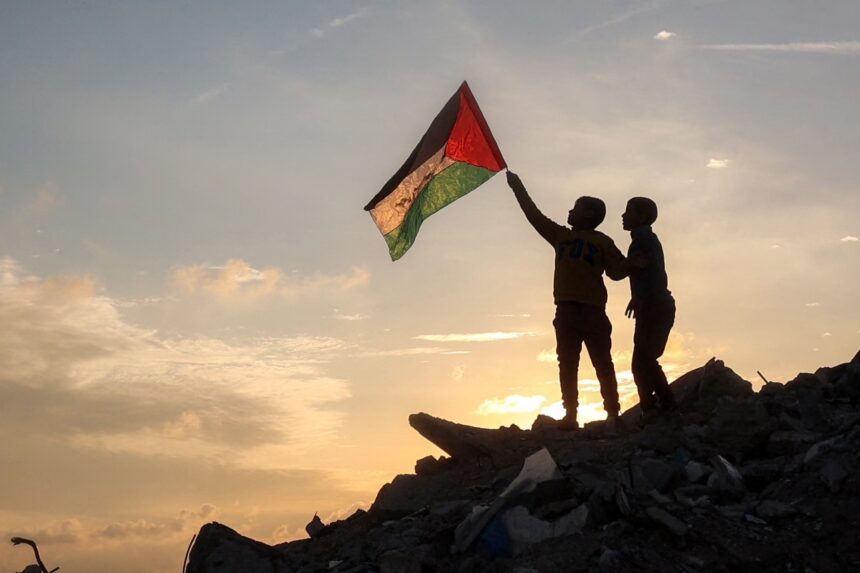
Europe increasingly recognises Palestinian statehood as a political objective while watching the territory required for it being steadily eroded. European governments oppose settlement expansion, settler attacks, land confiscation and the E1 project; a growing number have recognised the State of Palestine, while some have imposed restrictions on settlement goods and services, sanctioned individuals associated with settler violence and repeatedly condemned settlement expansion. But the measures remain fragmented and fall short of matching the consequences Europe says it is trying to prevent.
That tension was visible on 8 September, when 12 countries including the UK, France, Spain and Canada issued a joint statement declaring that Israeli actions in the West Bank were undermining the possibility of two states and announcing intentions to introduce or support European restrictions on trade in settlement goods. Governments increasingly agree on the threat to Palestinian statehood while differing over how far to go in addressing it, with positions shifting according to national politics, governing parties and changing coalitions. The result is a widening gap between Europe’s stated position on Palestinian statehood and the measures it is prepared to take to preserve its territorial basis.
Israel’s response has increased the political cost of closing that gap. After Britain announced an import ban and a comprehensive regime targeting illegal settlements, alongside companies and individuals involved in construction, infrastructure, financing and real estate linked to settlement expansion, Israel announced that it would close the British consulate in East Jerusalem, exclude Britain from a US-led coordination mechanism for Gaza, end British training of Palestinian Authority security forces in Ramallah and bar 12 British officials and other nationals from entering Israel. Former senior US official Elliott Abrams said the measures were likely to have diminished Britain’s diplomatic influence, particularly by restricting London’s role in Palestinian-related diplomacy and security activity.
European governments must therefore weigh Israeli retaliation alongside the domestic and diplomatic costs of appearing passive. Their caution also reflects decades of defence, military equipment, data-sharing, technology, healthcare and innovation ties with Israel. These make political pressure inseparable from broader strategic cooperation. Britain can impose targeted settlement measures while maintaining forms of intelligence and security cooperation with Israel.
Washington adds another constraint for European policy makers. The United States remains Israel’s principal military and diplomatic ally and pivotal to Europe’s security. The United States is not expected to impose the settlement-import restrictions introduced by several Western governments and pro-Israel members of Congress could press the administration to respond to European measures viewed as discriminatory toward Israel.
Political movements across European cities are another factor governments take into consideration. Palestine is becoming a point of convergence among European political forces otherwise divided on almost everything else. Horseshoe theory, which suggests that the far left and far right can resemble one another, is too blunt here: Europe’s far left and far right do not share an ideology or political motivation. On the left, Palestine is framed through international law, anti-colonial politics, minority rights and opposition to occupation. On parts of the nationalist right, criticism of Israel can reflect hostility towards Washington, opposition to foreign intervention or rejection of established foreign-policy elites, while other right-wing movements remain strongly supportive of Israel. The convergence is therefore around particular aspects of the Palestinian question rather than a common political programme.

The American debate over being “progressive except for Palestine” offers a useful comparison. The phrase captures the tension that arises when liberal commitments to equality, self-determination, international law and opposition to occupation acquire political qualifications regarding Israel and Palestine. Europe presents a related but distinct phenomenon: pro-Palestine, within limits. European governments increasingly accept Palestinian statehood, Palestinian rights and the illegality of settlements as matters of principle. The limit becomes clearer when defending those principles requires significant strategic or political costs.
Palestine’s geopolitical influence has expanded beyond its traditional baseline into broader European debates over international law, borders, sovereignty, security and transatlantic relations. Spain exemplifies this transition. Following its 2024 recognition of Palestinian statehood, Madrid has emerged as a prominent critic of Israeli policy, with the issue now deeply embedding itself into domestic conversations regarding religion, migration and North African diplomacy.
While these debates continue, the West Bank is being transformed. On 18 August, Israel opened a tender for 1,234 housing units in E1, east of Jerusalem, with bids due on 19 October, one week before the 27 October parliamentary election. The units form part of a larger plan for 3,401 homes. E1 is strategically significant because development there would affect the territorial relationship between East Jerusalem and the north and south of the West Bank.
No major Jewish political bloc appears to be campaigning on establishing a Palestinian state as an immediate objective. Netanyahu opposes Palestinian statehood, while centre and centre-left figures who previously supported Palestinian sovereignty are not making its establishment the defining programme of this election. The far right is meanwhile advancing proposals for the removal or “transfer” of Palestinians. On 4 September, Netanyahu’s far-right partners renewed calls for the “voluntary emigration” of Palestinians from Gaza. National Security Minister Itamar Ben-Gvir and Defence Minister Israel Katz have supported proposals for mass emigration, while Netanyahu has expressed support for voluntary emigration while distancing himself from re-establishing Jewish settlements in Gaza. Foreign Minister Gideon Sa’ar said on 9 September that Israel had no plans to deport Palestinians from Gaza. Earlier proposals remain politically significant because senior members of the governing coalition have placed Palestinian departure within the election debate.
In the West Bank, pressure on Palestinian communities operates through settlement expansion, land seizure and restrictions on movement. Attacks against Palestinians are not isolated acts by individuals. They take place under the watchful eye and with the military support of the Israeli army, the political protection of the government and the incitement of some of its members. Loss of access to land, roads, farms and essential services can make communities harder to sustain without a single order announcing their removal.
Roads are critical because they appear administrative while producing lasting territorial consequences. In July, Israeli authorities issued 15 land-confiscation orders affecting approximately 200 dunams in the Jenin governorate. The land is intended in significant part for roads and infrastructure associated with planned settlements, including a connection between the planned Emek Dotan and Noa settlements. The Jordan News Agency, citing Palestinian land authorities, reported that the orders covered more than 11 kilometres of military roads and a new military outpost. A housing tender, land order or road project can therefore appear to be an individual administrative measure while collectively determining how settlements connect, how Palestinian communities relate to one another and whether territory can function as the basis of a future state.
The EU has instruments beyond condemnation. To play a meaningful role on the world stage, its response cannot stop at customs duties and trade measures. Its economic position gives it leverage, but diplomatic credibility depends on translating that leverage into political measures when the principles it claims to defend are at stake.
The EU should revisit Israel’s compliance with Article 2 of the EU-Israel Association Agreement which makes respect for human rights and democratic principles an essential element of the partnership. This examination should be conducted in an honest and comprehensive way and not cede to those who claim that Israel is the only democratic country in the Middle East. It is true that European governments from time to time call for imposing sanctions on extremist settlers and organisations involved in attacks on Palestinians but one should be careful with the wording of that call. The language of targeting “illegal settlements” warrants care: it implies a distinction between settlements subject to sanctions and those presumed legal. When the broader European position is that Israeli settlements in the occupied Palestinian territory are illegal under international law such fluid, grey and concessional language deserves a firm stand. The EU does not need every member state to agree on every possible sanction before developing a meaningful policy. It needs clearer consequences attached to positions it has already adopted, particularly when it describes settlements as illegal, recognises Palestinian statehood and supports a two-state solution.
Egypt and other Arab governments are pressing European policy in that direction. On 6 August, the Arab League reaffirmed the centrality of Palestinian self-determination and statehood, keeping Gaza’s humanitarian crisis within the longer question of Palestinian sovereignty rather than allowing reconstruction to become detached from the future of the Palestinian territories.
On 10 September, Egypt joined Qatar, Jordan, the United Arab Emirates, Indonesia, Pakistan, Türkiye and Saudi Arabia in welcoming Britain’s decision to ban goods from Israeli settlements in the occupied Palestinian territories and restrict services linked to them. The eight countries called for wider international action against settlement expansion and reaffirmed the 4 June 1967 borders, with East Jerusalem as the capital of a geographically contiguous Palestinian state, as the basis of a viable two-state solution. They also welcomed the separate declaration by 12 countries on national and European restrictions on settlement goods. That day, Foreign Minister Badr Abdelatty met EU ambassadors accredited to Egypt and expressed appreciation for their stance as Cairo seeks to mobilise international support for Palestinian statehood into measures protecting its territorial basis.
Egypt’s position links statehood to the June 4, 1967 borders, East Jerusalem as its capital and the preservation of Palestinians on their land. Recognition cannot create the territory over which a state is supposed to exercise sovereignty. A Palestinian state requires territorial continuity, functioning institutions and the economic and political capacity to govern. European humanitarian assistance to Gaza remains indispensable, but reconstruction detached from the political conditions causing the destruction risks becoming a mechanism for managing repeated devastation. Institutional reform can strengthen Palestinian governance but cannot indefinitely substitute for sovereignty.
The political calendar gives Europe further reasons to delay. Israel votes on 27 October, Palestinian political developments and the future of the Palestinian Authority will shape the regional landscape and the United States holds congressional elections in November. The UN General Assembly offers another opportunity to reaffirm international law and Palestinian statehood. Its declarations can reinforce opposition to settlement activity but have limited effect without economic and political consequences. Recognition has substantial diplomatic value, although that value diminishes as the territory intended for the recognised state becomes fragmented.
The central question is no longer whether European governments support Palestinian statehood, but whether they regard it as a political objective whose territorial, economic and institutional foundations must be defended while they still exist, rather than a diplomatic aspiration to revisit when circumstances permit. Recognition may affirm Palestinian statehood in principle, but inaction can erode the conditions that make it possible in practice. Europe has the economic and diplomatic weight to act, yet continues to wait as the territory on which that policy depends is transformed. That is the contradiction of the Wait of the Union: European governments can afford to postpone difficult choices; Palestinians cannot afford to defer the consequences.
