

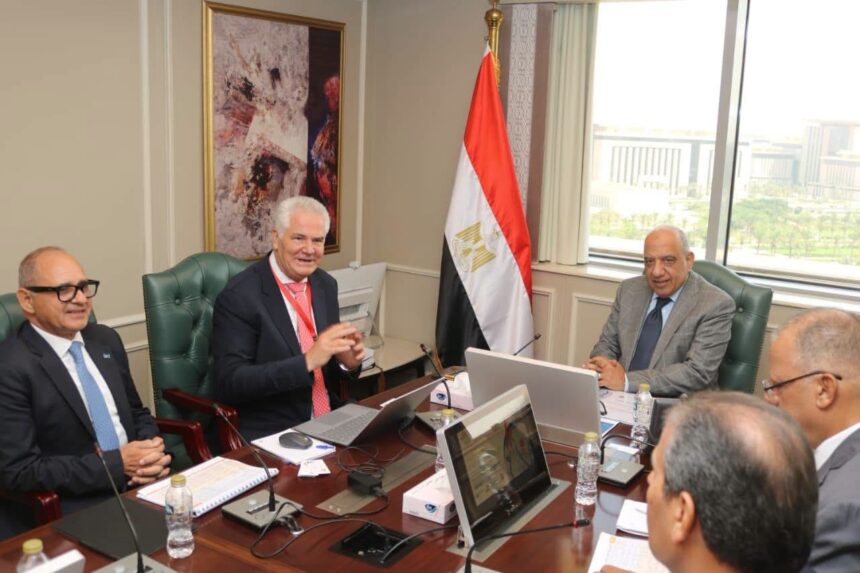
Egypt’s Minister of Electricity and Renewable Energy Mahmoud Esmat reviewed the latest developments of an integrated renewable and clean energy project in the Sinai Peninsula, comprising solar power plants and a pumped-storage hydropower facility with a total capacity of 3.1GW.
Esmat met with a delegation from the Renergy Group Partners consortium, led by Robert Falk, founder of Renergy Group, and Mostafa Madkour, Chairperson of Madkour Group, to review the findings of a joint study conducted with the ministry’s team and discuss available options and the steps required to begin implementing the project.
The consortium comprises Renergy Group Partners as the main developer, Green Tech Egypt as the local technical partner, and OAK Holdings as the financial and investment partner.
The meeting, held at the ministry’s headquarters in the New Administrative Capital, also discussed the project’s technical and financial feasibility, the technologies to be deployed, grid connection arrangements, investment requirements, local component share and the electricity capacity to be supplied by the project.
The project will be implemented in two phases, with a combined capacity of 3,100MW.
The minister reviewed the study’s findings and their alignment with the electricity sector’s strategy to increase the share of renewable energy in Egypt’s energy mix. He stressed the need to support the national grid with clean, reliable and stable sources of electricity as the country expands its reliance on renewable energy.
Esmat explained that pumped-storage hydropower projects and battery energy storage systems are among the key pillars for securing the national electricity grid and ensuring sustainable and stable power supplies.
He disclosed that the ministry’s work programme is based on several pillars under the state’s broader energy transition strategy, with the expansion of renewable energy projects and reducing reliance on fossil fuels among its main priorities.
The minister also highlighted Egypt’s growing focus on battery energy storage systems, noting that battery storage has been introduced into the national electricity grid over the past two years.
Esmat pointed out that Egypt is moving forward with the development of a pumped-storage hydropower project in El Tor, South Sinai, as part of efforts to integrate different generation sources and energy storage technologies into the national electricity system.
He further noted that the project would contribute to securing the unified grid and maintaining the stability and continuity of electricity supplies, while enabling Egypt to make better use of its geographic characteristics and natural resources.
The minister highlighted the potential of pumped-storage systems, particularly in managing and storing water for electricity generation, as well as improving the management and utilisation of renewable energy resources.
The ministry is also seeking to maximise the economic returns from these resources while providing clean and secure energy solutions as part of Egypt’s energy transition.
The meeting included a presentation outlining the project’s proposed scenarios and available options, as well as its comprehensive technical and financial feasibility study. Discussions also covered the technology to be used and grid interconnection through the pumped-storage facility, which is expected to provide stable and sustainable power capacity.
The project forms part of Egypt’s broader strategy to increase renewable energy generation, reduce fossil fuel consumption and strengthen the reliability of the national electricity grid through a combination of renewable generation and storage technologies.


