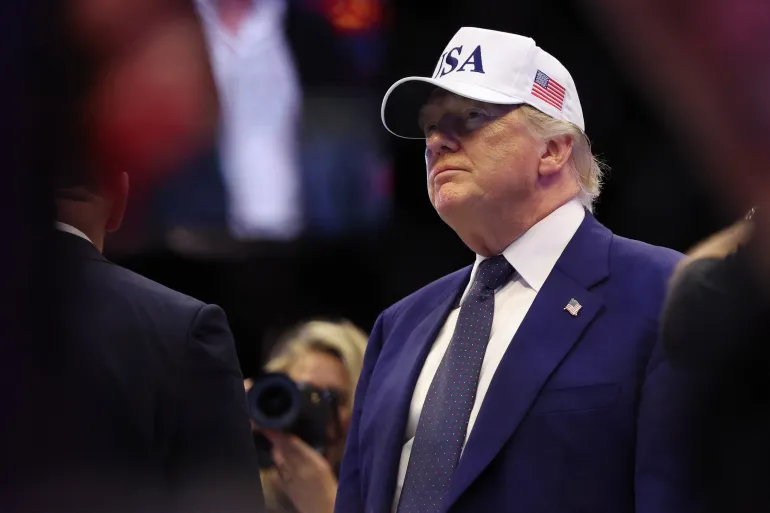
US President Donald Trump renewed his military threats against Iran on Saturday, warning that he had ordered an overwhelming military response if Tehran were to assassinate him or attempt to do so, even as Washington and Tehran prepared to resume indirect talks in Oman aimed at easing tensions and preserving the fragile ceasefire.
In a post on Truth Social, Trump said he had instructed the US military to respond with overwhelming force if Iran carried out what he described as threats against his life, claiming that “a thousand missiles” had been positioned to strike Iran immediately, followed by thousands more if necessary.
A day earlier, Trump said he had agreed to continue negotiations with Iran but had informed Tehran “unequivocally” that the ceasefire was over.
Despite the escalating rhetoric, diplomatic efforts continued. A senior US official told ABC News that American and Iranian negotiators were expected to resume indirect talks in Muscat on Saturday. According to the official, Iranian representatives had sought additional discussions to resolve outstanding issues, while Washington hoped Tehran would publicly declare an end to attacks on commercial shipping in the Strait of Hormuz and acknowledge, either explicitly or implicitly, that previous attacks had been a mistake.
Iran, however, denied requesting a new round of negotiations. Foreign Ministry spokesperson Esmaeil Baghaei rejected Trump’s assertion that Tehran had approached Washington. However, Pakistani sources told Germany’s DPA news agency that Iran had asked Islamabad to convey its willingness to resume negotiations through diplomatic channels.
Iranian Foreign Minister Abbas Araghchi said Tehran had “kept its word” regarding the memorandum of understanding reached with the United States before departing for Oman to participate in talks focusing on bilateral relations and regional developments, particularly the security situation in the Strait of Hormuz.
The strategic waterway remained at the centre of the negotiations. Senior US officials said Washington is seeking a formal Iranian declaration confirming that attacks on commercial shipping have ceased, that all navigation routes through the Strait of Hormuz remain open, and that no transit fees will be imposed on passing vessels.
“What we are asking for is a formal statement confirming that all routes through the Strait of Hormuz are open and that firing on ships has stopped,” a senior US official said. “Otherwise, we have nothing to offer Iran.”
Alongside the US-Iran negotiations, regional diplomatic efforts continued to support the ceasefire reached on 15 June.
Jordanian Foreign Minister Ayman Safadi and Qatari Prime Minister and Foreign Minister Sheikh Mohammed bin Abdulrahman Al Thani discussed ongoing efforts to preserve the truce, stressing the importance of preventing renewed military escalation and supporting mediation initiatives.
Pakistan also stepped up its diplomatic engagement. According to Pakistan’s Foreign Ministry, Foreign Minister Ishaq Dar and his Saudi counterpart agreed during a telephone conversation that renewed conflict would serve no party’s interests, undermine regional stability, and jeopardise ongoing peace efforts. They called on all sides to exercise maximum restraint and allow diplomatic mediation to continue.
Meanwhile, Iran’s Supreme Leader Mojtaba Khamenei adopted a defiant tone in a written message issued following the funeral of his predecessor and father, Ali Khamenei. He vowed revenge for the deaths of what he described as “all the martyrs of the two wars against Iran,” saying that retribution was a national demand that would come soon and that “free people around the world” would play a role in carrying it out.