As regional tensions have redrawn the security map of the Middle East over the past year, Cairo and Paris have leaned harder into a relationship three decades in the making — one built on naval drills, fighter jets, shipyards, and, most recently, a wartime show of force that put French troops, aircraft, and an aircraft carrier within reach of Egypt’s own borders.
Egypt remains one of the region’s indispensable military powers, commanding an army widely regarded as among the most capable in the Arab world. As the Middle East has been shaken by successive waves of conflict, Cairo has cultivated a network of alliances without ceding an inch of its strategic independence. Few of those partnerships run as deep — or have been tested as visibly in 2026 — as the one with France.
A friendship three decades in the making
The Egyptian-French relationship is not a product of the current crisis; it has been built over decades of trust between the two militaries, sustained diplomatic contact, and a shared conviction that stability in the Middle East and the Mediterranean is non-negotiable.
Since 1994, the Egyptian and French navies have trained together in the joint exercise Cleopatra — nearly 30 years of uninterrupted operational cooperation at sea. That foundation set the stage for a formal upgrade in the relationship: during President Emmanuel Macron’s official visit to Cairo on April 7–8, 2025, Egypt and France elevated their ties to the level of a Strategic Partnership. A year later, on April 20–21, 2026, the two countries convened the first round of their official strategic dialogue in Cairo, co-chaired by senior foreign ministry officials from both sides, to review early progress under the new framework and chart cooperation on security, migration, trade, and regional crisis management.
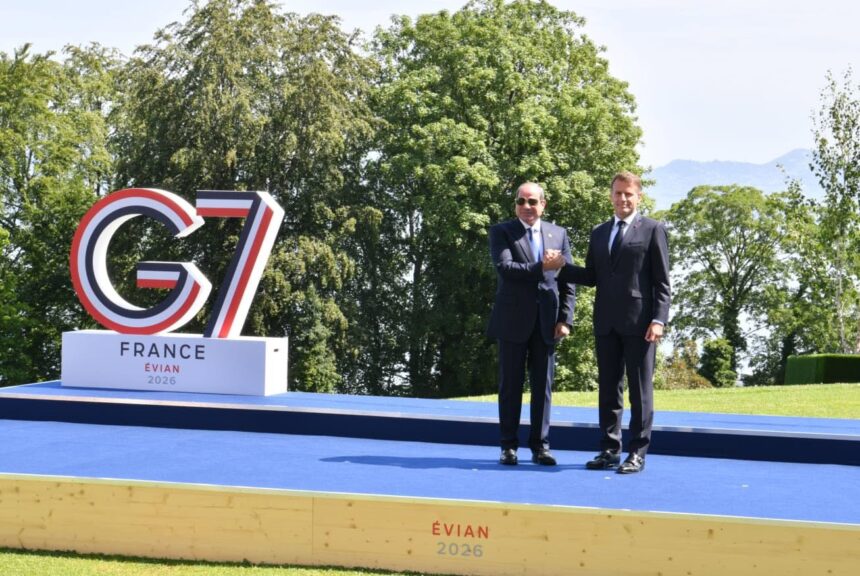
Macron returned to Egypt again in May 2026, this time to inaugurate the new campus of Senghor University alongside President Abdel Fattah Al-Sisi — a visit during which Macron described the Egypt-France alliance as “an alliance for peace and stability.”
The rapport between the two heads of state has become a hallmark of the relationship. Their recurring meetings — three in just over a year — reflect a direct and strategic dialogue anchored in a shared read of the region: that Middle East and Mediterranean stability is a common, and non-negotiable, interest for both capitals.
Building Egyptian military power, one platform at a time
Egypt’s defense choices are deliberate, not incidental — and increasingly, they run through Paris.
In the air: With 54 Rafale fighter jets, Egypt operates one of the largest exported Rafale fleets in the world, giving its air force a combination of strike capability, air superiority, and intelligence-gathering capacity that ranks among the most formidable in the region.
At sea: French-built platforms have transformed the Egyptian navy’s reach — two Mistral-class helicopter carriers, a FREMM multi-mission frigate, and four Gowind-class corvettes. Crucially, three of those corvettes were built on Egyptian soil, at the Alexandria Shipyard, through a genuine technology-transfer arrangement rather than a straightforward arms sale. The distinction matters: France has helped Egypt develop a sovereign, lasting industrial and military production capability — not simply sold it hardware.
When the region went to the brink, France showed up
The value of the partnership was put to the test in early 2026, when the US-Israeli military campaign against Iran, launched on February 28, expanded into a wider regional conflict that drew in French forces, allies, and interests across the Eastern Mediterranean.
The numbers behind the deployment:
- In under 10 days, France mobilized more than 4,000 soldiers
- French Rafale jets flew more than 200 missions
- More than 1,300 tonnes of military equipment were transported into the region
- The Charles de Gaulle carrier strike group — France’s only aircraft carrier, redirected from a NATO exercise in the Baltic on March 3, 2026 — sailed roughly 7,000 kilometers to reach the Eastern Mediterranean within days, carrying around 20 Rafale Marine jets, E-2C Hawkeye surveillance aircraft, and escorting frigates and helicopter carriers
Paris framed the deployment as defensive: honoring its bilateral defense commitments to regional partners without becoming a party to the conflict. By the second quarter of 2026, France had positioned itself as the foreign power with the largest military footprint spanning the Eastern Mediterranean, the Red Sea, and the Indian Ocean — protecting shipping lanes, reassuring allies including Cyprus and Gulf states, and preparing for a possible mission through the Strait of Hormuz.
On the diplomatic track, France translated that military posture into political capital. On April 17, 2026, President Macron and UK Prime Minister Keir Starmer co-chaired a conference at the Élysée Palace that brought together roughly 50 countries — deliberately excluding the United States from the format — to defend freedom of navigation through the Strait of Hormuz. For Egypt, whose Suez Canal is a vital economic artery, the stakes in that waterway’s stability could not be more direct, and Cairo’s position converges closely with the one Paris has staked out.
After the Iran-US agreement, France pushed to make it stick. Following the signing of the memorandum of understanding between Washington and Tehran — sealed by Presidents Trump and Pezeshkian on June 17, 2026 — France did not simply welcome the news from the sidelines. Paris has been actively working its diplomatic channels to secure the durable reopening of the Strait of Hormuz, back Lebanese state authorities amid continued instability, and press for verifiable guarantees on Iran’s nuclear and ballistic missile programs. That approach — exerting influence and pressing implementation without escalating or dictating terms — is precisely what has made France a credible interlocutor in Cairo’s eyes.
The bigger picture
Three decades of naval drills. A strategic partnership sealed in 2025 and put into practice through 2026. A modern air and naval force built, in significant part, with French technology and — increasingly — Egyptian hands. And a wartime deployment that showed Paris was prepared to back its regional commitments with troops, jets, and an aircraft carrier when the moment demanded it.
For Cairo, the relationship with Paris has become a case study in what a sovereign, selective alliance looks like: deep enough to shape Egypt’s military capability for a generation, flexible enough to leave Egyptian decision-making entirely in Egyptian hands.