

The fragile ceasefire between the United States and Iran appeared to collapse on Wednesday as both sides exchanged fresh military strikes across the Gulf, reigniting regional tensions, disrupting maritime security in the Strait of Hormuz, and prompting widespread condemnation from Arab governments.
The US military launched a new wave of strikes overnight against military targets in southern and southwestern Iran, targeting air defence systems, coastal surveillance sites, anti-ship missile batteries, drone launch facilities, and radar installations, according to a US official cited by Reuters. US Central Command said it had struck more than 80 targets in its latest operation, following attacks on commercial shipping in the Strait of Hormuz.
Iran responded by announcing missile and drone strikes against what it described as US military facilities across the region. The Islamic Revolutionary Guard Corps (IRGC) said it had targeted 85 American military sites, including installations in Bahrain and Kuwait, while the Iranian army said it launched drone attacks against US forces stationed at Sheikh Isa Air Base in Bahrain, warning that all American bases in the region had become “legitimate targets.”
Kuwait said its air defence systems intercepted incoming projectiles, while Bahrain activated missile warning sirens for the second time in recent days. Neither country immediately reported casualties or damage.
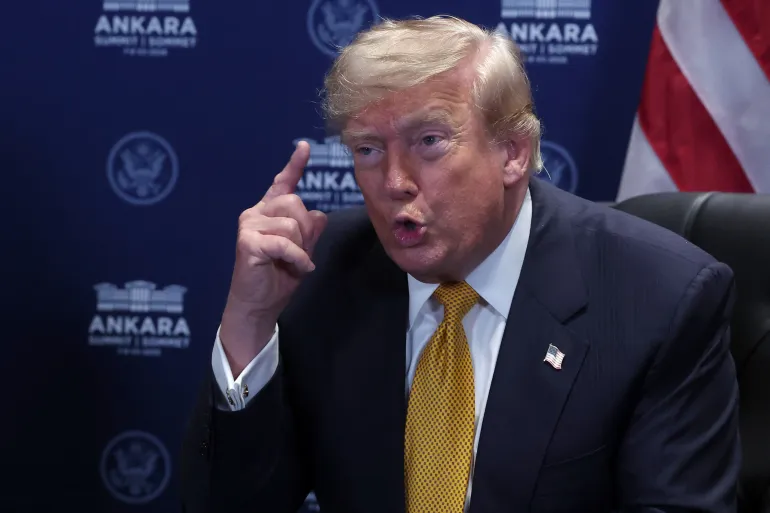
President Donald Trump declared that the ceasefire with Iran was “over” during a meeting with NATO Secretary-General Mark Rutte on the sidelines of the alliance’s summit in Ankara. He warned that Washington was prepared to launch another major strike against Iran later in the day.
“Iran will never obtain a nuclear weapon,” Trump said, accusing Tehran of violating the temporary agreement by attacking commercial shipping in the Strait of Hormuz. He added that US forces had identified the locations of Iran’s nuclear materials and possessed the capability to recover them.
Iran condemned the latest US strikes as a blatant violation of both the ceasefire memorandum signed last month and the UN Charter. The Foreign Ministry said key elements of the agreement had effectively become meaningless following repeated American attacks, the cancellation of US licences permitting Iranian oil exports, and continued Israeli military operations in Lebanon.
The escalation followed attacks on commercial vessels transiting the Strait of Hormuz, including the Qatari tanker Al Rukayyat. Qatar summoned Iran’s deputy ambassador to lodge a formal protest, describing the attack as a serious threat to international navigation and global energy security.
Iran maintained that it remained committed to managing maritime traffic under the terms of the memorandum but warned that any further military action could lead to the closure of the Strait of Hormuz. Iranian state media quoted an informed source as saying Tehran would shut the strategic waterway if subjected to additional attacks.
The International Maritime Organization said around 6,000 seafarers remain stranded aboard vessels in the Gulf because of the deteriorating security situation and urged shipping companies to avoid transiting the Strait of Hormuz until conditions improve.
The renewed confrontation triggered a wave of regional condemnation. Egypt denounced Iran’s attacks on Kuwait and Bahrain as a flagrant violation of their sovereignty, reaffirming that Gulf security is an integral part of Egypt’s national security. Saudi Arabia and Qatar also condemned the attacks, while Oman warned that continued military escalation threatens international trade and global energy supplies, calling on all parties to return to dialogue and implement the existing understandings.
Meanwhile, NATO leaders reaffirmed in their summit declaration that Iran must never acquire nuclear weapons and called on Tehran to respect freedom of navigation through the Strait of Hormuz.
