

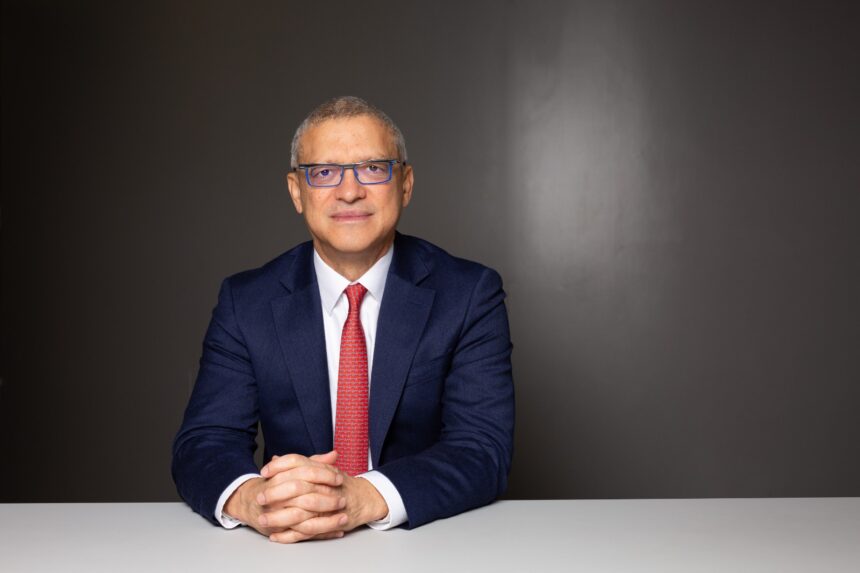
As British International Investment (BII) prepares to deploy £15bn worldwide over the next five years, Egypt is emerging as one of the institution’s most strategic markets, according to BII CEO Leslie Maasdorp.
With an investment portfolio approaching $850m across 64 companies, the UK development finance institution is betting on renewable energy, manufacturing, financial inclusion and private-sector growth to drive Egypt’s next phase of economic transformation.
In an interview with Daily News Egypt, Maasdorp outlined the institution’s ambitious growth strategy, discussed its plans to mobilise private and institutional capital into Egypt, and explained why the country remains BII’s largest investment destination in Africa.
He also shared insights on climate finance, renewable energy, industrial development and the critical role of the private sector in driving sustainable economic growth.
BII has recently unveiled a new five-year strategy. What are your key priorities globally and in Egypt?
We have launched an ambitious five-year strategy under which BII aims to deploy up to £15bn across its geographies in Africa, Asia and the Caribbean. Roughly half of this capital will come from our own balance sheet, while the remaining half will be mobilised from institutional investors, pension funds and asset managers.
Egypt occupies a very important position within our portfolio. While India remains our largest market globally, Egypt is our second-largest market worldwide and our largest market in Africa. This reflects the strength of our long-standing partnership with the Egyptian government and our confidence in the country’s economic potential.
Today, our portfolio in Egypt stands at approximately $850m invested across 64 companies, supporting more than 130,000 jobs.
Which sectors are most attractive to BII in Egypt over the coming years?
Climate finance is one of our highest priorities. Around 40% of our planned global investments over the next five years will be allocated to climate-related projects, including renewable energy, climate technologies and initiatives that reduce carbon emissions.
In Egypt, renewable energy remains particularly exciting. The country has exceptional solar and wind resources, creating enormous opportunities for investment. One of the most promising areas today is battery energy storage systems, which help address the intermittency challenges associated with renewable energy generation.
Beyond energy, we are actively investing in manufacturing, pharmaceuticals, financial services, logistics, ports and technology-enabled sectors.
How does BII view Egypt’s industrial development agenda?
We strongly support Egypt’s efforts to transition from an economy driven by imports and consumption to one powered by production, exports and industrialisation.
Manufacturing is particularly attractive because it creates jobs at scale while generating foreign exchange earnings. We are especially interested in export-oriented businesses that can strengthen Egypt’s competitiveness and contribute to sustainable economic growth.
We also see opportunities in localising strategic industries, including clean-energy supply chains and industrial technologies that can reduce import dependence and enhance economic resilience.
What role does the private sector play in BII’s investment approach?
The private sector is at the heart of everything we do. We exclusively invest in private-sector companies and do not invest in state-owned enterprises.
Our objective is to help businesses scale, attract additional financing and become national, regional or even global champions. We invest across the financing spectrum, from venture capital and private equity funds to larger infrastructure and corporate investments.
Importantly, we do not measure success solely by the amount of capital we deploy. Our real objective is to act as a catalyst—helping de-risk investments, encouraging competition and mobilising additional commercial capital into the market.
How does BII differ from traditional investors?
We take a long-term approach. We are not driven by short-term trends or quick returns. Instead, we provide patient risk capital that supports businesses through different stages of growth.
Building industries, creating jobs and transforming economies takes time. That is why we measure impact over five- to 10-year horizons rather than focusing on annual performance metrics.
Development impact remains central to BII’s mission. How is that reflected in your investments?
Development impact is fundamental to our investment philosophy. We place particular emphasis on supporting small and medium-sized enterprises because of their critical role in job creation. We also focus on financial inclusion, technology adoption and expanding access to finance.
Gender inclusion is another major priority, with up to 30% of our investments over the next five years directed towards gender-focused opportunities. We work to address barriers facing women entrepreneurs, including limited access to collateral and financing opportunities. We believe empowering women and young people is essential for sustainable economic development.
How do you plan to attract more private and institutional capital into Egypt?
Mobilising private capital is our number one priority. One of our key roles is to help de-risk projects so that commercial investors feel comfortable participating. We often invest during the early stages of projects, when risks are highest, and then help transform those investments into stable, cash-generating assets.
A good example is renewable energy infrastructure. Once a project reaches operational maturity, it becomes significantly more attractive to pension funds, sovereign wealth funds and other institutional investors.
Are you exploring new investment structures with international partners?
Absolutely. We are working closely with partners such as the European Bank for Reconstruction and Development (EBRD) and the International Finance Corporation (IFC) to develop innovative investment platforms.
The idea is to aggregate projects into larger investment vehicles that can attract multiple asset managers and institutional investors. Rather than financing small projects individually, we aim to create scalable structures that can unlock much larger pools of capital.
This approach has already proven successful in renewable energy and could be replicated across infrastructure, climate projects and other strategic sectors.
How does BII approach exits from investments?
We typically hold minority stakes and take a long-term perspective. After several years, usually around five years or more, we may exit through a variety of routes, including sales to existing shareholders, secondary investors or public listings.
An important aspect of our model is capital recycling. We do not distribute annual dividends to shareholders. Instead, proceeds generated from successful exits are reinvested in new development projects.
A good example is our exit from the Kelix Bio pharmaceutical platform, which had built operations across Egypt, India and Morocco before being acquired by a strategic investor from the UAE.
Which sector has the potential to create the greatest impact in Egypt?
Without question, the energy sector has transformational potential. Egypt possesses world-class renewable energy resources and has established clear national targets for expanding clean energy generation. Combined with growing opportunities in storage technologies and green hydrogen, this creates a compelling investment landscape.
As we have seen in other markets, including India, energy can serve as a catalyst for broader economic transformation, industrial growth, job creation and long-term competitiveness. We believe Egypt is exceptionally well positioned to benefit from this opportunity.


