

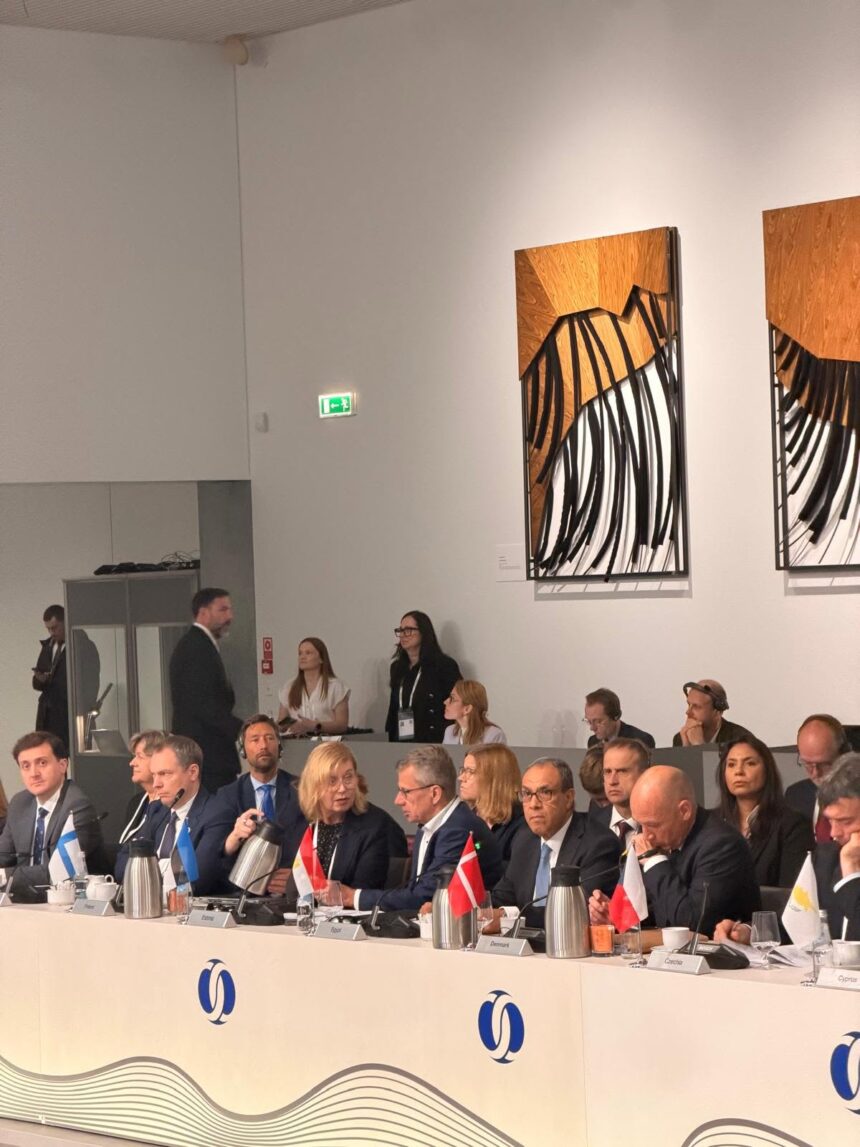
Egypt urged multilateral development banks to deploy faster and more flexible financing to counter the economic fallout of Middle East conflicts, whilst confirming the continued rollout of a 2024-2027 European Union financial support package.
Minister of Foreign Affairs, International Cooperation and Egyptian Expatriates Badr Abdelatty outlined the appeals on Saturday during the 35th Annual Meeting of the European Bank for Reconstruction and Development (EBRD) Board of Governors in Latvia.
Addressing the plenary session as Egypt’s governor to the bank, Abdelatty highlighted the severe disruptions to global trade, supply chains, commodity markets, and energy caused by geopolitical tensions. He warned that tightened global financing conditions, rising borrowing costs, and limited access to concessional funding are disproportionately burdening African and developing nations with mounting debt.
To mitigate these pressures, Abdelatty welcomed the EBRD’s conflict response initiative for the Middle East and its preparation of an Eastern Mediterranean crisis package, stressing the necessity of multilateral action to support affected economies.
In bilateral talks with Valdis Dombrovskis, European Commissioner for Economy and Productivity, the two officials confirmed the continued implementation of the EU’s financial support package for Egypt spanning 2024 to 2027. They discussed the negative impacts of regional escalation on global transport and insurance costs, with Dombrovskis commending Egypt’s ongoing role in containing crises and maintaining regional stability. Both sides agreed to expand cooperation in renewable energy, the green economy, digital transformation, food security, and infrastructure.
The Egyptian minister further detailed the country’s economic strategy during separate meetings with EBRD President Odile Renaud-Basso and Matteo Patrone, EBRD Vice President for Banking. Building on a meeting with Renaud-Basso in London last month, Abdelatty noted that Egypt is taking a proactive approach to secure energy needs, enhance food security, and maintain financial stability amidst regional volatility.
Abdelatty attributed Egypt’s economic resilience to structural and monetary reforms, notably the adoption of a flexible exchange rate, which he said absorbed a significant portion of external shocks. Renaud-Basso praised these measures for achieving fiscal discipline, improving debt sustainability, and enhancing the broader business environment to attract investment.
Reaffirming the state’s commitment to private sector-led growth through public-private partnerships, Abdelatty encouraged the EBRD to expand its operations in the Egyptian market. He highlighted investment opportunities in renewable energy, artificial intelligence, information technology, and the automotive sector, specifically electric vehicles.
During the summit, Abdelatty also met with Latvian Minister of Foreign Affairs Baiba Braže to congratulate her on her reappointment following the formation of Latvia’s new government. Noting the political consultations held between the two nations in Cairo in January 2025, Abdelatty proposed establishing a joint Egyptian-Latvian business council. The council would aim to boost bilateral trade, encourage digitalisation and information technology investments, and facilitate tripartite cooperation in Africa by leveraging Egypt’s position as a regional hub.


