Egypt is overhauling its post-establishment business regulations, including slashing the time required for capital increases and unifying operational licensing, to facilitate the ease of doing business equally for both domestic and foreign investors, the country’s investment minister said.
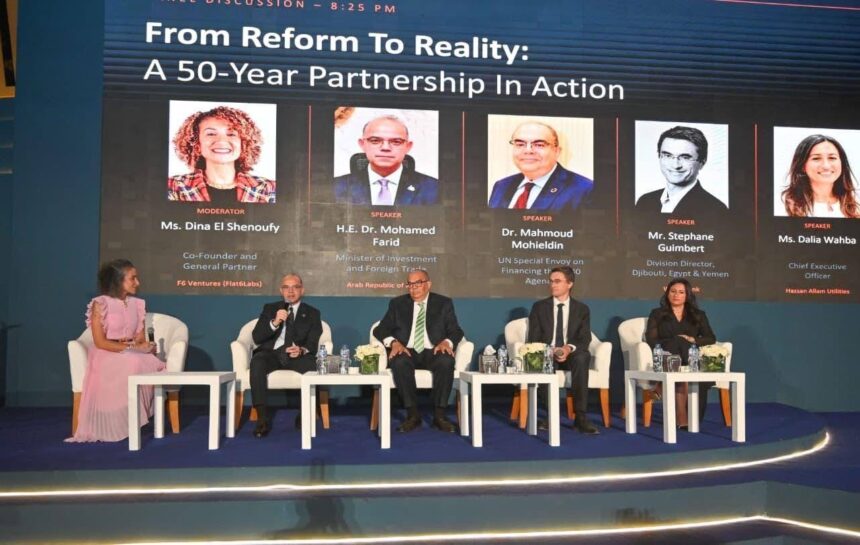
Speaking at an event marking the 50th anniversary of the partnership between Egypt and the World Bank Group’s International Finance Corporation (IFC), Minister of Investment and Foreign Trade Mohamed Farid outlined a strategic shift away from solely targeting foreign direct investment (FDI).
“We don’t think in terms of foreign investors and local investors. The ultimate point is to facilitate the ease of doing business on several fronts, for local investors and foreign investors,” Farid said. “It wouldn’t be realistic for us to be doing reforms for the sake of just attracting FDI while local investors should be facing whatever difficulties they are facing on their daily life.”
Detailing the government’s operational shifts, Farid noted that current capital increase subscriptions can take up to six months to complete. The state aims to resolve this near-term bottleneck by better connecting the financial regulatory authority, the company registrar, and clearing houses. Furthermore, a medium-term reform is underway to create a centralised system for operational licenses, which are currently spread across approximately 90 different governmental entities. Farid stressed that the Ministry of Investment is changing its modus operandi to move “from strategy to execution,” rather than simply issuing decrees, citing plans to end unnecessary government interference in the economic valuation of merging companies.
To localise economic development, Egypt is establishing new investment zones in less privileged areas, such as Mit Ghamr and Benha, with a specific focus on job creation for women in the industrial sector. The government is also coordinating with the Ministry of Industry to target FDI in specific areas—with seven sectors announced and 12 pending—while treating entrepreneurship as a cross-cutting element across agriculture, energy, and technology.
Stephane Guimbert, the World Bank Country Director for Egypt, Yemen, and Djibouti, noted that a $1bn growth package for Egypt was recently approved. Guimbert stressed that future economic success relies on scaling systems rather than relying on one-off pilots. He cited the Benban solar park as a successful platform that mobilised the IFC, the Multilateral Investment Guarantee Agency (MIGA), and the International Bank for Reconstruction and Development (IBRD) to provide guarantees without burdening the government’s balance sheet.
“Jobs needs growth, needs private sector. Private sector needs confidence, clarity, and competition,” Guimbert said, adding that commercial justice and reducing the friction in investor decision-making are paramount ahead of a new business climate report expected in the coming months.
Dalia Wahba, Chief Executive Officer at Hassan Allam Utilities, echoed the need for scalable frameworks. Wahba, whose firm recently secured a $65m loan from the European Bank for Reconstruction and Development (EBRD), noted that policy reform cannot work in isolation and requires institutional collaboration alongside a capable private sector. Charting Egypt’s economic history—from the capital market boom of the 1990s and the logistics expansion in the 2000s to the renewable energy surge of the last decade—Wahba stated that standardising contractual structures and properly allocating risk between the state and private entities are necessary to build a consistent project pipeline. She identified logistics and digital infrastructure as the next key sectors poised for expansion.
Former investment minister and UN Special Envoy Mahmoud Mohieldin pointed to macro-economic stability as a shared responsibility that extends beyond the central bank and the finance ministry. Citing a recent 400-page IFC report on the region, Mohieldin said future growth must focus on leveling the playing field, deepening reliance on the domestic grid, and expanding access to carbon markets and green finance. Asked about their 20-year economic vision for Egypt, the panellists forecast the creation of up to 40 million jobs, generating 1 million jobs annually, and the country reaching the top 10 percent of global economic metrics.
An unnamed closing speaker noted that Egypt’s ongoing reforms will compound over time, highlighting that export competitiveness, climate-smart investments, and regional integration position the country for sustained growth.
The event concluded with a farewell to Sheikh Omar Sylla, a retiring IFC division director who previously led the institution’s asset monetisation programme in Egypt. Reflecting on his tenure, Sylla praised the private sector for taking risks based on a shared belief in the country’s economic future.
“I carry with me a deep conviction that Africa’s moment is not tomorrow; it is here,” Sylla said. “This continent’s youth population, its entrepreneurs, its builders—they are the real deal.”