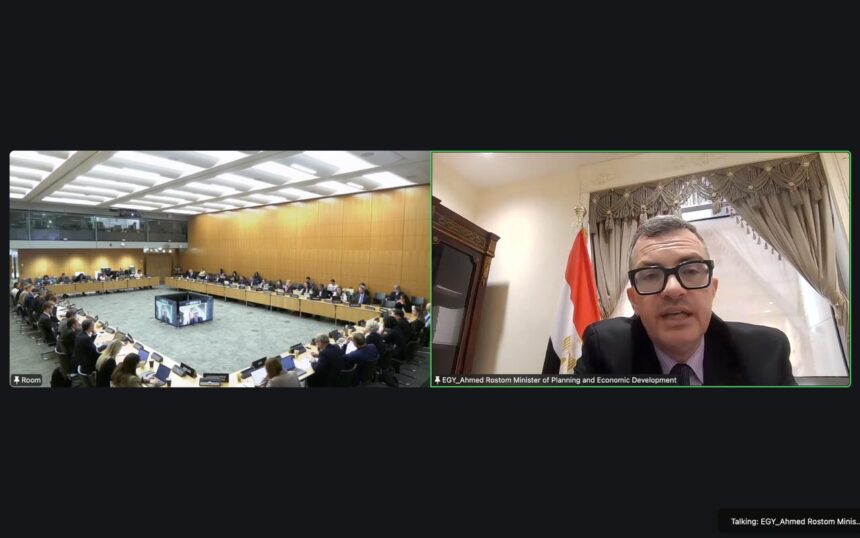
Ahmed Rostom, Minister of Planning and Economic Development, participated in a meeting of the External Relations Committee of the Organisation for Economic Co-operation and Development (OECD) to review areas of cooperation between Egypt and the organisation.
During his remarks, Rostom highlighted the depth of cooperation between Egypt and the OECD, describing it as a long-standing and evolving strategic partnership based on supporting evidence-based policymaking, strengthening institutional development, and achieving inclusive and sustainable economic growth.
The minister said a key milestone in relations between Egypt and the OECD dates back to 2005, when Egypt became a founding partner in the OECD’s Middle East and North Africa Initiative, laying the groundwork for a sustainable institutional framework for dialogue and knowledge exchange.
He added that cooperation has continued to expand over the years, reflecting Egypt’s increasing alignment with OECD standards and frameworks.
Rostom also reviewed Egypt’s economic reform programme launched in 2016, which was anchored in Egypt Vision 2030 and aimed at restoring macroeconomic stability, enhancing competitiveness, and expanding social protection programmes.
The minister highlighted the closing conference of the OECD country programme, held in Cairo on 4 May in the presence of Prime Minister Mostafa Madbouly and the OECD secretary-general.
He said the event reviewed the outcomes of five years of close cooperation and marked the launch of 10 strategic reports prepared by the organisation covering priority sectors including innovation, investment, productivity, green growth, governance, and women’s economic empowerment.
According to Rostom, the reports represent an important resource for supporting evidence-based policymaking in Egypt.
He stressed that the country programme has played a pivotal role in strengthening institutional capacities, improving coordination among government entities, and embedding OECD standards into national policymaking mechanisms, helping ensure the long-term sustainability of the programme’s impact.
On follow-up mechanisms, Rostom said the Ministry of Planning and Economic Development has developed a dedicated electronic platform for the programme, enabling project managers across national entities to update implementation progress and monitor different aspects of cooperation, thereby improving coordination and enhancing the efficiency of programme management.
The minister added that the programme’s impact has extended regionally and internationally. In May 2025, Egypt assumed co-chairmanship of the OECD’s Middle East and North Africa Initiative on “Governance and Competitiveness for Development” for the 2026–2030 period, in addition to co-chairing the Women’s Economic Empowerment Forum.
He said the appointments reflect Egypt’s growing role as an active partner in regional and international policy dialogue.
Looking ahead, Rostom revealed that the ministry is leading broad consultations with national entities and the OECD to determine the priorities of the programme’s second phase.
He said the next phase aims to become more focused and targeted by deepening structural reforms in competitiveness, governance, and private sector development, while further integrating OECD standards and tools into national systems to support institutional reform and improve public policy efficiency.
Rostom concluded by saying that the upcoming phase of cooperation will focus on enhancing the competitiveness of the Egyptian economy, strengthening the capacity of state institutions to adopt more efficient and sustainable policies aligned with international standards, and supporting Egypt’s long-term development priorities.
The Egyptian country programme has received broad praise from representatives of OECD member states, including officials from the European Union, the United Kingdom, Turkey, Switzerland, Portugal, Greece, Germany, Austria, and Italy, who commended its role in supporting and accelerating economic reforms in line with international best practices.